Finance Minister Nirmala Sitharaman will likely focus on boosting consumption, MSME growth, infrastructure, capital expenditure, and more. As the government gave massive tax concessions last year, the Union Budget 2026 is expected to boost certain sectors which have been long pending.
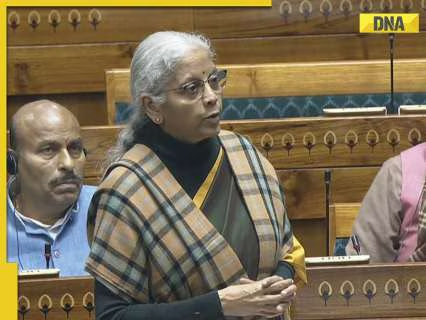
Union Finance Minister Nirmala Sitharaman in Parliament
Finance Minister Nirmala Sitharaman will likely focus on boosting consumption, MSME growth, infrastructure, capital expenditure, and more. As the central government had last year given various concessions and major relief announcement, specifically targeting the new tax regime, the Union Budget 2026 is expected to boost certain sectors which have been long pending.
“The government’s approach has been consistent, boost growth through infrastructure-led investment, create jobs and strengthen social delivery. Budget 2026 will further consolidate these priorities,” a senior official told the Business Today.
What sectors will likely see change in policies?
Government policies
Currently, three key government programmes: MGNREGA (allocated Rs 86,000 crore), Pradhan Mantri Awas Yojana–Gramin (PMAY-G) (Rs 54,882 crore) and Pradhan Mantri Gram Sadak Yojana (PMGSY) (Rs 19,000 crore) take up around 85 per cent of the Ministry of Rural Development’s expenditure.
These efforts towards government’s rural programmes shows its focus on rural employment policy, as officials told BT that MGNREGA is set for a complete overhaul, as the proposed Viksit Bharat Guarantee for Rozgar and Ajeevika Mission (VB-G RAM G) will likely replace the current rural job scheme in FY27.
According to experts, the PM Internship Scheme (PMIS), designed to improve youth employability, will be prioritised for expansion. They have said that the government is considering expanding the eligibility from the existing age group of 21–24 to 18–30 years, along with more than doubling the current monthly stipend of Rs 5,000.
SMEs
“India requires far-reaching reforms in tax administration, particularly to ease compliance pressures on SMEs under income tax and GST. Taxpayers need to be categorised, with SMEs subject to lower scrutiny and a lighter compliance framework than large enterprises,” Mukesh Butani, Founder and Managing Partner at BMR Legal, said while speaking with BT.
HRA
At present, the upper limit of HRA exemption stands at 50% of salary for metro cities and 40% for non-metro cities, a policy different from the real picture. According to experts, the government must revise HRA provisions to transparently showcase current rental realities, specifically in Tier-2 cities where rents are almost equivalent to metros.
Health insurance
Experts are also of the opinion that there must be provision for income tax deduction on health insurance premiums under the new tax regime. The benefit is available only under the old tax regime.
Higher loan interest
As the prices have soared sky high with limited tax relief, purchase of homes has become a distant reality for many taxpayers. According to experts, the government should provide benefits on home loan interest by raising the deduction to Rs 5 lakh. Another recommendation has been to provide this relief under the new tax regime.
Streamlined rental income assessment
Experts are of the view that tax should be on actual rent income regarding let out properties, in which case the following must be allowed:
-Standard deduction of 30%
-Full deduction for municipal/local taxes
-Interest expenditure
Couples to be taxed jointly
Joint taxation option for married couples
The Institute of Chartered Accountants of India (ICAI) has suggested launching an optional joint taxation system for married couples in India. Presently, married couples file individual returns as they separately pay taxes.
With the present tax policy, one partner who earns more than the other or single earner bears the tax burden, often pushing income into higher tax slabs.
The organisation has proposed that with joint taxation a fairer tax framework can be implemented where one family is treated as one single unit. This system already works in the US and the UK.