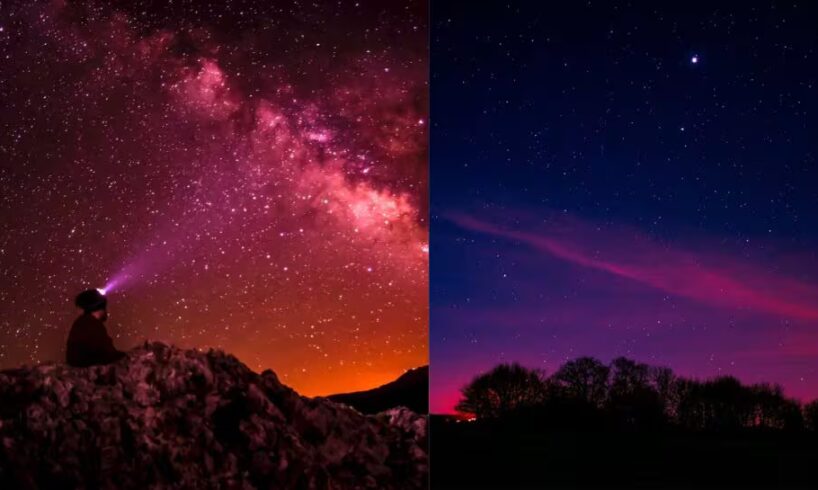
Ladakh: Rare Red Auroras Light Up Ladakh Skies
In a rare celestial spectacle, deep red auroras lit up the night sky over Hanle in Ladakh on January 19–20, 2026, creating one of the most breathtaking astronomical sights ever seen from India. Situated at an altitude of about 4,500 metres in the remote Changthang region, the Hanle Dark Sky Reserve offered ideal conditions to witness this once-in-a-generation phenomenon.
Solar Eruptions Behind the Spectacle
Add Zee News as a Preferred Source
The stunning auroral phenomenon was triggered by powerful coronal mass ejections (CMEs), massive bursts of plasma and magnetic energy released from the Sun’s outer atmosphere. Scientists said the red auroras over Hanle were the result of an intense S4-level solar radiation storm, the strongest space-weather event since the Halloween solar storms of October 2003. The rare appearance of the aurora borealis over Indian skies drew worldwide attention and highlighted India’s growing capabilities in space-weather monitoring.
Watch
Rare red auroras illuminated the night sky over Hanle, Ladakh, after the most intense solar storm in over two decades struck Earth.
This breathtaking phenomenon occurs when charged solar particles interact with Earth’s atmosphere — a mesmerizing sight and a humbling reminder of… pic.twitter.com/fJAyp3vIjL
Manni (@ThadhaniManish_) January 29, 2026
Why Hanle Was the Perfect Viewing Point
The Hanle Dark Sky Reserve in Ladakh, with its unique geographical location and pristine environmental conditions, proved to be an ideal vantage point for observing the rare red aurora display.
Geomagnetic Storm Triggers Low-Latitude Auroras
Scientists at the Indian Institute of Astrophysics (IIA), Bengaluru, said the aurora witnessed over Hanle was caused by a powerful geomagnetic storm that began around 3.30 am on January 20 and peaked later that night at about 8.30 pm.
Explaining the rarity of the event, solar astrophysicist P. Vemareddy of the IIA said that during the ongoing 25th solar cycle, only six geomagnetic storms exceeding 200 nanotesla have been recorded that were strong enough to produce auroras at low latitudes. In this case, a coronal hole near the Sun’s active region likely helped the CMEs reach Earth within 24 hours.
NASA Data Confirms Severe Space Weather Event
Data from NASA’s remote-sensing instruments showed that the storm resulted from the interaction of a CME expelled from the Sun around 11.30 pm on January 18, travelling at speeds of at least 1,400 km per second. Scientists classified the event as a G4-level geomagnetic storm, accompanied by an S4-level solar radiation storm.
Studying the Sun’s Impact on Earth
Researchers at Hanle used a combination of ground-based and space-based observations to study the storm and examine the physical processes behind it, helping improve understanding of how solar activity influences Earth, Network18 reported.
“Auroras have been recorded at Hanle on five occasions between 2023 and 2025. While such displays are usually seen at higher latitudes, the strength of the current solar cycle has allowed auroras to appear as far south as Ladakh and be captured from the Hanle observatory,” said Dorje Angchuk, engineer-in-charge at the facility. He added that the event also underlined the importance of protecting the pristine night skies of the Hanle Dark Sky Reserve.
India’s High-Altitude Astronomy Hub
The Indian Institute of Astrophysics operates the Indian Astronomical Observatory, with facilities located at Hanle, Leh and Merak in Ladakh.