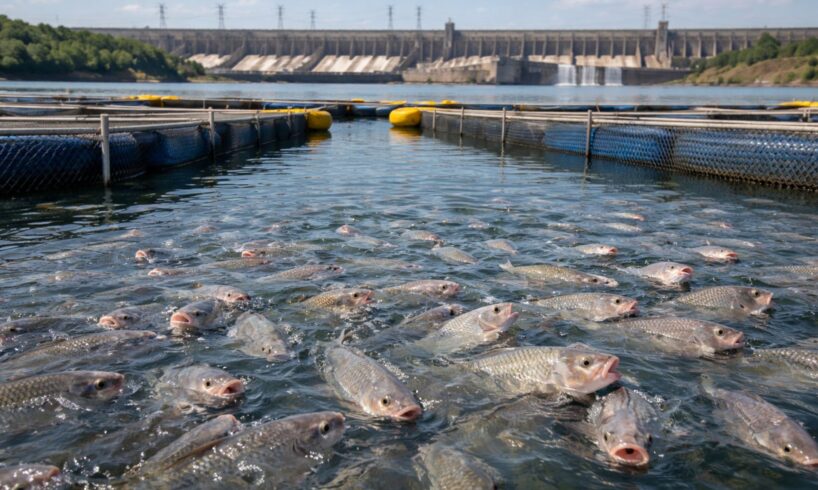
A plan to raise up to 400 tons of tilapia in the Itaipu reservoir is progressing in Paraguay, but is hampered by a bilateral agreement and the Brazilian Congress. The power plant cites protocols and multiple uses of the water, while biologists highlight the risk of leaks, invasion, and chain reactions.
The Brazilian government’s intention to enable the creation of up to 400 tons of tilapia in the reservoir of Itaipu For now, it faces a political and legal obstacle: to become law, the measure depends on a review of the bilateral agreement with Paraguay and, after that, on approval from… Congress.
On the other side of the border, Paraguay already passed a law on December 22nd that paves the way for the cultivation of the species in the lake of the binational power plant.
The discussion gained traction because the Paraguayan text allows the breeding of exotic species in closed and semi-open bodies of water in the country, which, in practice, removes a legal barrier to tilapia farming in the area of the project.
— ARTICLE CONTINUES BELOW —
However, the rule that applies to the reservoir shared between the two countries is still the Brazil-Paraguay Bilateral Agreement, which prohibits the use of species considered exotic in the lake.
Any change on this point needs to be approved by the Brazilian legislature.
With about 1.350 km²The Itaipu reservoir already supports simultaneous uses.
The area is intended for power generation, water storage, sedimentation processes, and commercial production activities, as well as serving as a habitat for different species of local fauna.
It is within this context of multiple functions that the possibility of installing net cages for tilapia fattening has come under the spotlight of criticism from ecology and conservation experts.
Law in Paraguay stalls in the Brazilian Congress.
In Paraguay, the law passed on December 22nd was presented as a milestone in regulating environmental licensing for the breeding of allochthonous or exotic species in certain aquatic environments.
A plan to raise 400 tons of tilapia in Itaipu is progressing in Paraguay, but faces obstacles in Brazil and warnings from biologists about environmental risks.
According to reports from agencies and media outlets that have followed the issue, the regulation allows progress in negotiations to enable cultivation in the reservoir of the power plant.
Nevertheless, the central point of the debate lies in the bilateral agreement governing Itaipu.
Even with the Paraguayan signal, large-scale production in the lake would depend on a formal review of the agreement, a process that may involve diplomatic negotiations and, on the Brazilian side, proceedings in Congress.
So far, there is no indication that this analysis is underway.
When contacted, the Parliamentary Agricultural Front stated that there is “no concrete movement, ongoing process, or any type of coordination” at this time to revise the agreement.
The FPA also said that the discussion, if it takes place, needs to be accompanied by clear rules for the sector.
“A formal review of the bilateral agreement could indeed go through Congress, but that is not currently on the table. The immediate focus needs to be on providing technical and regulatory predictability to the sector. We consider it essential that the Ministry of Fisheries present a clear schedule of actions. The productive sector needs objective signals to plan investments,” the delegation stated.
Environmental risks cited by biologists and ecologists.
Experts consulted in the discussion point out that the main concern is not just the farming itself, but what could happen if fish escape from the fattening systems.
Biologist and ecology professor Jean Vitule states that, in fish farming structures, there are records of escapes in different contexts and that this type of occurrence can have repercussions in areas connected to the reservoir.
“Every reservoir has adjacent rivers. Once tilapia escapes, it’s not like a chemical pollutant, it’s a biological pollutant; it can run from the mouth to the source, in the opposite direction to the river, unlike a chemical or biological pollutant,” said the professor, coordinator of an ecology and conservation laboratory at UFPR.
The argument relies on the invasive nature of the species and the possibility of its dispersal beyond the lake if containment efforts fail.
Vitule also mentions that events such as strong winds, heavy rain, collisions with tree trunks, and even operational variations in reservoir flow can increase the risk of physical damage to the cultivation structures, with the cages breaking or tipping over.
Another point he raised is the indirect effect of increased nutrients in the area surrounding the tanks.
According to the professor’s assessment, the large-scale presence of tilapia could favor the proliferation of other exotic organisms, such as… golden mussel, already mentioned as a problem in the reservoir.
He states that the species would benefit from the availability of area and organic matter, with the potential for encrustation on structures, increased maintenance costs, and impacts that could lead to the need for chemical reagents for control.
Along the same lines, biologist Gilmara Junqueira states that tilapia have a high capacity for adaptation and resistance to different temperature and environmental conditions, including more extreme scenarios.
For her, these advantages become even more relevant in altered environments, such as reservoirs, and increase the risk if there is leakage to other sections of the basin.
According to the biologist, once outside the controlled environment, the species can compete for food and space with native fish, alter ecological relationships in other ecosystems, and even reach protected areas.
Furthermore, she warns of the possibility of introducing parasites and pathogens associated with cultivation, with the chance of contaminating local species.
Territorial behavior and high reproductive rates are also cited as factors that favor dominance in environments where the species manages to establish itself.
A thematic report from the Brazilian Platform on Biodiversity and Ecosystem Services (BPBES) is mentioned in the debate as a reference for mapping the effects associated with invasive alien species.
In the material, tilapia appears as one of the cases with a high volume of recorded impacts, according to the characterization released by experts involved in the document.
What Itaipu says about its operation and control measures.
On the power plant’s side, Itaipu reported that the potential introduction of tilapia into the reservoir would not affect energy generation operations and that it sees no conflict between the different uses of the water.
The hydroelectric plant also emphasized that the lake is already officially a reservoir for multiple use, with functions that go beyond energy production.
When questioned about how it intends to reduce environmental risks, the company stated that the central measure would be to maintain water quality, a condition that, according to the plant, is influenced by the dynamics of the surrounding area.
Among the factors mentioned are agricultural and agro-industrial activities, population density, and environmental conservation efforts.
Furthermore, Itaipu outlined a set of procedures aimed at monitoring and control.
The plant stated that it plans to monitor the productive areas in the aquatic environment, adopt appropriate feed and highly efficient feeding protocols, as well as implement tools to prevent reproduction, such as monosex populations and/or sex reversal.
The plan also mentions sanitary control and preventive measures, such as vaccines, the use of animals with sanitary and genetic traceability, robust cultivation structures with monitoring and automation systems, compliance with environmental conditions linked to licenses, and preference for reservoir areas considered more resilient.
However, critical researchers argue that, even with protocols, zero risk is difficult to guarantee in open systems, especially when the stated goal involves large-scale production.
The controversy, therefore, combines three dimensions: the political pace of a bilateral review, the economic pressure for the expansion of fish farming, and the environmental consequences of introducing an exotic species into a reservoir connected to wider rivers and ecosystems.
If the review of the agreement moves forward and the issue is definitively placed on the Congressional agenda, what will be the real weight that environmental studies and warnings will have in the decision to transform Itaipu into a tilapia farming hub?