By Ahmed Tabaqchali, Chief Strategist of AFC Iraq Fund.
Any opinions expressed are those of the author, and do not necessarily reflect the views of Iraq Business News.
“Equity Market Discounts Regional Tensions”
The market, as measured by the Rabee Securities U.S. Dollar Equity Index (RSISX USD Index), was down 0.9% for the month, on the back of a solid three-year rally in which it was up 224.5%.
The year began with three significant developments, two of which were marked by conflict, that ordinarily would have been expected to negatively impact the equity market, or at a minimum lead market participants to sell to preserve profits -especially as the developments came at the end of such a significant three-year rally.
However, the equity market looked through them, with the RSISX USD Index trading in a narrow range of -1.2% to +0.9% versus the close of 2025, while average-daily turnover was down about 41.9% versus that of the prior three months (turnover adjusted for block trades). Thus, supporting the thesis that the market’s technical picture continues to be positive, and that the RSISX USD Index is continuing with the process of consolidating its gains that started in December 2024, following a blistering 35.9% three-month rally.
While this consolidation could continue over the next few weeks, the likely consolidation or pullback should be within its multi-month uptrend (chart below).
Rabee Securities U.S. Dollar Equity Index and Daily Turnover
(Source: Iraq Stock Exchange, Rabee Securities, AFC Research, daily data as of January 29th.
Note: daily turnover adjusted for block trades)
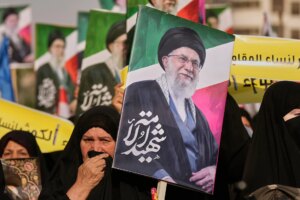
The first of the three developments was the massive anti-government demonstrations in Iran that began in the last days of 2025, and expanded significantly throughout early January to become the most-significant anti-government demonstrations since the founding of the Islamic Republic in 1979, before a bloody crackdown seemed to end them, or at least for now. Unlike prior protests, this was a protest that erupted in the bazar, traditionally conservative and loyal to the regime, whose joining the then ongoing massive anti-government protests in 1979 played a major factor in ending the prior regime.
Consequently, raising fears of a significant political instability in Iran, which were magnified by U.S. threats to the regime, and the build-up of the “beautiful armada”. All of which come with potentially negative consequences for the region, and especially for Iraq, which shares a 1,600 km border with Iran, close political, and economic ties.
The second of the three developments was the nomination a Prime Minister (PM) designate, part of the ongoing government formation, who was the sitting PM in June 2014 when ISIS took over the country’s second largest city. The choice was controversial as the nominee was viewed as being largely responsible for the sectarian tensions in the country during his two tenures as PM, from 2006-2014, that eventually led to the rise of ISIS.
The U.S. administration reacted negatively to this nomination, viewing it as a pro-Iran development, and issued threats that included measures which could negatively affect Iraq’s access to its oil revenues and foreign reserves. While the fears over access to oil revenues and foreign reserves are overblown, rooted in misunderstandings, U.S. threats to Iraq are a negative development.
The final of the three developments was the government’s implementation, at the start of 2026, of long-overdue customs tariffs, part of its plans for increasing non-oil revenues -that was made possible following the automation and digitisation of tariff collection processes over the prior months. While the implementation is an aspect of the cumulative positive effects of relative stability that leads to more efficient government processes, local importers reacted negatively -as this implementation was linked to affecting cross-border transfers by these importers.
Thus, essentially linked to the Central Bank of Iraq’s (CBI) implementation in November 2022, of its then new procedural requirements for the provisioning of U.S. dollars (USD) for importers; which subsequently was a crucial factor in the acceleration of the secular transformation of the economy towards formality and banking. However, the move towards formality is a multi-year process, and as such, the still informal section of importers faced difficulties in effecting cross-border transfers, leading to greater demand for USD in the parallel market. This then led to an increase in the delta of the parallel market exchange rate of the Iraqi dinar (IQD) versus the USD over the official exchange rate.
The delta spiked in late January 2026 in response to the US threats but has since subsided somewhat (chart below). While the increase in the delta is a negative development, in that it has effects on the economy and access to foreign goods, the increase only brought the delta to levels that prevailed at the end of 2024 -and thus part of the delta’s long-term decline as the economy moves towards much increased formality and banking adoption.
Dinar Parallel Market Exchange Rate vs. the Dollar and its Delta over the Official Exchange Rate
(Source: Iraqi Central Statistical Organization, Iraqi Foreign Exchange Houses, AFC Research,
daily data as of January 31st)
As negative as these developments are, and still can be, the equity market looked through them and continued to discount the ongoing secular transformation of the economy driven by the two key dynamics, discussed here in the past, i.e. the cumulative positive effects of the relative stability and structural banking developments. The market’s looking thorough the three developments is mirrored by the muted increase in expectations for future oil prices, as measured by Brent crude futures contracts as of January 30th -which are only about 9.5% higher for the next 18-months versus the same expectations as of December 31st, a figure that mostly reflects expectations of short-term disruptions to supplies, and not major threats to the region’s oil supplies (chart below).
Market Expectations for Future Oil Prices
As measured by Brent Futures Contracts (USD per barrel)
(Source: US Energy Information Administration, investing.com, AFC Research, data as of January 30th)
As argued in the outlook for 2026, the over-arching theme, is that both of the two key dynamics -the cumulative positive effects of the relative stability and structural banking developments- are in the early stages of their transformation of the economy, a process that would unfold over the next few years, bringing with it high economic growth that would feed into higher corporate profits, and ultimately higher stock market returns. However, considerable risks remain given Iraq’s recent history of conflict, the continued risks of U.S.-Iran tensions escalating into an actual conflict, Iraq’s extreme leverage to volatile oil prices, as well as the real risk that a sustained crash in oil prices, of two years or more, will derail the economy’s secular transformation.
Please click here to download Ahmed Tabaqchali’s full report in pdf format.
Mr Tabaqchali (@AMTabaqchali) is the Chief Strategist of the AFC Iraq Fund, and is an experienced capital markets professional with over 25 years’ experience in US and MENA markets. He is a board member of Arab Bank Iraq, a Visiting Fellow at the LSE Middle East Centre, Senior Fellow at the Institute of Regional and International Studies (IRIS), and a Senior Non-resident Fellow at the Atlantic Council.
His comments, opinions and analyses are personal views and are intended to be for informational purposes and general interest only and should not be construed as individual investment advice or a recommendation or solicitation to buy, sell or hold any fund or security or to adopt any investment strategy. It does not constitute legal or tax or investment advice. The information provided in this material is compiled from sources that are believed to be reliable, but no guarantee is made of its correctness, is rendered as at publication date and may change without notice and it is not intended as a complete analysis of every material fact regarding Iraq, the region, market or investment.