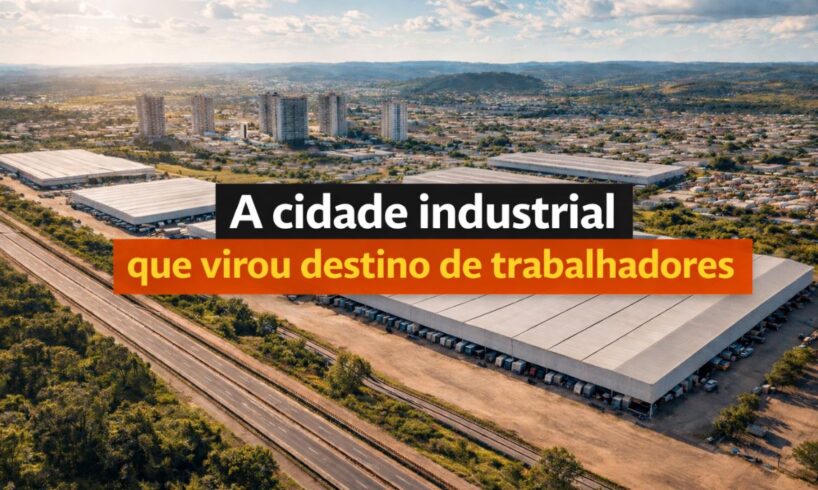
Located between Goiânia and Brasília, a municipality in the interior of Goiás state has expanded its industrial and logistical presence, bringing together factories, distribution centers, and strategic infrastructure that have attracted companies and workers from different regions of the country.
Anápolis, in the interior of Goiás, has been expanding its participation in the Brazilian industrial landscape through a combination of factors. structured industrial park, logistics infrastructure e strategic geographic position between Goiânia and Brasilia.
Located approximately 50 kilometers from the capital of Goiás and about 140 kilometers from the federal capital, the city has come to occupy a relevant role in the routes of goods circulation and in the establishment of companies with national operations.
This movement is associated with factors such as the existence of a planned industrial district, the concentration of industries from different sectors and the connection with important logistics corridors in the Midwest.
— ARTICLE CONTINUES BELOW —
See also other features
The world’s largest excavator weighs over 14 tons, is equivalent to a 30-story building, and can excavate up to 240 cubic meters per day.
China is accelerating its progress toward opening the first fully automated, human-operated car factory, marking the beginning of the era of “dark factories” with robots operating in the dark, redesigning vehicles for machine logic, drastically reducing costs, and threatening jobs worldwide.
By dominating most of the global cobalt refining market, Chinese companies are expanding their control over batteries, electronics, and strategic energy supply chains, even when the ore is mined outside of China.
Brazilian industry loses momentum due to high interest rates and a drop in business confidence.
Over the years, these characteristics have contributed to attracting companies and expanding job opportunities, especially in activities related to industry and logistics.
The industrial growth of Anápolis occurs within a broader context of the decentralization of productive investments in Brazil.
Experts in regional development point out that medium-sized cities, with good infrastructure and strategic locations, tend to gain ground as an alternative to large capitals, where operating costs are usually higher.
Anápolis Agroindustrial District and the role of DAIA.
One of the main drivers of this process is the Anápolis Agroindustrial District, known as daia.
Created in the 1970s, the complex was the first planned industrial hub in the state of Goiás and, over time, came to concentrate companies from various branches of the manufacturing and logistics industries.
Since its implementation, Daia has been associated with the organization of industrial activity in the municipality, offering areas designated for the installation of factories, basic infrastructure, and easy access to the main transportation routes.
Academic studies on the urban and economic development of the city link the presence of the district to… generation of formal jobs and growth in municipal revenue.
Currently, the space brings together companies from the pharmaceutical, food, chemical, automotive, and logistics sectors, including national and multinational groups.
The diversity of activities helps to reduce dependence on a single segment and expands the connections of the local economy with production chains from different regions of the country.
Pharmaceutical industry strengthens the industrial hub in Goiás.
Among the segments installed in Anápolis, the pharmaceutical It stands out for its production volume and the number of companies.
Information released by industry entities and the state government indicates that Goiás has established itself as one of the main pharmaceutical hubs in Brazil, with a strong concentration in the Goiânia–Anápolis axis.
The municipality is home to industrial plants of pharmaceutical manufacturers that serve the national market and, in some cases, also export.
The presence of these companies contributed to the formation of a integrated production chainwhich involves suppliers, service providers, distribution centers, and the demand for skilled labor.
According to sector analyses, the expansion of this hub over the years has been accompanied by investments in industrial modernization and increased production capacity.
These movements, in turn, tend to impact other sectors of the local economy, such as transportation, storage, technical services, and vocational education.
Strategic location and logistics infrastructure in the Midwest.
Geographic location is cited as one of the main factors that favor the establishment of companies in Anápolis.
The city is located at the intersection of federal highways that connect the Midwest to other regions of the country, such as… BR 060, BR 153 and BR 414, facilitating the movement of loads in different directions.
In addition to its road network, Anápolis integrates projects of multimodal logistics in Goias.
The state’s Multimodal Logistics Platform is located in the municipality and brings together structures aimed at coordinating different modes of transport, with a focus on the large-scale movement of goods.
In this context, the Centro-Oeste Dry Port is also mentioned as part of the local logistics arrangement, functioning as a support point for customs and distribution operations.
The proximity to the Railway North-SouthThe project, currently being integrated with other railway lines, reinforces the city’s role in strategies for transporting goods and services.
According to logistics experts, the combination of highways, railways, and support infrastructure tends to reduce operating costs and increase efficiency in the transportation of goods.
These factors often weigh heavily in the decision of companies evaluating where to install production or distribution centers.
Industrial jobs and their effects on the local labor market.
The growth of the industrial and logistics park has direct repercussions on market of work .
Academic research and surveys on the municipality’s economic profile indicate an increased demand for professionals in the industrial, logistics, technical, and administrative fields.
This movement also stimulates indirect activities, such as commerce, services, construction, and education, which accompany the arrival of new workers and businesses.
Anápolis thus began to attract people from different regions seeking opportunities related to industry and associated services.
Analysts point out that the continuation of this process depends on factors such as urban planning, infrastructure investments, and professional training.
The ability to absorb new developments without compromising public services and urban mobility is cited as one of the challenges for rapidly expanding cities.
With an diversified industrial park, strategic location in the Midwest e Logistics integration under developmentAnápolis has come to occupy a relevant space in discussions about industrial decentralization in Brazil.