Company Logo
Brazil’s loyalty market is driven by ecosystem-led models, with financial institutions embedding rewards into banking relationships and retailers using loyalty for repeat behavior. Marketplaces expand loyalty through integrated services, while coalition programs hold niche roles. Regulatory compliance strengthens incumbents.
Brazilian Loyalty Market
Brazilian Loyalty Market · GlobeNewswire Inc.
Dublin, Feb. 10, 2026 (GLOBE NEWSWIRE) — The “Brazil Loyalty Market Size & Forecast by Spend Value Across 100+ KPIs by Program Type, Channel Mix, Sector, Embedded Loyalty Penetration, and Platform Spend Segmentation – Databook Q1 2026 Update” report has been added to ResearchAndMarkets.com’s offering.
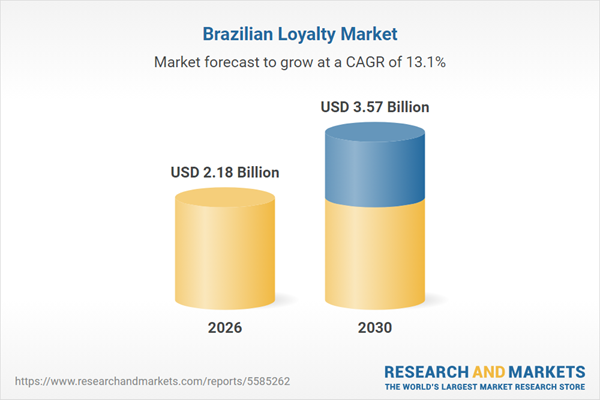
The loyalty market in Brazil is expected to grow by 15.5% annually, reaching US$2.18 billion by 2026. The loyalty market in the country has experienced robust growth during 2021-2025, achieving a CAGR of 17.8%. This upward trajectory is expected to continue, with the market forecast to grow at a CAGR of 13.1% from 2026 to 2030. By the end of 2030, the loyalty market is projected to expand from its 2025 value of US$1.89 billion to approximately US$3.57 billion.
Brazil’s loyalty market is being reshaped by financial ecosystems, competitive retail dynamics, and large marketplaces. Loyalty increasingly functions as an embedded layer within everyday digital and commercial activity. Over the forecasting period, ecosystem-led models are expected to strengthen, while structural disruption remains limited.
Brazil’s loyalty market is competitive but ecosystem-led. Financial institutions, retailers, and marketplaces dominate through embedded loyalty tied to daily usage, while coalition programs remain relevant in specific sectors. Over the forecasting period, competition is expected to intensify around ecosystem integration and execution discipline, with regulation and scale continuing to favour established players.
Brazil’s loyalty market is competitive but consolidated around platforms that already control commerce, payments, or financial relationships. Competitive intensity is driven by how deeply loyalty is embedded into daily usage rather than by the number of programs in operation.
Banks and fintechs account for a significant share of loyalty activity. Nubank and Banco Inter position loyalty as part of ongoing financial relationships, while traditional banks continue to operate card-linked rewards and partner ecosystems. Competition in this segment focuses on primary account and card usage rather than promotional differentiation. Retail competition remains intense among omnichannel players such as Magazine Luiza and Grupo Pao de Acucar, while Mercado Livre anchors marketplace-led loyalty. These players compete on integration quality apps, fulfilment, and payments rather than on novel reward structures.
Story Continues
Programs such as Smiles retain relevance in travel and card ecosystems but do not directly challenge bank- or retail-led loyalty at scale. Their competitive role is stabilising and sector-specific. New entrants focus on enablement cashback engines, offer management, and loyalty infrastructure rather than building consumer-facing programs. Partnerships tend to extend existing ecosystems, while M&A activity remains selective and capability-driven.
Regulatory enforcement under Brazil’s data protection framework has increased compliance demands, favouring large platforms with established governance and raising barriers for smaller operators.
Embed loyalty as a core feature of financial relationships
Loyalty in Brazil is increasingly delivered through financial institutions rather than standalone retail programs. Nubank integrates rewards into card and account usage, while Banco Inter embeds loyalty within a broader ecosystem that includes banking, marketplace, and services.
Daily consumer engagement has shifted toward digital banking and instant payments. As payments become interchangeable, financial institutions use loyalty to influence primary account usage and cross-product adoption.
Financial-led loyalty is expected to deepen, with rewards structured around usage patterns and bundled services rather than isolated points accumulation.
Use loyalty to stabilise frequency in a promotion-intensive retail market
Large retailers continue to operate loyalty programs as tools to manage repeat behaviour across online and physical channels. Magazine Luiza integrates loyalty into its omnichannel model, while Grupo Pao de Acucar links loyalty to everyday grocery purchasing.
Brazil’s retail environment is characterised by frequent promotions and price competition. Loyalty provides a controlled mechanism to guide frequency and basket composition without continuous headline discounting.
Retail-led loyalty remains structurally important, with progress focused on execution app integration and targeting rather than fundamental redesign.
Reinforce ecosystem stickiness through marketplace-led loyalty
Ecommerce platforms embed loyalty across multiple services rather than limiting it to transactions. Mercado Livre connects rewards to its marketplace, logistics, and payments infrastructure, reinforcing repeat usage.
Marketplaces compete on fulfilment reliability, payments convenience, and service breadth. Loyalty helps retain users across multiple touchpoints rather than single purchase moments.
Marketplace-led loyalty is expected to become more tightly integrated across shopping, payments, and delivery experiences.
Preserve coalition loyalty in travel and card-based use cases
Coalition loyalty continues to play a defined role, particularly in travel and credit cards. Smiles operates as a multi-partner program linked to air travel, financial services, and retail partners.
Brazil has an established culture of mileage and points accumulation, especially through credit cards, where rewards accrue over time rather than daily spend.
Coalition loyalty is expected to persist but remain sector-specific rather than expanding into mass retail.
Align loyalty design with data protection and transparency requirements
Loyalty programs increasingly emphasise consent management and clear customer communication in line with Brazil’s data protection framework.
Regulatory enforcement and consumer awareness influence how data is collected and used, particularly in digital and ecosystem-based loyalty models.
Personalisation will progress within disciplined, consent-led boundaries rather than through aggressive data exploitation.
Key Attributes:
Report Attribute
Details
No. of Pages
127
Forecast Period
2026 – 2030
Estimated Market Value (USD) in 2026
$2.18 Billion
Forecasted Market Value (USD) by 2030
$3.57 Billion
Compound Annual Growth Rate
13.1%
Regions Covered
Brazil
Report Scope
Brazil Retail Sector Market Context
Brazil Retail Industry Market Size, 2021-2030
Brazil Ecommerce Market Size, 2021-2030
Brazil POS Market Size Trend Analysis, 2021-2030
Brazil Loyalty Spend Market Size and Growth Dynamics
Brazil Loyalty Spend Market Size and Future Growth Dynamics, 2021-2030
Brazil Loyalty Spend on Schemes by Value Accumulated and Value Redemption Rate, 2025
Brazil Loyalty Spend Share by Functional Domains, 2021-2030
Brazil Loyalty Spend by Loyalty Schemes, 2021-2030
Brazil Loyalty Spend by Loyalty Platforms, 2021-2030
Brazil Loyalty Schemes Spend Segmentation by Loyalty Program Type
Point-based Loyalty Program
Tiered Loyalty Program
Mission-driven Loyalty Program
Spend-based Loyalty Program
Gaming Loyalty Program
Free Perks Loyalty Program
Subscription Loyalty Program
Community Loyalty Program
Refer a Friend Loyalty Program
Paid Loyalty Program
Cashback Loyalty Program
Brazil Loyalty Schemes Spend Segmentation by Channel
Brazil Loyalty Schemes Spend Segmentation by Business Model
Brazil Loyalty Schemes Spend Segmentation by Key Sectors
Retail
Financial Services
Healthcare & Wellness
Restaurants & Food Delivery
Travel & Hospitality (Cabs, Hotels, Airlines)
Telecoms
Media & Entertainment
Other
Sector Channel Views: Loyalty Schemes Spend by Key Sectors and Channels
Online Loyalty Spend by Sector, 2021-2030
In-store Loyalty Spend by Sector, 2021-2030
Mobile App Loyalty Spend by Sector, 2021-2030
Brazil Retail Sector Deep-Dive: Loyalty Schemes Spend by Retail Segment
Brazil Loyalty Schemes Spend Segmentation by Accessibility
Card Based Access
Digital Access
Brazil Loyalty Schemes Spend Segmentation by Consumer Type
B2B Consumers
B2C Consumers
Brazil Loyalty Schemes Spend Segmentation by Membership Type
Free
Free + Premium
Premium
Brazil Loyalty Spend Split by Embedded vs. Non-Embedded Loyalty
Brazil Loyalty Spend Split by Use of AI / Blockchain
Brazil Loyalty Platform Spend Segmentation by Software Use Case
Analytics and AI Driven
Management Platform
Brazil Loyalty Platform Spend Segmentation by Vendor / Solution Partner
In-house
Third-Party Vendor
Brazil Loyalty Platform Spend Segmentation by Deployment
Brazil Loyalty Platform Spend Segmentation by Offering
Brazil Consumer Demographics & Behaviour (Loyalty Spend Share), 2025
Age Group
Income Level
Gender
Brazil Loyalty Program KPIs, Behavioral Metrics & Embedded, 2025
Primary Loyalty Motivation Split Analysis
Loyalty Program Breakage Rate Analysis
Loyalty Program Enrollment Channel Mix Analysis
Embedded Loyalty Penetration by Channel
For more information about this report visit https://www.researchandmarkets.com/r/85l45f
About ResearchAndMarkets.com
ResearchAndMarkets.com is the world’s leading source for international market research reports and market data. We provide you with the latest data on international and regional markets, key industries, the top companies, new products and the latest trends.
Attachment
CONTACT: CONTACT: ResearchAndMarkets.com Laura Wood,Senior Press Manager [email protected] For E.S.T Office Hours Call 1-917-300-0470 For U.S./ CAN Toll Free Call 1-800-526-8630 For GMT Office Hours Call +353-1-416-8900