But new data published by the government revealed that the average monthly percentage for core staff has been consistently below 50% since the policy was introduced.
Disciplinary action is not taken against staff who fail to meet the 40% office working request.
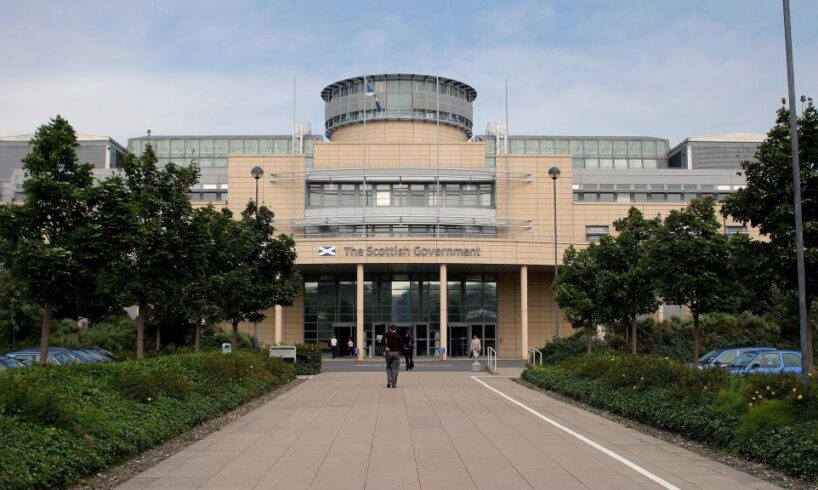
In October last year, the average monthly percentage of core staff in Atlantic Quay in Glasgow was 34.5%.
Edinburgh’s St Andrew’s House had an average occupancy of 24%, while the Capital’s Saughton House had 8.1% and Victoria Quay, 12.2%.
The figure is calculated by using the number of unique IT log-ins by core civil servants divided by the number of desks allocated to them. It does not include staff working in the Scottish Parliament.
Figures varied each month, with Victoria Quay, which has a capacity for approximately 3,000 full-time equivalent staff, recording an average percentage of 8.2% occupancy in December 2025.
Saughton House – home to multiple public sector offices including HM Inspectorate of Prisons for Scotland (HMIPS) – had an average occupancy of 6.2% amongst core civil servants.
Read More:
The highest average percentage between October 2025 and January 2026 was Glasgow’s Atlantic Quay in November, with 47.3% occupancy.
The Herald had requested the data in December but it was refused so that the Scottish Government to release it within 12 weeks.
Core civil servants were told the 40% target could be met by meeting in teams, collaborating with colleagues, operating out in the field, participating at in-person events such as training or meeting with stakeholders at their premises.
An investigation conducted by The Herald into the hybrid working policy revealed that senior government officials were accused of “breaching” a partnership working agreement with civil service unions over inadequate consultation.
The agreement in place between unions and Scottish ministers required “contractual changes” to be adequately negotiated.
The Public and Commercial Services (PCS) union told officials that it was “offensive” for the Scottish Government to suggest staff cannot be creative or collaborative unless they are working in person.
The union warned the hybrid working policy fuelled a “pernicious right wing culture war” against public sector workers, while internal documents from the government’s intranet led junior civil servants to label the policy “humanely insensitive”.
Despite the concerns of trade unions, the Permanent Secretary Joe Griffin has said it remains his “future ambition” to move civil servants towards 60% of office attendance.
Read More:
Civil servants were furious with the office working request, with a dossier of documents revealing the policy was privately described as negatively impacting staff with caring responsibilities.
A junior official fumed: “Which responsible, right-thinking person will leave their loved one who needs attention, and comes to work and performs to the best of their ability?”
On August 1, they added: “It feels like we are just tools to be used.
“Are we to live in isolation from our families in need of care? Culturally and humanely insensitive for me.”
Another claimed the equality impact assessment (EQIA) conducted to assess the policy was “completely skewed”.
A junior staffer said: “I can’t help but feel like this EQIA has [been] produced to defend a decision that has already been taken, rather than a truly objective assessment of impacts to assess whether and how a decision should be taken.
“This is really very dispiriting indeed.”
The Scottish Government’s offices were closed from December 24, 2025 and reopened on January 5, 2026, which could explain the lower figures.
A Scottish Government spokesman told The Herald: “This data supports effective management of the Scottish Government estate.
“It cannot be used to assess the impact of our hybrid working policy, as it provides no insight into people working outside Scottish Government offices, such as logging on and working from the Scottish Parliament or working with stakeholders in the community, or the use of hot desking facilities, nor does it take into account the reduction in Scottish Government headcount over the past 3 years or the impact of our buildings closure programme over that time period”.