Shafaq News
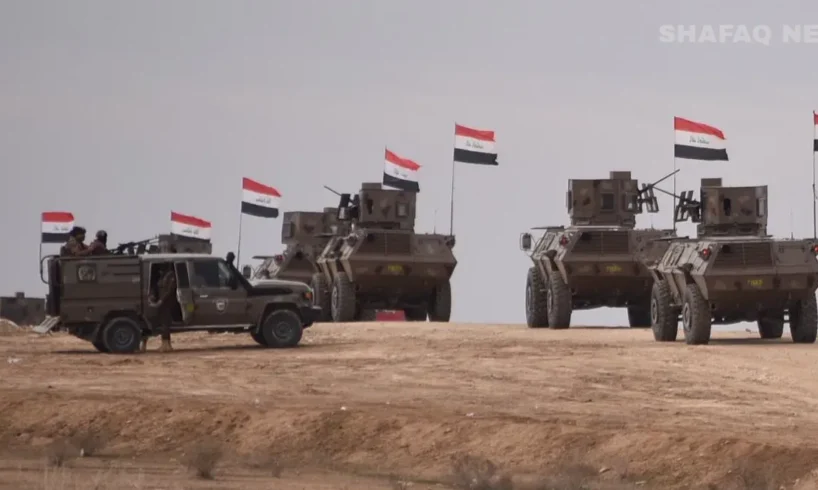
The Iraqi Armed Forces face significant
responsibility in securing the country’s borders and protecting the state from
internal and external threats following the withdrawal of Global Coalition
forces from Iraq. This transition represents an opportunity to demonstrate the
Iraqi Army’s ability to assume full responsibility without relying on external
support, while focusing on building a professional national army trained and
equipped with the latest weapons and military technologies.
The history of the Iraqi Army spans more than a
century, during which it was, for decades, among the most prominent armies in
the region and the world. It fought internal and external battles, from the
harsh war with Iran and the invasion of Kuwait to confronting the US invasion
and later battling ISIS.
Professionalism Under Pressure
The spokesperson for the Commander-in-Chief of
the Iraqi Armed Forces, Sabah Al-Numan, affirmed that Iraq is moving steadily
toward building “a professional military system based on accumulated field
experience from battles resolved in favor of the state,” noting that this
vision “is grounded in a unified national doctrine and exclusive loyalty to the
state and constitution.”
Regarding armament, Al-Numan told Shafaq News
that the Iraqi Army also seeks to achieve technical self-sufficiency by
reviving domestic military manufacturing and localizing military technology,
while developing air power, preparing for cyber warfare, and utilizing the
army’s expertise in urban warfare and combating terrorist groups, “to become
among the leading armies in the region in terms of equipment and manpower.”
There remains, however, a path full of obstacles
to strengthening the Iraqi Army. Although Iraq’s 2008 Strategic Framework
Agreement with the United States established a formal security partnership
—centered on training, equipping, and supporting Iraqi Security Forces— it fell
short of addressing the country’s full military and security requirements. The
gap became more apparent as Washington attached complex conditions to arms
deals with Baghdad, limiting Iraq’s ability to procure and deploy critical
capabilities.
To be sure, US support did not disappear.
Between 2015 and 2024, Washington has provided Iraq with $1.25 billion in
Foreign Military Financing to bolster its security forces, logistics, and
counterterrorism efforts, in addition to more than $590 million allocated to
weapons destruction programs. Yet this assistance, while significant, focused
largely on stabilization and counterterrorism rather than on building a fully
autonomous, strategically equipped army capable of regional deterrence.
Compounding the challenge, the United States
faced pressure from regional allies, including Israel and several Gulf states,
which opposed supplying Iraq with advanced weaponry that could shift the
regional balance of power. These governments feared that expanding Iraq’s
military capacity might indirectly strengthen Iran’s influence. As a result,
Iraq endured prolonged security vulnerabilities —not only in negotiating arms
contracts with Washington, but also in fully operating and deploying certain
advanced weapons systems and equipment.
During the 1980s, the Iraqi Army ranked among
the world’s strongest forces at the height of the war with Iran. That
institutional power collapsed after the 2003 US invasion, when the head of the
US-led Coalition Provisional Authority, Paul Bremer, issued a decision
dissolving the force, forcing Iraq to rebuild its military from scratch.
Over decades, the army had fought regional wars
—including in 1948 following the
declaration of “the State of Israel” in Palestine and the October 1973 war
between Syria, Egypt, and Israel— and suppressed internal uprisings, most
notably in the Kurdistan Region, which extended over many years, shaping both
its operational doctrine and its political entanglements.
Today, Iraq ranks sixth in the Middle East
according to the 2026 Global Firepower Index, but restoring strategic autonomy
requires more than ranking positions; it demands functional independence.
Reform, Leadership, and Structural Weaknesses
The new Iraqi Army established after 2003
adopted a voluntary recruitment approach to build a professional military
institution whose members choose military life willingly. However, one of the
weaknesses negatively affecting the army’s efficiency, according to experts who
spoke to Shafaq News, lies in “integration officers,” individuals affiliated
with political entities who were incorporated into the army after the change of
regime.
Military expert Alaa Al-Nashou believes that
establishing a professional national army requires substantial resources,
beginning with the formation of military schools, institutes, and academies to
train officers and fighters, and extending to preparing divisions and corps
capable of leading operations domestically and externally.
Al-Nashou told Shafaq News that preparing a
professional soldier is not limited to physical training alone but includes
physical and psychological preparation and tactical maneuvers enabling him to
handle all military scenarios, from offensive and defensive operations to
retreat combat. He stressed the need to establish mechanisms to ensure
professionalism within the army, “most notably distancing the military
institution from partisan and political conflicts, combating corruption and
favoritism within it, and removing unqualified officers and ranks, especially
integration officers.”
“Iraq needs to grant military formations direct
authority to confront any border threat without interference from “armed
factions,” he added, calling for the establishment of a military council
composed of former commanders and officers to supervise the development of
combat, organizational, and morale capabilities, in addition to sending
military personnel to training courses both inside Iraq and abroad,
particularly in countries with advanced military expertise such as the United
States, Europe, and Russia.
Read more: US strategy 2026: Containment or military strike for Iraqi armed factions
Air Defense Gaps and the Sovereignty Question
The two experts agree that developing air power
has become a decisive element in protecting Iraq. Between August 2024 and
October 2025, the Iraqi Army received 15 US-made Bell 505 training aircraft,
along with French Caracal helicopters designated for search and rescue, air
transport, and ground support missions.
They noted that these aircraft represent a
qualitative leap in military training and pilot qualification, while also
contributing to providing fire support for ground forces and enhancing their
flexibility. Iraq is also preparing to receive the South Korean M-SAM air
defense system during the current month of February to ensure border protection
from any potential airspace violations.
However, this is not sufficient, according to
many experts who spoke to our agency. Iraq currently lacks comprehensive air
defense weapons, advanced missile systems, early warning and air surveillance
systems, and ground-based air defense capabilities, which are all crucial
military capacities to address external threats. The Iraqi military institution
also requires greater functional integration at the operational level. This
shortcoming was evident in recent regional wars, where Iraq was unable to
enforce its political position prohibiting the use of its airspace for attacks
on Iran, a situation that could recur if a new round of US-Israeli
confrontation with Tehran erupts.
Military expert Adnan Al-Kinani affirmed that
Iraq now possesses advanced air capabilities, including fighter aircraft,
drones, short, medium, and long-range ballistic missiles, and air defense
systems to protect borders from violations, adding that Iraq has domestic
military manufacturing to supply weapons and equipment in the event of
aggression or import difficulties, diversified ground forces including special
forces, infantry, mechanized infantry, armor, and artillery, as well as
electronic warfare capabilities to counter modern threats.
He also stressed the importance of qualified
national leadership to guide training, oversee armament, and execute
operations, warning that “the presence of unqualified leaders poses a threat to
the army’s ability to protect the state.”
There appears to be an urgent need to establish
an Iraqi national security strategy that takes into account Iraq’s security
requirements in the coming phase. The threat of ISIS remains present, while
Israeli military dominance in the region, including its use of Iraqi airspace,
raises alarm. The military advancements achieved by neighboring countries such
as Turkiye, Iran, and Saudi Arabia necessitate rapid military development to safeguard
Iraq’s political position.
This Iraqi reality and need are not hidden from
Washington. However, the major challenge lies in convincing it to assist in
meeting these needs and strengthening Iraq’s military structure amid US
constraints and reservations, which are unlikely to retreat from ensuring
Israel’s dominance on one hand and weakening Tehran and its allies on the
other, a dilemma that continues to exhaust Iraq and its attempts to advance on
multiple levels.
Written and edited by Shafaq News staff.