2026-02-18T11:26:52+00:00
font
Enable Reading Mode
A-
A
A+
Shafaq News- Baghdad
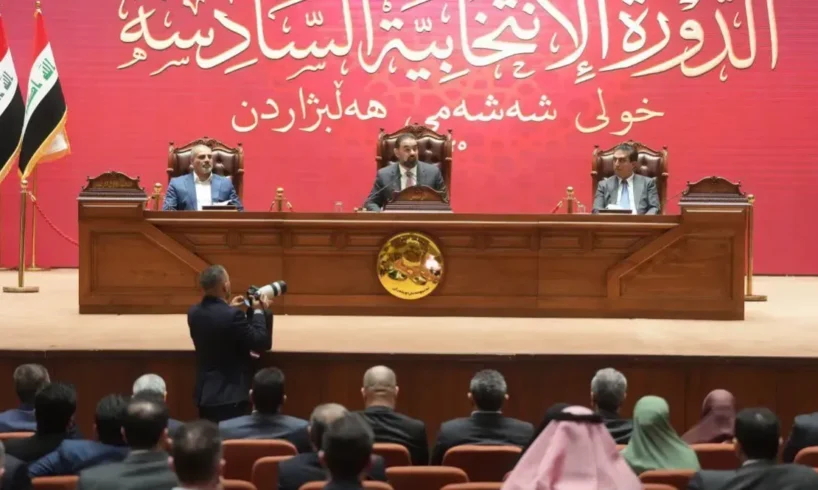
Iraqi lawmakers and ministers were asked
to donate a portion of their salaries to the State Treasury, in a new
initiative designed to ease citizens’ financial burdens and bolster government
funds amid a worsening economic crisis.
The initiative, proposed by MP Karim Aliwi
Al-Muhammadawi of the Badr Organization, calls on officials to contribute half
—or more— of their monthly pay to help reduce taxes and customs fees for
citizens. The program could last six months to a year, or until the country’s
financial pressures subside.
While the proposal has attracted public
attention, it has received little backing in parliament. The current government
continues enforcing austerity measures, including salary cuts, higher customs
duties, and the removal of advisers from several ministries.
Optics over Substance
MP Abbas Hiyal of the Reconstruction and
Development (Al-Ima’ar Wal Tanmiya) Alliance framed salary donations as a minor
element of a broader challenge. He conveyed to Shafaq News that Iraq needs
structural reforms to navigate the crisis. “Symbolic steps, like donating
salaries, require official approval and must accompany genuine reforms and
careful financial management.”
Underscoring Iraq’s payroll scale, he
noted that the country requires around 85 trillion dinars ($58B) annually to
cover public sector salaries. “Iraq is rich in oil and other resources.
Temporary fixes won’t solve the problem. We need practical solutions that help
the most vulnerable and allocate resources efficiently,” he continued.
MP Thaer Al-Jassim of the National
Approach Alliance (Al-Nahj Al-Watani) argued that donations would only matter
if they produce tangible results. Speaking to Shafaq News, he suggested, “If
giving half a salary strengthens the treasury and supports the economy, even a
full donation could be justified. But experts should guide this, not public
relations campaigns.”
Jassim also pointed out that reviewing
underperforming oil and telecommunications contracts could generate far more
revenue than symbolic contributions.
Read more: Iraq’s economic “perfect storm”: Experts warn the crisis is structural and social
The Symbolic Tax
Economist Nawar Al-Saadi indicated that
cutting or donating MPs’ salaries would have minimal effect on Iraq’s overall
budget. “Public spending depends mainly on oil revenues. Lawmakers’ salaries
are a tiny fraction of total expenses, so donations won’t meaningfully reduce
the deficit.”
Cautioning that the initiative carries
symbolic value by reinforcing trust between citizens and the state, he
maintained that the real solution lies in addressing structural imbalances,
diversifying revenue, reducing oil dependency, and curbing waste and corruption.
“Salary reductions send a positive message
but are not a real economic fix,” he added, pointing that Iraq’s parliament
spent more than 5.5 trillion dinars (≈ $3.8B) from 2015 to 2025 while passing
321 laws, averaging over 17 billion dinars (≈ $11.6M) per law.
The fifth parliamentary session which
ended in November 11, 2025 recorded the highest spending at 2.4 trillion dinars
(≈ $1.6B) for 69 laws, roughly 35 billion dinars (≈ $24M) per law, while the
fourth session spent 1.8 trillion dinars (≈ $1.2B) for 91 laws, around 20
billion dinars (≈ $13.7M) per law.
Read more: A Lost Term: Iraq’s weakest parliament since 2003