Ukraine has made its largest battlefield gains in more than two-and-a-half years a new analysis has suggested, retaking more than 200 square kilometres of its territory from Russia in just five days last week.
As the latest round of United States-brokered peace talks between Kyiv and Moscow ended in gridlock on Wednesday, the situation on the front lines — some analysts argued — could be shifting.
Ukraine’s advances were calculated by news agency Agence-France Presse, using data from the Institute for the Study of War (ISW), an independent research organisation that monitors developments in the war.
The territorial gains were recorded between February 11 and 15, and come as Russia’s military struggles with communication issues after having their access to Elon Musk’s Starlink satellite internet system blocked.
Compounding the Kremlin’s issues are fresh claims Vladimir Putin’s military could be shrinking for the first time since he ordered his full-scale invasion of Ukraine almost four years ago.
Kyiv’s successful thrusts forward have taken place in several locations, and have coincided with the Starlink access changes.
Both Ukraine and Russia have relied heavily on the portable internet systems to follow and respond to battlefield developments in real time.
But earlier this month the US company founded by Mr Musk restricted access from terminals in Russian-held territory after lobbying from officials in Ukraine.
“This is a really significant success for the Ukrainians,” said Dr Jenny Mathers, a senior lecturer in international politics at Aberystwyth University said.
“It obviously has made a huge difference.”
Despite Ukraine’s boost, the ISW noted Russia has gained net territory on the battlefield in February.
“Looks like the steps we took to stop the unauthorised use of Starlink by Russia have worked,” Mr Musk wrote on social media earlier this month. “Let us know if more needs to be done.”
A Ukrainian soldier surveys a Starlink terminal near the front lines. (Reuters: Clodagh Kilcoyne)
It’s not yet clear how long Ukraine can sustain its new-found momentum for.
“I think the fact that they’ve made some gains is important, but what we’ve seen in this war is that Russia is not good with innovation, and they’re quite slow to respond to change, but they do respond to change,” Dr Mathers said.
“We’ve seen this time and again. Ukraine will get a new weapons system from the West, or adopt a new strategy, or it will do something different, and the Russians are put back on their heels for quite a while, but then they adapt and they learn and they figure out a way to get around it.
“It’s really important for the Ukrainians to make the most of this moment.”
Compounding the Starlink outages is the fact the Russian government has begun cutting access to the encrypted messaging service, Telegram, which had also been used extensively in its military.
Russian war bloggers have bemoaned the disruption, which means that transferring information between units and command posts on the front lines that could previously be done in a matter of minutes now takes hours.
The regions Putin does not hold, but wants anyway
A report released last month by the Centre of Strategic International Studies (CSIS), a Washington DC-based think tank, provided a pessimistic snapshot of Russia’s war.
It claimed Putin’s forces had suffered around 1.2 million casualties (killed, wounded and missing) since the start of the full-scale invasion of Ukraine in February 2022.
“These numbers are extraordinary. No major power has suffered anywhere near these numbers of casualties or fatalities in any war since World War II,” the report read.
It claimed there were roughly 415,000 Russian casualties last year alone. Despite massive losses, the report found gains had been slow going.
“After seizing the initiative in 2024, Russian forces have advanced at an average rate of between 15 and 70 metres per day in their most prominent offensives, slower than almost any major offensive campaign in any war in the last century,” it read.
In other words, Putin’s army sustained around 35,000 casualties a month in 2025, to — over the same time period — move forward less than the span of the Sydney Harbour Bridge in some battles.
Russia ‘a complete, negative s**t show’
Russia has so far been able to replenish its military by offering generous sign-on bonuses for men prepared to fight, sending prisoners to the front lines and luring mercenaries from South America, Asia and Africa.
Some Western intelligence suggests that in December — for the first time since the full-scale invasion was launched — Russia sustained more casualties than it was able to recruit.
A report by the Carnegie Russia Eurasia Centre published last week noted the number of Putin’s subjects “willing to go to war for money is dwindling”.
“The current recruitment system generally attracts socially disadvantaged people, from the unemployed to prisoners,” it read.
“They are typically individuals with low motivation and limited qualifications and aptitude for learning. Yet the nature of warfare increasingly requires trained specialists rather than mass infantry.”
Messages encouraging people to join Russia’s military are hard to escape in Saint Petersburg. (Reuters: Anton Vaganov)
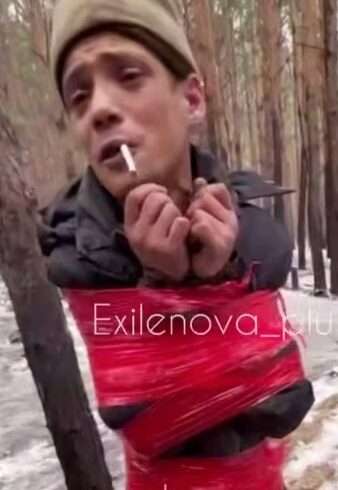
Amid brutal winter conditions on the front lines, multiple videos circulating on social media show what can happen to Russian soldiers who do not follow the often-suicidal demands of commanders.
In one, men can be seen tied to trees in a snowy forest. Another man can be heard shouting: “These idiots tried to leave their positions without permission, refusing to follow orders.”
The ABC has not independently verified the clips.
A UK government estimate last year claimed around 18,000 troops had deserted Putin’s army since the start of the full-scale invasion.
Dr Mathers said it would be “a huge problem” for Putin if his military began shrinking.
“The way that Russia is fighting the war relies upon an almost inexhaustible source of people — men basically — to be wasted. They’re put in very very difficult positions and are killed, to make very small gains,” she said.
“If Russia were to be significantly constrained in its ability to replenish that source of manpower in the army, they would have to do some very serious rethinking about how they fight the war.”
Videos circulating on social media claim to show Russian soldiers punished for not following orders. (Telegram: Exilenova+)
According to multiple analysts, Russia’s economy is showing signs of strain because of the war.
“Russian manufacturing is declining, consumer demand is weakening, inflation remains stubbornly high, and the country faces a labour crunch,” the CSIS report read.
The country’s newspapers have covered inflation woes extensively.
The price of fruit and vegetables, some of which have shot up more than 40 per cent in a month, has gained particular attention.
Komsomolskaya Pravda, a tabloid, this week provided free packets of cucumber seeds with its Monday edition.
Russians in the city of Omsk survey cucumbers, which have surged in price. (Reuters: Alexey Malgavko)
The country’s deteriorating economic situation has had impacts on the battlefield.
In a recent video, pro-war blogger Yevgeny Golman — who has been fundraising for Russia’s military — complained money was drying up and that there was “barely enough to buy socks and underwear” for soldiers.
“What’s happening in the country in general is a complete negative s**tshow,” he said.
“I can see that by the end of the first quarter [of this year], people will start to wise up a little.
“In Moscow, 500 restaurants have closed. Many businesses are closing down, owned by people who used to help with diesel and whatever they could [for troops].
“By the end of the year, we’ll be completely f**ked.”
A man walks past a damaged building in the frontline city of Pokrovsk in Ukraine. (Reuters: Anton Shynkarenko)
Peace talks between Russia, Ukraine and the United States were held behind closed doors in Geneva, Switzerland on Tuesday and Wednesday, local time.
Rustem Umerov, the head of Ukraine’s delegation, described the meetings as “intensive and substantive”, while the country’s President Volodymyr Zelenskyy said all participants had agreed to continue discussions.
“We can see that progress has been made, but for now, positions differ because the negotiations were difficult,” Mr Zelenskyy told reporters.
Vladimir Medinsky, the head of Russia’s delegation and an aide to Putin, also said the negotiations had been “difficult”, according to state media outlet TASS.
Official discussions lasted only two hours on Wednesday.
A senior Australian military figure this year told the ABC earlier they expected the war in Ukraine to continue for some time, noting the Russian population’s ability to withstand the pains associated with the invasion appeared to be significant.