How Russia’s influence campaigns lock in common knowledge before anyone can verify the facts.
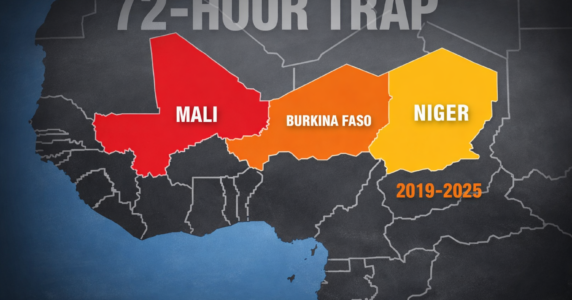
Central Sahel focus: Mali, Burkina Faso, Niger (2019-2025).
Russian influence operations in the Central Sahel follow a simple playbook: strike when verification is slow and emotions are high.
Mali, Burkina Faso, and Niger are vulnerable to quick narrative spikes after a crisis. A coup, an attack, a foreign withdrawal, a sanctions threat, or a regional summit can trigger the same sequence. The public wants answers now. Networks move faster than investigators. Pre-packaged frames appear first, tailored to local grievances and delivered with confidence. The goal is to win the first explanation because the first explanation becomes the baseline for every future argument.
Since 2023, the tradecraft has become more organized and frequent. The shift is not just more propaganda. The shift is a clearer influence architecture that hides behind a legitimate brand. A polished outlet, a professional tone, and consistent distribution make interference harder to spot and easier to spread. When it looks like news, it travels faster and gets challenged later.
How the influence system moves: brand – distribution – amplifiers – audiences.
The key mechanism is narrative laundering. A frame does not need to start locally to sound local. It moves through handoffs that strip away the origin and add legitimacy. A post becomes a quote. A quote becomes a screenshot. A screenshot becomes a forward in closed channels. Then it shows up in public debate, then in elite commentary, and finally in the headlines. Each step makes the claim feel more normal. By the time verification arrives, the argument has shifted. People stop asking if it is true and start saying everyone knows this happened.
Laundering chain: post – forward – headline.
Two strategic shifts made this easier. The end of the UN mission in Mali removed a layer of ground level observation. This slowed independent verification and prolonged the life of contested claims. The Niger coup and the regional response created a legitimacy stress test. This was a moment when institutions had to act publicly and quickly. That is when influence campaigns push hardest: to delegitimize Western partners, weaken regional deals, and portray pressure as neo-colonial coercion or collective punishment.
The targeting is layered. Politically mobilized urban publics matter because they amplify stories quickly during legitimacy contests. Security sector communities matter because sovereignty and security language works well inside institutions that hold power. Elite and diplomatic audiences matter because regional bodies create legitimacy frames that can be reinforced or eroded through sustained pressure. Each audience gets a tailored version, but the intended effects are the same.
Platform takedowns are useful but incomplete. Transparency reporting can reveal some coordinated networks. It cannot reliably expose closed networks or offline organization. A lack of an enforcement signal is not proof that coordination is absent. That is why language must remain conservative when evidence is partial, and why confidence thresholds must be clear.
The most reliable defense in practice is institutional discipline under time pressure. Every trigger event should start a 72 hour sprint. At 24 hours, lock an evidence and claims log anchored to primary documents and verifiable statements. At 48 hours, map the pathway: who carried the frame, where it moved, and which nodes accelerated it. At 72 hours, publish a confidence brief that controls what can be shared, where it can be shared, and what attribution language is justified.
This is how credibility is protected. The goal is not to out-shout the operation. The goal is to out-document it, out-map it, and break the early window where a lie hardens into a default belief.
If you have found a spelling error, please, notify us by selecting that text and pressing Ctrl+Enter.