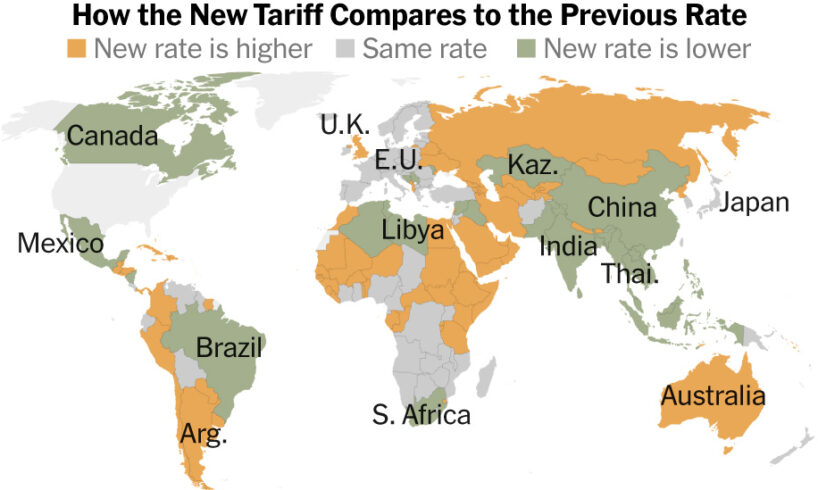
Imports around the world are set to face a new, 15 percent tariff under President Trump’s latest trade policy, announced Saturday in the wake of a Supreme Court decision that struck down a large slate of his previous duties.
How the new tariff compares to the previous rate
Notes: Rates shown are a comparison between the emergency tariffs invalidated by the Supreme Court and the president’s new 15 percent baseline. For Canada and Mexico, the tariffs do not apply to goods subject to a trade deal with the United States. Other tariffs, like sectoral Section 232 tariff and China-specific Section 302 tariffs, are not shown here. The new global tariff does not apply to all goods; some are exempt, and others are subject to certain other duties.
The new tariff, announced in a social media post, is higher than the rate Mr. Trump initially ordered — and, for some countries, it is harsher than the duties that previously applied to their goods. But the president has carved out exceptions for certain products and countries, while promising additional tariffs on the horizon.
The result is a fast-shifting patchwork of trade policies, which includes a roster of other import taxes that apply to foreign steel, lumber, cars and other goods on national security grounds.
The Supreme Court ruling nevertheless cut at the heart of the president’s campaign to reset the world trading order, raise new federal revenue and pressure private businesses to make more of their products domestically.
How the share of U.S. imports under different trade rules evolved
Source: New York Times analysis of U.S. Census Bureau international trade data.
The stakes remain unchanged, and whether Mr. Trump can succeed is still an open question with great consequences for the U.S. economy. The president’s brinkmanship has at times rattled financial markets around the world, and his tariffs threaten to raise prices for American businesses and consumers, who often ultimately foot the bill for duties on imported goods.
For Mr. Trump, the Supreme Court ruling marks an end to the tariffs he announced last spring on what he called “Liberation Day.” These duties were among his most punishing, with some countries seeing taxes on their exports ranging as high as 50 percent.
To implement the tariffs, a power generally reserved for Congress, Mr. Trump invoked the International Emergency Economic Powers Act, a 1970s law that does not explicitly mention the word tariff. No president before him had ever interpreted the statute in this way, but Mr. Trump tried to wield the law in order to raise or lower rates unilaterally, a defining element of his trade strategy.
Under the law, known as IEEPA, Mr. Trump imposed a baseline,10 percent tariff around the world, then calibrated rates on some countries based on a loose and evolving rubric. Even when the president struck deals with other countries, he kept in place tariffs set using IEEPA, skirting the need to obtain congressional approval.
But the scope of his actions triggered lawsuits by state officials and small businesses, which prevailed repeatedly as the matter wound its way to the Supreme Court, where the justices similarly took fault with the president’s trade strategy. They found that IEEPA does not authorize the president to impose tariffs.
In place of his expansive emergency tariffs, Mr. Trump quickly announced a new, across-the-board 15 percent tariff on many imports. He did so using a provision of law known as Section 122 of the Trade Act of 1974, which no president before him had ever invoked.
Unlike Mr. Trump’s earlier actions, Section 122 has limits. He can only raise tariffs under this provision to 15 percent, and he can only keep them in place for 150 days, unless Congress extends the duties. And the tariffs may only be used to address a small set of issues, including the trade deficit.
Mr. Trump initially set the rate at 10 percent before raising it to the 15 percent cap on Saturday. It will not apply to certain goods, including some agricultural products, which previously had seen tariffs relaxed, and imports subject to duties the president already imposed under national security authorities. Nor will the new directive affect imports covered by the trade agreement between the U.S., Mexico and Canada.
Mr. Trump said the new tariff would take effect immediately, though his previous directive set the date as Feb. 24.
Mr. Trump has promised to pursue another set of tariffs using a separate provision in the same 1970s law, known as Section 301. That power allows the president to impose tariffs in response to unfair trade practices, following a federal investigation.
38 Countries paying a lower rate after making a deal
ChinaAustriaBangladeshBelgiumUnited KingdomBulgariaCroatiaCyprusCzechiaDenmarkEstoniaFinlandFranceGermanyGreeceHungaryIndiaIndonesiaIrelandItalyJapanLatviaLithuaniaLuxembourgMaltaNetherlandsPhilippinesPolandPortugalRomaniaSlovakiaSloveniaSouth KoreaSpainSwedenSwitzerlandTaiwanVietnam
Using steep tariffs, or sometimes simply the threat of them, Mr. Trump struck a series of agreements with key U.S. trading partners, including those in the European Union. The fate of those deals is in doubt now with the Supreme Court decision, because many of the deals were premised on tariff rates under the IEEPA law, even as the president said on Friday that some of them would remain in place.
Each of those deals had set those countries’ tariffs at 15 percent or higher, lowering what would have been steeper duties in exchange for favorable trade concessions and new promises to invest in the United States. The administration has struck agreements with countries including Japan, Switzerland and South Korea, the details of which vary.
The president’s tariffs have generally fallen into two categories: taxes imposed on imports arriving from certain countries; and duties that apply to specific products, often without regard to their origin. The latter category was not affected by the Supreme Court ruling.
In recent months, Mr. Trump has subjected a widening roster of goods to these duties, which are invoked using a provision of federal law — Section 232 — meant to address trade issues that present national security threats.
SteelActive50AluminumActive50Autos and auto partsActive25Copper partsActive50Timber and lumberActive10Cabinets and vanitiesActive25Upholstered furnitureActive25Heavy-duty trucksActive25BusesActive10Some semiconductorsActive25PharmaceuticalsIn process—AircraftIn process—PolysiliconIn process—Crewless aircraft
In process—MoviesIn process—Wind turbinesIn process—Medical equipmentIn process—RoboticsIn process—
By late September, the president had announced duties on imported steel; aluminum; cars; car parts; heavy-duty trucks; and lumber and wood products, including bathroom and kitchen cabinets and upholstered furniture. (He later suspended some of the planned increases on those lumber products.)
The president has signaled on numerous occasions that he is pursuing additional industry-specific tariffs, including on semiconductors. Mr. Trump can issue these tariffs after the government conducts a national security investigation, which it has initiated for wind turbines, another industry that the president has sought to tax.
In some cases, these industry-specific tariffs do not pile on top of the duties that Mr. Trump has imposed on specific countries. For others, like the European Union, agreements brokered with the United States would override the sector-specific duties.
There is perhaps no country that Mr. Trump has targeted more than China. At various moments over the last year, the two sides engaged in an escalating tit-for-tat trade battle using tariffs, including ones that were ruled illegal on Friday.
The two sides eventually reached a truce that brought down many of their punishing duties, at least while the countries could continue to negotiate new trade terms.
54%
”Reciprocal“
tariff
104%
Rate rise as China responds
30%
Negotiated truce rate
20%
Reduced “fentanyl” tariff
In an earlier conflict over export restrictions, trade between the United States and China essentially came to a halt, rattling financial markets and raising fears of price increases for U.S. consumers.
China has long been in Mr. Trump’s crosshairs, dating back to his first term. Upon returning to office, he initially sought to penalize Beijing for failing to stem the flow of fentanyl into the United States. But he has since wielded tariffs to address a broad range of grievances.
Mr. Trump first took aim at Canada and Mexico in February 2025, announcing a 25 percent import tax on all arriving goods, which the president justified by saying the two nations had not sufficiently helped to combat the flow of fentanyl.
Facing blowback domestically and abroad, he later paused and modified that arrangement to reflect the U.S.M.C.A. while talks continued. The North American trade agreement is set to be reviewed later this year.
Even as Mr. Trump imposed his most unforgiving tariffs, his administration largely left in place a policy that allowed Americans to import goods up to $800 without facing duties. The policy, known as the de minimis exemption, officially ended in late August, meaning that these goods will face tariffs based on their country of origin.
The president previously eliminated this exemption on goods arriving from China, in a move that threatened to deliver a blow to e-commerce, since 60 percent of de minimis shipments to the United States came from that country and Hong Kong.