A barrister for his victims’ families said the position was ‘cowardly and highly offensive’
15:48, 24 Feb 2026Updated 15:49, 24 Feb 2026
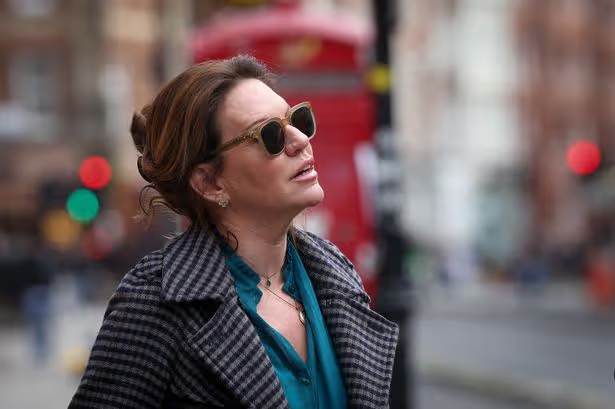
Emma Webber, the mother of Barnaby Webber arrives at Mary Ward House in Tavistock Place, London, ahead of day two of the Nottingham attacks inquiry.
(Image: Joseph Raynor/ Reach PLC)
Police have apologised for a string of “unacceptable failures” in their handling of triple killer Valdo Calocane, but insist they could not have prevented the attacks.
Nottinghamshire Police admitted they should have executed a warrant for Calocane’s arrest for assaulting a police officer in January 2022, which had been outstanding for 10 months before his murderous rampage on June 13, 2023.
The force also said it should have properly investigated his attempt to break into a woman’s flat in May 2020.
The public inquiry into the tragedies, which started in London this week, heard police did not believe it would have prevented the deadly attacks.
John Beggs KC, the barrister representing the force, said police should have executed the warrant for Calocane’s arrest “in a timely manner but failed to do so at all”, which had been described by the then Assistant Chief Constable Rob Griffin as “a serious systemic operational failure”. Rob Griffin is now the Temporary Deputy Chief Constable of Nottinghamshire Police.
But he said it was not realistic that Calocane would have been imprisoned for his assault.
Between May 2020 and August 2022, police interactions with Calocane totalled 10 or 11, he told the inquiry.
James, Lee and Darren Coates (L-R), son of Ian Coates who was killed by Valdo Calocane
Most of these were for anti-social behaviour or mental health sections, but two – a break-in at a neighbour’s flat and assault of a police officer – resulted in injuries to others.
“Even though the incidents were unpleasant and anti-social they did not reasonably herald that he would become a triple killer,” Mr Beggs said.
“PC Pritchard’s injuries were minor and sadly not unusual in the course of their ordinary duties.”
He added that the incidents were not unusual or remarkable for the police.
Earlier in the day, Tim Moloney KC, representing the families of those who had died, told the hearing that the police’s position that his arrest would not have made a difference was “cowardly, highly offensive and insulting to the intelligence of the families”.
The barrister said Calocane could have been sectioned again or given a community treatment order, where he would be closely monitored.
“The chances of those horrible killings would have been substantially reduced,” he said.
“They just left him out on the streets. He committed an offence while wanted on a warrant.”
University of Nottingham students Barnaby Webber and Grace O’Malley-Kumar, both 19, and grandad Ian Coates were stabbed to death by Calocane, who then ran over Wayne Birkett, Marcin Gawronski and Sharon Miller with Mr Coates’ van.
Mr Beggs told the inquiry it is not realistic that police could have prevented the killing of Ian or van attacks, with police not being able to know what mode of transport he was using.
He apologised on behalf of the force for communication failures following the attacks but denied it was trying to cover the matters up.
He also said the misconduct of officers and workers, including the unauthorised viewing of body-worn camera footage, were “unacceptable failures”.
The public inquiry into the tragedies heard from a long list of other organisations on the second day of hearings, including Nottinghamshire Healthcare Foundation Trust (NHFT), which provided Calocane with mental health treatment for paranoid schizophrenia before the stabbings.
This included the decision to discharge him to his GP in September 2022 when he began disengaging with services.
“The trust recognises in years preceding tragic events there were opportunities that could have been identified, seized and acted upon differently, and for this the trust is profoundly sorry,” its legal representative Jason Beer KC said.
Valdo Calocane’s mother Celeste and brother Elias arriving at the inquiry into the Nottingham attacks where they will be giving evidence (Image: Joseph Raynor )
Mr Beer said NHFT has undergone some “significant change” since the attacks but accepts more work is required.
“[The trust] does not consider the events entirely preventable but believes the changes it has implemented go to the heart of the very risks that contributed to Calocane’s case,” he said.
Earlier on Tuesday, the mother of Valdo Calocane told the inquiry of her “deep sorrow”.
In a pre-prepared statement read out to the hearing by her legal representative Adam Straw KC, Celeste Calocane offered her condolences to the victims and bereaved families of the Nottingham attacks.
She said how she had not been fully aware of the extent of her son’s paranoid schizophrenia due to his disengagement with health services, and would have been much more vigilant if she was.