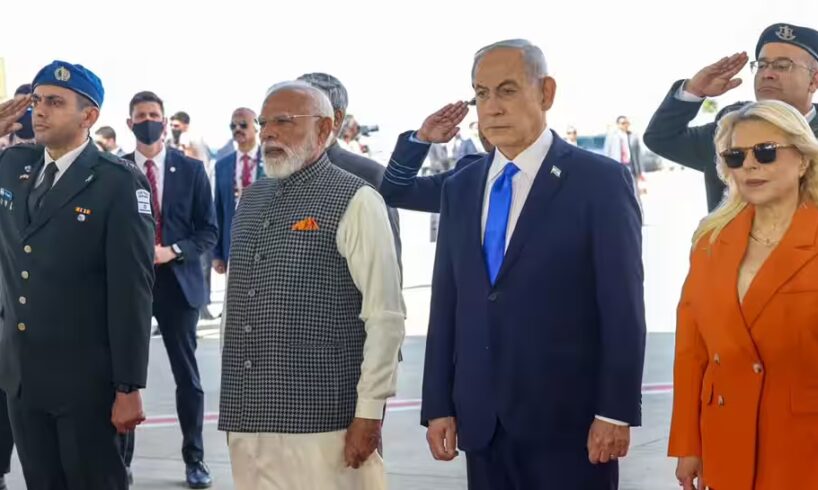
Prime Minister Narendra Modi’s visit to Israel amid looming US-Iran tension has not gone unnoticed in the Middle East and with New Delhi’s western neighbour, Pakistan. PM Modi, who reached Israel on Wednesday, said that he had an ‘excellent meeting’ with his Israeli counterpart Benjamin Netanyahu and discussed a wide range of subjects aimed at boosting bilateral ties. Prime Minister Modi is visiting Israel after 9 years.
“We discussed a wide range of subjects aimed at boosting bilateral ties. Sectors such as technology, water management, agriculture, talent partnership and more offer immense scope for close collaboration. We also discussed key developments in the region,” he said on X.
The visit’s timing coincides with the deadline of America’s warning to Iran over nuclear talks. Prime Minister Modi is the only Indian PM to visit Israel, first in 2017. While this is his second visit, the symbolism was unmistakable amid the red carpet welcome rolled out by Israeli counterpart Benjamin Netanyahu. Amid the geopolitical tension, PM Modi’s visit signals complete galvanisation of India’s strategic ties with Israel. And the signs are everywhere, for everyone to understand, right from Pakistan to Turkey and Saudi Arabia.
Add Zee News as a Preferred Source
Days before PM Modi’s arrival, Netanyahu invited India to be a part of the ‘hexagon of alliances’, a proposed regional framework placing India at its centre alongside Greece, Cyprus and unnamed Arab (likely UAE), African and Asian states.
This appears to be a clear plan to counter Islamic-NATO as envisioned by Pakistan in coordination with Turkey.
In an era where Turkey vocally criticises Israel and Pakistan has locked a Strategic Mutual Defence Agreement with Saudi Arabia, Tel Aviv is looking to create a counter-axis. According to analysts, India and Israel’s growing ties are a cause for concern in Islamabad, especially after the Operation Sindoor result.
Notably, during Operation Sindoor, Indian forces used multiple Israeli weapon systems, including Barak-8 medium-range surface-to-air missile system, HARPY (and similar) loitering munitions, SkyStriker loitering munitions and Heron reconnaissance UAVs. Israeli drones were used extensively by India, and the precision missiles aided Pakistan’s wounds. With a close defence deal with Russia, France and Israel, India has reshaped its strategic calculus, putting Pakistan in a volatile spot, feel defence experts.
India is not only Israel’s largest defence buyer but also a supplier of key weapons that Tel Aviv used against Hamas. The two nations are enhancing their ties in the field of defence, artificial intelligence, quantum computing, cybersecurity and agriculture. Israel is now opening exports of its previously restricted and secret military hardware to India under a new classified framework. The weapons include Israel’s Iron Beam, a 100kW-class high-energy laser weapon and the sharing of Iron Dome missile defence technology, which will make the Indian sky impenetrable for enemy missiles.
Pakistan, with nuclear weapons, radical leaders and a sponsor of terrorism pose a threat to the world, feel analysts. Its growing ties with Ankara and Riyadh have already raised alarms in Tel Aviv and now, neither India nor Israel is willing to take any chances. This could well see growing intel sharing between Mossad and RAW.
Analysts believe Modi’s Israel embrace at a time of heightened regional volatility sends a calibrated but unmistakable geopolitical message. By deepening defence, technology and intelligence cooperation with Israel, New Delhi is signalling that its West Asia policy is no longer confined to energy security or diaspora concerns, but is anchored in hard security and strategic alignment. For Pakistan, this may prove to be unsettling, but it’s what it is. This narrows Pakistan’s strategic space and reshapes regional power equations amid ongoing Middle East tensions.