Shafaq News
Iraq’s decision to deposit its maritime
boundary coordinates with the United Nations this February has pushed the
long-running Khor Abdullah dispute beyond a technical legal file and into a
broader test of regional alignment. Baghdad describes the issue as a sovereign
step grounded in international law, but coordinated concern from Gulf states
and rare diplomatic friction with Arab capitals traditionally has triggered and
viewed as political partners.
The dispute is about far more than a
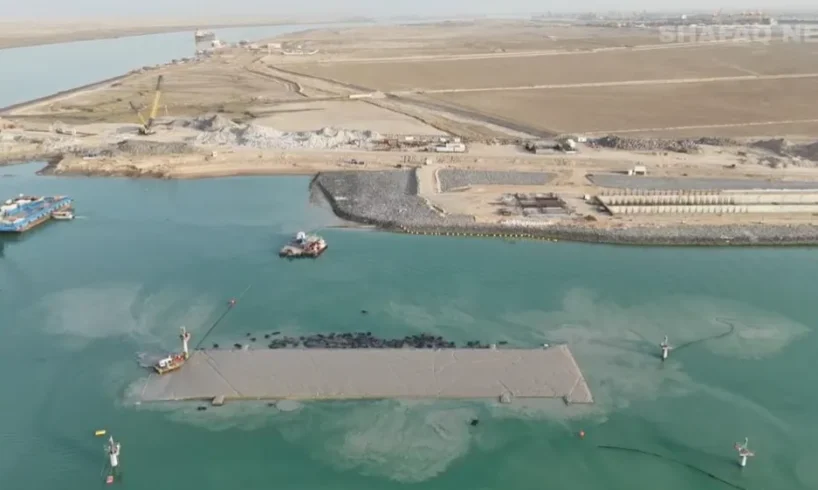
narrow channel of water. Khor Abdullah represents Iraq’s only maritime gateway
to the Gulf, connecting Umm Qasr, Khor al-Zubair, and the under-construction
Grand al-Faw Port to international shipping lanes. How that corridor is defined
and managed carries direct implications for Iraq’s trade flows, oil exports,
and long-term effort to position itself as a regional logistics center.
Those stakes grow sharper with the
development of the Grand al-Faw Port —a project valued at nearly $5 billion and
designed to handle up to 99 million tons of cargo annually. The port is central
to Baghdad’s vision of turning southern Iraq into a major transit and trade
hub, making secure and clearly defined maritime access not only a sovereignty
issue, but an economic necessity.
From Historical Demarcation To Legal
Repositioning
The roots of the dispute date back to UN
Security Council Resolution 833 in 1993, which demarcated land and maritime
borders between Iraq and Kuwait following the 1990 invasion. In 2012, the two
countries signed a navigation agreement to regulate traffic and security in the
shared channel. That agreement was later ratified in Iraq, but it remained
controversial domestically.
In September 2023, Iraq’s Federal Supreme
Court ruled the ratification law unconstitutional, reopening internal debate
over the agreement’s legal basis and strategic impact. Building on that ruling,
Baghdad deposited a detailed maritime domain map with the United Nations
earlier this month and prepared to submit the court’s decision annulling the demarcation
framework up to marker 162 —a move that implicitly calls for re-demarcation
under international law.
Gulf states responded by urging Iraq to
withdraw the submission and address the issue through diplomatic channels.
Kuwait has treated the filing as a destabilizing step, while Baghdad insists it
acted in full accordance with the 1982 UN Convention on the Law of the Sea.
Arab Capitals Align Cautiously
The dispute widened when Palestine,
Jordan, and Egypt expressed concern over Iraq’s UN submission, reaffirmed
support for Kuwait’s sovereignty, and urged both sides to resolve the matter
through dialogue consistent with international law.
Iraq’s Foreign Ministry reacted by
summoning the ambassadors of the three countries. During meetings with
Undersecretary for Bilateral Relations Ambassador Mohammed Hussein Bahr
Al-Uloom, Baghdad presented its position and described the statements as
overlooking Iraq’s legal perspective.
Bahr Al-Uloom stressed that the UN deposit
represents a sovereign right exercised transparently and in line with
international law, adding that Iraq remains committed to resolving the issue
through legal and diplomatic mechanisms that protect its national interests.
The exchange underscored a deeper
divergence: Baghdad frames the move as a lawful correction within international
conventions, while several Arab capitals appear to interpret it through the
prism of regional stability and prior commitments linked to post-1991
arrangements.
Competing Interpretations
In Baghdad, political analyst Ali al-Habib
described the Arab reactions —particularly from Jordan and Palestine— as
contradictory given Iraq’s economic ties and support. He argued that Iraq’s
maritime access is a matter of sovereign necessity and suggested that Baghdad
may need to reassess how it structures its regional relationships if political
backing does not align with economic cooperation.
From Amman, political analyst Hazem Ayad
said Jordan’s stance rests on international agreements and previous
Iraqi-Kuwaiti understandings, consistent with Arab League calls to avoid
unilateral steps. He also noted that the Khor Abdullah file remains internally
contested in Iraq, shaped by successive government decisions and judicial
rulings.
The Palestinian reaction carried its own
sensitivity. Writer and analyst Farhan Allaqam said Palestine cannot afford to
be drawn into disputes between Arab states, arguing that maintaining balanced
positioning would better serve Palestinian interests. “Any perception of bias
could risk damaging ties with Iraq, a longstanding supporter of the Palestinian
cause.”
A Domestic Dimension
The issue has also resonated inside Iraq
when dozens gathered along Al-Corniche Street in front of the Kuwaiti
consulate, praising the UN deposit and describing it as a step toward affirming
Iraq’s maritime rights. Participants said the gathering reflected public
backing for legal measures to “safeguard national sovereignty.”
Though limited in scale, the move signaled
that the maritime file carries symbolic and economic weight in southern Iraq,
where livelihoods depend directly on secure, predictable access to Gulf waters.
Domestic sentiment could narrow Baghdad’s room for compromise if negotiations
intensify.
Sovereignty, Bloc Discipline, And What
Comes Next
The unfolding dispute now operates on
three interconnected tracks. Legally, Iraq appears prepared to pursue its case
within international frameworks, using the Federal Supreme Court ruling and the
Law of the Sea as anchors. Diplomatically, Gulf pressure indicates a preference
for containment through dialogue rather than procedural escalation.
Politically, internal support may reinforce Baghdad’s determination to press
its claim.
This episode may mark a turning point in
Iraq’s regional posture. If Baghdad continues to advance its maritime claims
through international institutions despite coordinated Arab concern, it could
reflect a more interest-driven approach to regional relations —one in which
sovereign legal agency carries greater weight than bloc expectations.
For now, Iraq presents its move as a
lawful assertion rather than a confrontation. The trajectory of the dispute
will hinge on how Baghdad and its Arab counterparts manage the balance between
national rights and collective alignment in the months ahead.
Read more: Khor Abdullah: A waterway entangled in sovereignty disputes and legacy of invasion
Written and edited by Shafaq News staff.