Shafaq News
Iraq faces mounting security and judicial pressure as it
receives around 6,000 ISIS detainees transferred from Syria, a move officials
describe as one of the largest post-territorial defeat security operations
since 2017. Lawmakers and security analysts warn that the influx —which includes
hardened fighters and individuals accused of crimes against Yazidis— could
strain prison systems and reignite dormant extremist networks if not tightly
managed.
The Supreme Judicial Council said on February 16 that
initial interrogations had been completed for more than 500 detainees, part of
a broader process involving individuals of 61 nationalities now held in Iraqi
prisons. The transfers accelerated after shifts in northeastern Syria, where
the Syrian Democratic Forces (SDF) had long detained ISIS members and their
families.
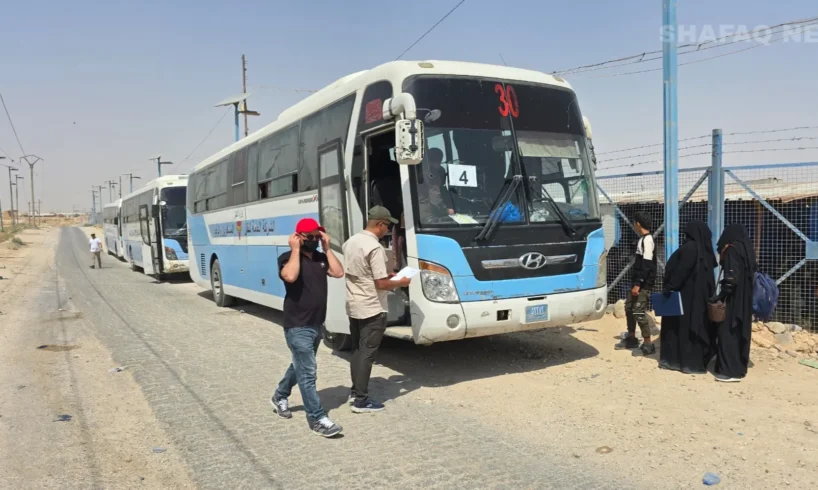
An employee of an international organization working in
Al-Hol camp in Syria’s Al-Hasakah province told Shafaq News that most of the
roughly 2,000 Iraqi families previously residing there fled following the SDF’s
withdrawal and the arrival of tribal fighters and Syrian government forces.
“Most entered Iraq through illegal crossings, while others settled in various
Syrian regions, since some Iraqi men married Syrian women and vice versa,” he
said, requesting anonymity due to the sensitivity of his work. He added that
Syrian authorities transferred dozens of Iraqi families who refused
repatriation from Al-Hol to Aq Burhan camp in rural Aleppo.
According to the same source, many foreign families also
left within the first two days after the SDF withdrawal, some heading toward
Idlib and Aleppo with assistance from Syrians who entered the camp, while
others reportedly crossed into Iraq and Lebanon via smuggling routes.
Legal Accountability And Yazidi Cases
The transfers have reopened painful wounds for communities
affected by ISIS atrocities, particularly the Yazidis of Sinjar.
Mahma Khalil, a Yazidi member of Iraq’s parliament, warned
that receiving ISIS members —especially what he described as a “third
generation” raised in extremist environments— represents a serious security
risk. He urged both material and moral compensation for Iraq and called for
firm judicial action “against these criminals, in respect for the families of
victims in the mass graves of Sinjar, Speicher, Bir Allo Antar, Al-Khasfa pit
and other sites.”
Last week, Sarab Elias, Director General of Yazidi Survivors
Affairs at the Ministry of Labor and Social Affairs, told Shafaq News that
three ISIS members recently transferred from Syrian prisons were implicated in
the 2014 enslavement of Yazidi women.
“Preliminary investigations involve more than 400 ISIS
members, and one of the victims allegedly enslaved by the three suspects is
currently in Germany,” Elias said, noting that specialized judicial and
security committees are overseeing the first batch of interrogations and that
legal procedures remain ongoing.
The cases underscore the dual challenge facing Iraqi
authorities: ensuring due process while delivering accountability for crimes
widely recognized as genocide.
Scale Of The Detention Challenge
Before recent evacuations, Al-Hol camp housed more than
24,000 people, including 15,000 Syrians, 3,500 Iraqis, and around 6,200 foreign
nationals. Following the fall of ISIS’s last territorial stronghold in
Al-Baghuz in March 2019, thousands of fighters, wives, and children fled to
SDF-administered areas.
In Iraq, ISIS seized nearly one-third of the country in June
2014, capturing major cities in Nineveh, Saladin, and Al-Anbar before Iraqi
forces, backed by the US-led Coalition, declared victory in late 2017. Despite
losing territorial control, the group has maintained sleeper cells capable of
launching intermittent attacks, particularly in rural areas stretching between
Diyala, Kirkuk, and Saladin, locally known as “the triangle of death.”
Security experts argue that the detainee transfers could
either strengthen Iraq’s intelligence capabilities —by centralizing
interrogations and extracting operational data— or create vulnerabilities if
detention facilities become targets.
Ahmed Al-Sharifi, a security analyst, described many of the
transferred detainees as ideologically hardened fighters, warning that social
reintegration would be “highly unrealistic.” The more immediate concern, he
said, lies in maintaining firm control inside prisons, especially amid regional
tensions involving the United States, Israel, and Iran that could affect armed
factions in Iraq.
Adnan Al-Kinani, another security expert, cautioned that
some detainees possess extensive experience in killing and torture, posing what
he called a “real test” for Iraqi security agencies. “Hosting such detainees
could invite both internal and external pressures, including attempts to secure
releases or facilitate prison breaks.”
Saif Raad, a security specialist, pointed out that Iraqi
prisons operate under reinforced protection plans and that ongoing
investigations may expose sleeper networks and foreign support channels,
potentially enhancing national security preparedness.
Read more: ISIS detainee transfers test Iraq’s post-Coalition security
International Responsibility And Regional Context
The presence of detainees from more than 60 countries has
intensified debate over international responsibility. Several states have
refused to repatriate their nationals who joined ISIS, citing security
concerns.
The United States and Britain have previously classified
their citizens affiliated with ISIS as national security threats. Former US
Secretary of State Mike Pompeo said Washington would not allow Hoda Muthana,
who traveled from Alabama to join ISIS in Syria, to return to the United States
after she was stripped of her citizenship.
By contrast, Turkiye has agreed to receive its nationals
held in Iraq, a move welcomed by Iraqi Foreign Minister Fuad Hussein during a
recent meeting with US envoy Tom Barrack.
If other countries continue to resist repatriation, Iraq may
face prolonged detention responsibilities that extend beyond its original
mandate, effectively becoming a holding ground for foreign fighters whose home
states decline to take them back.
Beyond The Battlefield
The transfers mark a transition from open battlefield confrontation
to long-term containment and institutional management, and preventing
ideological resurgence inside and beyond detention facilities. How Iraqi
authorities manage this phase —under regional volatility and international
pressure— carries significant implications for national stability and the
durability of the country’s post-Coalition security framework.
Written and edited by Shafaq News staff.