Charles has opened up about saving the historic cinema almost 114 years old
05:00, 28 Feb 2026Updated 13:31, 28 Feb 2026
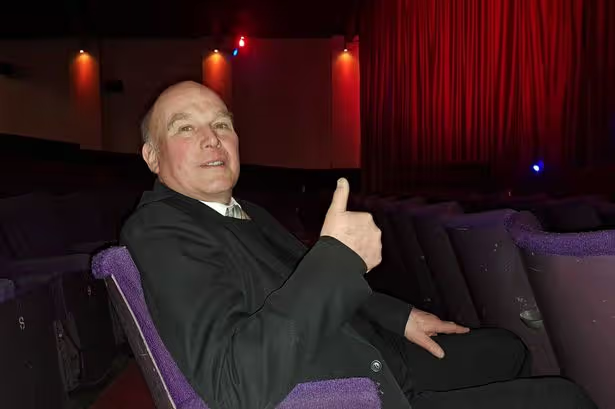
Charles Morris owns Leeds’ Cottage Road Cinema(Image: Samuel Port)
Taking over Leeds’ oldest cinema was a “traumatic experience with lots of surprises,” said the owner of five independent picture-houses, including four in Yorkshire.
Cottage Road Cinema, in Headingley, first opened as a cinema almost 114 years ago on July 29, 1912, narrowly beating out the Hyde Park Picture House, which opened a couple years later in 1914. It has been exhibiting films ever since.
It was Charles Morris’ dream from the age of seven to one day own his very own cinema. One of his most cherished early memories was watching Disney’s animated feature The Lady and the Tramp in 1955. Over the years, he says he “accidentally” acquired five cinemas through a mix of chance, contacts, and good fortune.
Charles, who is a stepdad to one, and step-grandad to two, is originally from Hoylake, in the Wirral. He worked for many years as an electrical engineer before acquiring The Rex cinema in Elland, Calderdale, in 1988.
His late wife Judy said she didn’t mind him purchasing cinemas, as long as they got to live in a country house in the Lake District. One of Charles’ finest experiences as a cinema-owner was giving himself a private-screening of Quentin Tarantino’s Pulp Fiction when it released in 1994. He became so swept up in the movie, he was “oblivious” to all the rude language throughout its 2.5-hour run.
Leeds’ Cottage Road Cinema dates back to 1912(Image: Samuel Port)
As the years progressed, he also took over The Royalty Cinema in Bowness-on-Windermere, in the Lake District, in 1992, which he no longer owns, The Picture House in Keighley in 1996, The Plaza in Skipton, and The Roxy in Ulverston.
In 2005, Cottage Road Cinema was under threat of closure and Charles managed to save the venue in a “last minute” deal on July 29. This was exactly 93 years after the day it first opened in 1912.
Almost 114 years ago, the building was converted into ‘Headingley Picture House’ on July 29, after seven years of operating as a garage, according to local historian Eveleigh Bradford.
It was opened by pioneering newsreel cameraman Owen “Willie” Brooks and engineer George Reginald Smith. Brooks, in his 40s at the time, had links with Louis Le Prince, an early inventor of the motion-picture camera and man behind Roundhay Garden Scene in 1888 which is believed to be the oldest surviving film. The Leeds man had made his first film on Boar Lane in 1910 from the top of a horse tram, after developing his own camera.
Cottage Road is a 450 seat stadium style venue(Image: Samuel Port)
New owners Associated Tower Cinemas rebranded the cinema after taking it over in 1938, paying £12,999. It was renamed Cottage Road Cinema and was modernised after the Second World War, preserving the original lobby and covering the exposed steel roof.
The same owners ran the cinema until 2005 when it was facing closure due to financial losses. A friend of Charles approached him about saving it. He partly took it over as he “couldn’t bear to see another independent cinema close,” after seeing the Lounge Cinema in Headingley, which originally opened in 1916, close down that same year.
Charles said: “We came to a deal with the owner which was so last minute, that the early editions of the newspapers had it that the cinema was closing that day, and the later editions said it had been saved.”
Historic panelling adorns the cinema’s lobby(Image: Samuel Port)
Despite the community’s great relief and the pomp and ceremony of the press, Charles said taking it over became a “traumatic experience.” Redundancy letters had already been sent to staff months before Charles’ takeover, and the venues manager had already gone about planning a full career change.
There was real difficulty in replacing him with someone competent, which meant Charles was constantly having to travel over two hours from the Lake District and man the venue.
Charles: “When we took it on, a lot of things surprised us. It was slightly a traumatic experience to begin with. The staff had been expecting the cinema to close and had been issued with redundancy notices which were withdrawn when we took over. The manager had already made plans somewhere else.
“We had some difficulty staffing the place in the first few months. It involved me having to stay over there for certain nights to man the place, from Cumbria, through Skipton, over the Moors, in the fog.”
Charles Morris saved the cinema from closure in 2005(Image: Samuel Port)
He said the cinema had been modified over the years. Sometime in the 1970s, it was converted into a 450-seat “stadium cinema” where the seating is stepped all the way down from the back, after initially having a separate balcony and stalls. He said the venue, like many old venues, was “lavatorily challenged” with him having to make some changes to add more. There is also a metal spiral staircase leading upto the projector, which Charles says is “unusal” as it makes carrying up film stock a more difficult task.
The current challenges range from the repairs and running costs, particularly with heating up the massive venue, which is, on average, about double the size of most picture-houses. Audiences and the supply of films has also decreased since the impact of Covid-19 pandemic, Hollywood strikes, and the growth in streaming platforms.
A letter written from the cinema’s orginal owners Owen “Willie” Brooks and George Reginald Smith(Image: Samuel Port)
He said the initial staffing issues were sorted eventually and hailed his “excellent” current nine members of staff at the venue who are “exceedingly capable”. He relies on their “expert knowledge” of the cinema’s current digital projectors.
Charles currently has plans to replace some of the antiquated seating, those at the front with built-in ashtrays, in the coming months. This comes after lots of behind the scenes work to keep the cinema operating and in good condition for the public.
Charles wants filmgoers to have a paramount experience at his venues, and his staff members even gather in the old lobby hall to bid farewell to the audience as they are leaving
Charles said: “We do go for the personal touch. I think it’s what cinema should be about. We like the films and the public who come to see us and getting their points of view. We like to make the whole evening into an experience.”
Get all the latest What’s On news straight to your inbox by signing up to our newsletter here.
Did you know you can make Yorkshire Live a preferred source of Yorkshire news in Google, which will mean you get more of our breaking news, exclusives, and must-read stories straight away? Here’s more information about what this means and how to do it – you can also do it straight away by clicking here