

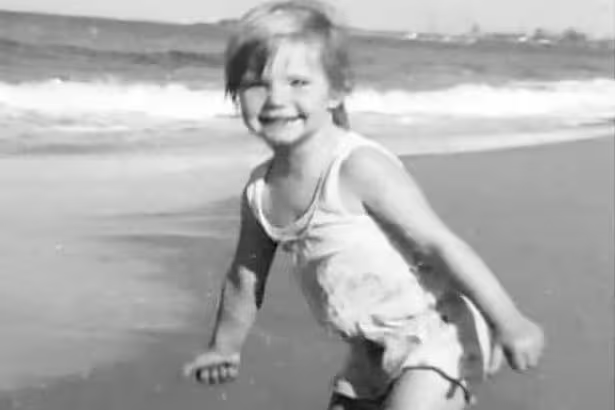
Cheryl Grimmer disappeared from an Australian beach in 1970 after her family emigrated from Bristol. A suspect confessed to strangling the three-year-old but legal technicalities have prevented prosecution.
Cheryl had playfully refused to do what her brother told her (Image: PA)
On a balmy January day in 1970, Carole Grimmer took her four young children to Fairy Meadow Beach in Wollongong, a coastal city situated just over an hour’s drive south of Sydney. Carole, who had moved to Australia from Knowle, near Bristol, two years previously, had entrusted her eldest child, Ricki, with supervising his siblings.
As the family excursion came to an end, Ricki – who was seven years old at the time – escorted his brothers Stephen and Paul, alongside their younger sister Cheryl, to wash off sand at the beach’s shower facilities. Whilst Ricki, Stephen and Paul swiftly completed their task and headed back to their mother, three year old Cheryl playfully refused to leave the shower block. Devastatingly, she was never seen again.
Despite a 17-year-old suspect subsequently admitting to killing Cheryl, nobody has ever faced trial for her murder. The suspect, who has never been publicly identified and is described in court records as “Mercury,” informed police: “Some of the children started to walk away and this little girl hung back. I came around from the back of the shower block and grabbed the little girl. I guess I must have strangled her,” he stated, continuing, “I did that to the little girl; I didn’t mean to do it.”
In his written statement, “Mercury” noted: “I tied a handkerchief and a shoelace around her mouth to stop her screaming and with the other shoelace I tied up her hands. There was some bloke sitting on the wall in front of the pavilion,” he said, “so I had to put my hand over her mouth to stop her screaming. Because if she had of screamed [sic], he would have heard it.”
Three-year-old Cheryl Grimmer, originally from Bristol, vanished from a shower block in Wollongong, New South Wales, on 12 January 1970(Image: Daily Mirror)
He claimed he had wished to take Cheryl’s towel and distinctive royal blue swimming costume home as trophies, but explained: “I decided not to because I thought my mother might find them, so I burnt them in an incinerator on a beach.”
Within hours of Cheryl’s disappearance, approximately 1,000 individuals had assembled to search the vicinity surrounding the beach for a missing child described as “height 3 feet 9 inches, small build, blonde short hair cut square around the back of the head, full fringe in front, fair complexion and blue eyes.”
The Grimmer family had been enjoying a day at the beach(Image: PA)
Within days, officers announced that two witnesses had come forward. They alleged to have spotted a “swarthy, small man” wearing a floppy hat carrying a small girl under his arm. At around the same time, a ransom note was sent to police demanding 10,000 Australian dollars for Cheryl’s return.
The note, which specialists suggested had likely been written by a teenager, was dismissed as a hoax. After months elapsed with no additional evidence surfacing, the large-scale police operation was reduced.
Fifteen months after Cheryl’s disappearance, “Mercury” came forward to confess that he had killed her. Officers noted that he had previously made a false confession to an unrelated murder, had a history of absconding from detention centres, and was known to have drug problems. Prosecutors chose not to charge him, leaving Cheryl’s disappearance a mystery.
Cheryl Grimmer with her dad(Image: SWNS)
Cheryl’s body was never recovered, and it wasn’t until 2011 that an inquest took place. The coroner officially declared that Cheryl had died shortly after she vanished, recording an open verdict on the “manner and cause” of death, and suggested that police reopen the case.
At the inquest, Carole Grimmer expressed her belief that her daughter was still alive. The confession was barely touched upon. “She was old and frail at the time and quite ill,” Ricki informed CNN. “I don’t think it totally computed with her, because it was rushed over so fast.”
New South Wales Police Detective Sergeant Damian Loone and Senior Constable Frank Sanvitale were assigned to re-evaluate the evidence. Upon reviewing the confession, DS Loone stated: “It was explosive… I was at a loss as to why he hadn’t been charged.”
Original investigators had thought they could align “Mercury’s” account of the crime scene with the area around Fairy Meadow Beach, but later scrutiny revealed that this assessment had been incorrect. As a result, in March 2017, “Mercury,” then aged 63, was arrested and extradited to New South Wales to face a charge of murdering Cheryl.
Cheryl’s parents went to their graves not knowing about the confession(Image: Daily Mirror)
However, legal technicalities hindered his prosecution. Justice Robert Hulme ruled that “Mercury’s” initial confession was inadmissible because, being 17 at the time, he should have been accompanied by a responsible adult.
His identity could not be disclosed, but in October last year, Jeremy Buckingham, a member of the New South Wales Legislative Council, utilised parliamentary privilege to expose the suspect’s actual name and details of his confession.
In February, Mr Buckingham returned to parliament to disclose the most recent alias under which “Mercury” had been living. In a personal message to the suspect, he stated: “You are a coward, a slug and a murderer and you should do the right thing now explain that confession you made in 1971 and admit to your egregious crime,” adding, “You have not gotten away with anything.”