Brazilian exports to the United States fell 23.2% in the first two months of this year compared with the same period last year, according to data from the Brazil–U.S. Trade Monitor prepared by the American Chamber of Commerce in Brazil (Amcham Brasil).
According to the survey, exports to the U.S. totaled $4.9 billion between January and February 2026, representing $812 million less in sales by Brazilian companies to the North American market.
Amcham Brasil notes that this is the lowest value for the first two months of the year since 2023. According to the organization’s analysis, the result reflects a combination of short-term market factors and the impact of tariff measures that continued to affect a significant portion of Brazil’s export basket until the end of February.
Looking only at February, Brazilian exports to the U.S. totaled $2.5 billion, a 20.3% decline compared with the same month last year. The organization also points out that Brazilian exports to the U.S. market have now recorded seven consecutive months of decline. The downturn began in August 2025, when the United States imposed import surcharges between 40% and 50% on a broad range of products.
Bilateral trade still under tension
According to Amcham Brasil, although the drop in February was less severe than in previous months, the performance indicates that the year has started with continued pressure on bilateral trade.
“It is important to note that the tariff changes announced at the end of February—after a decision by the Supreme Court of the United States that ended the 40% and 50% surcharges and replaced them with a new global surcharge of 10%—are not yet fully reflected in bilateral statistics,” the organization said.
Because the new measures came into effect only at the end of the month, their impact should start appearing in trade flows from March onward.
Oil and coffee weigh on exports
Amcham says the decline in exports in February was mainly influenced by the sharp drop in crude oil sales, which fell 80.7% compared with the same month last year, as well as refined petroleum products, which declined 42%.
Both products are exempt from the new surcharges but represent an important share of Brazil’s exports to the U.S. Coffee—which has also been exempt from surcharges since November—showed a significant decline of 40% year-on-year.
Meanwhile, products that were subject to 40% and 50% surcharges until the end of February recorded a 27.4% drop during the month. Products affected by tariffs under Section 232, such as wood products, saw even steeper declines.
Abraão Neto, president of Amcham Brasil, underscored that February’s data still do not capture the effects of the tariff reduction following the U.S. Supreme Court decision. “It will be important to monitor in the coming months to what extent this change will help improve the performance of Brazilian exports and the flow of bilateral trade,” he said.
“At the same time, it is essential that the governments of both countries move forward with understandings to avoid new trade restrictions, especially in the context of the Section 301 investigation,” he added.
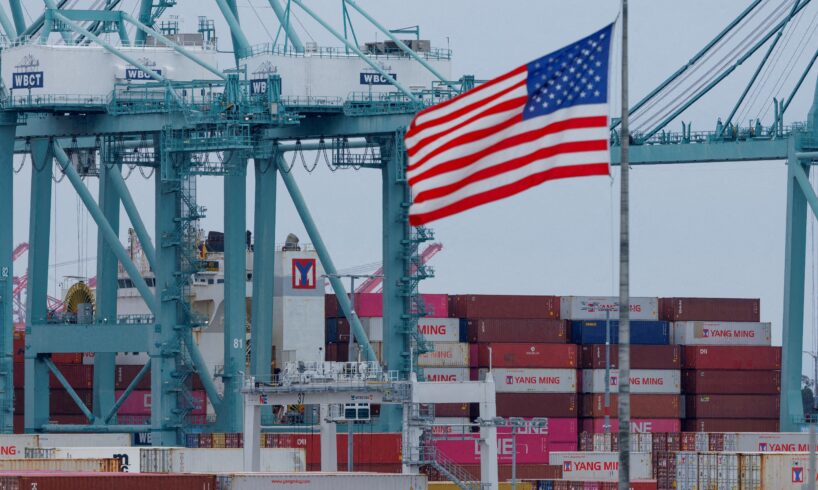
1 de 1 Cargo at the Port of Los Angeles: Decline was led mainly by oil and coffee sales — Foto: Mike Blake/Reuters Cargo at the Port of Los Angeles: Decline was led mainly by oil and coffee sales — Foto: Mike Blake/Reuters
This article was translated from Valor Econômico using an artificial intelligence tool under the supervision of the Valor International editorial team to ensure accuracy, clarity, and adherence to our editorial standards. Read our Editorial Principles.
Mais recente
Próxima
Brazil weighing scenarios as oil volatility rises, Haddad says