Flying vehicles gliding between towering glass-and-steel facades. The elite living a life of luxury atop massive skyscrapers. Below, workers toil around the clock to fuel the wealth of the powerful. There, they maintain the machines that run Metropolis — the futuristic city imagined in Fritz Lang’s visionary 1927 film, co-created with screenwriter and novelist Thea von Harbou, his wife.
The story unfolds in 2026, our present day. It features one of the first robots to ever be depicted in film. The human-machine was the embodiment of artificial intelligence. Many of the fears that surround AI today can be felt already in the characterization — nearly a full century ago.
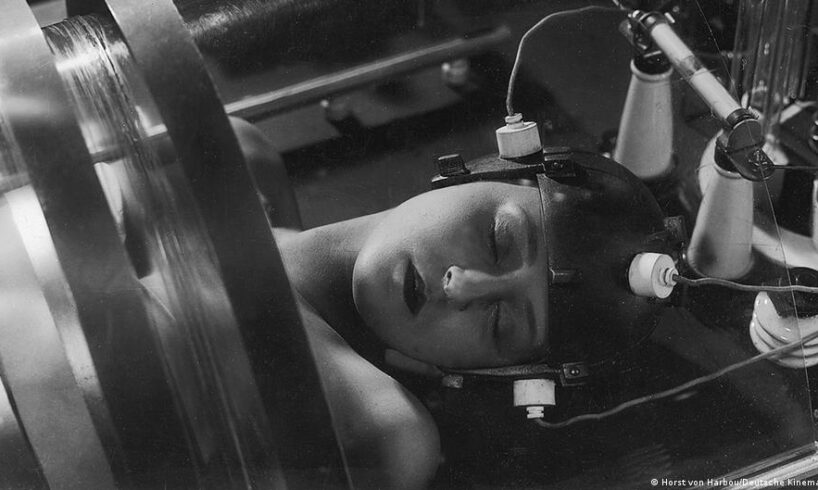
Fritz Lang envisioned Metropolis as a monolith of glass and steelImage: Horst von Harbou/Deutsche Kinemathek
The threat of AI
Maria, a human from the city’s working classes, tries to warn people about their rulers. In retaliation, Metropolis’s leader instructs a scientist to transfer her likeness to a robot — with sinister intentions. As Maria’s double, the machine manipulates the workers and exploits them even further. The plan succeeds because the workers cannot tell the difference between human and android.
When Fritz Lang envisioned the dystopian world of labor in 2026, he imagined humans left in the service of machines. Today, news reports appear almost daily with predictions of which jobs AI will replace, and how it might impact unemployment. On the social media platform X, U.S. entrepreneur Matt Shumer recently warned followers that office jobs could be face mass layoffs within a year or two.
Androids on the big screen
Lang’s “Menschmaschine” — German for “human machine” — is evil. The dark side of technology has long since been a cinematic staple. Lang’s robot inspired countless sci-fi stories where humans fall victim to their own creations. In James Cameron’s “Terminator” films, robots travel back in time to ensure their future victory over humanity. The steel skeletons had grown to see their flesh-and-bone creators as a threat.
Arnold Schwarzenegger in ‘Terminator 3: Rise of the Machines’Image: Columbia/dpa/picture alliance
Ridley Scott’s “Blade Runner” sent its replicants out on dangerous missions to colonize space. Earth had grown inhospitable — polluted and overpopulated, with constant rain. Replicants are forced to make other planets livable for humans. They are given lifespans of just four years, so developing emotions makes them a threat. Some, however, resist and turn against humans.
Both terminators and replicants appear human on the surface — just like the robot version of Maria in “Metropolis.” Occasionally, robots are depicted as helpers. C-3PO in George Lucas’s “Star Wars” offers a friendlier contrast — an android designed to assist. Similarly, proponents of AI today imagine machines supporting families as caregivers, nannies or household assistants. Critics raise warnings of murderous robots and compare the rise of AI to the invention of the atomic bomb.
Fritz Lang’s ‘Metropolis’: Milestone in science fiction film
To view this video please enable JavaScript, and consider upgrading to a web browser that supports HTML5 video
Progress or pitfall?
The city of Metropolis may not be destroyed by a nuclear war, but massive floods kill many: The artificial Maria incites the workers to destroy their city. Like Cameron and Scott later, Lang presented his robot as a hazard. While we’ve yet to see an android that appears flawlessly human, many of the other innovations Lang imagined — monorails and video phones — are now common parts of our lives.
The latter is basically a staple of modern living. Smartphones let us see and hear whoever we’re talking to. People working for the same company can meet in daily video conferences as if they were sitting side by side — even if they’re spread around the world. Turning off that camera can be met with suspicion. So can logging on in pajamas — and could those dark circles suggest that a colleague was out late? Lang’s vision blurred the line between progress and its perils.
But no one can deny that “Metropolis” had futuristic ideas back then, which are still relevant today. The future is now.
This article was originally written in German.