Shafaq News- Beirut
Seconds before the missile struck, the street
was quiet. Families inside their homes were preparing for the pre-dawn Ramadan
meal. Within moments, that calm collapsed into a chain of explosions as Israeli
airstrikes hit residential buildings across several streets in Beirut’s
southern suburb, the “Dahyeh.” The blasts echoed across the Lebanese capital, signaling
to residents that a new war had begun.
Within hours, tens of thousands of residents
began leaving the area in what many described as the largest mass displacement
the suburb has witnessed. By dawn, waves of bombardment intensified as people
stood watching their streets and homes from a distance, some hoping they would
return intact, others fearing the next Israeli warning to evacuate might target
their building.
Women gripped their children’s hands as they
fled. Men lifted their eyes to the sky as if trying to predict where the next
strike would land. Doors were left half open, lights still on, and kettles
perhaps still boiling on stoves as entire neighborhoods emptied in haste.
Exodus through Beirut
On roads leading from the suburb to other parts
of Beirut, the scene resembled an internal migration. Cars were packed with
hastily gathered belongings, blankets, milk containers, documents, and
sometimes a pet cage or a child’s toy. Some families headed to schools and
temporary shelters, others to relatives’ homes, while many spent the night in
their vehicles or on sidewalks.
Hassan, a doctor who ran a small clinic in the
suburb for years, said he barely had time to think when the bombardment
approached his home.
Speaking to Shafaq News while sitting with his
family on the floor of a school in northern Lebanon, where they are temporarily
staying, he said, “I took my wife, my children, and some basic belongings and
left the house. Until now, I don’t know how long this situation will last.”
The memory of that night remains vivid. Hassan
has tried to continue helping people despite losing his clinic. “I don’t have
the clinic or equipment like before, but I try to help people with medical
advice, especially those with diabetes, high blood pressure, or chronic
diseases,” he said, adding, “The hardest part is the children. Many of them
don’t understand what’s happening, but they see the fear in adults’ eyes.”
In another shelter, a school turned into a
temporary refuge, Dalal sat with her family in a classroom that had lost
everything that once made it a classroom, except the walls. “The sounds were
very loud, and the danger was great. We couldn’t stay in the house anymore. We
grabbed a few things and left quickly,” she noted.
When asked about the hardest part of
displacement, Dalal did not mention the cold or overcrowding. “A home means a
lot. When you leave it, you feel like a part of you is lost,” she clarified,
though she still holds hope of returning. “We are a people used to standing up
again. The important thing is that children feel there is hope and that this
period will pass.”
A Suburb Built from Displacement Waves!
Behind such stories lies a broader history. In
neighborhoods like Haret Hreik, Laylaki, Burj al-Barajneh, Bir Al-Abed, Chiyah,
and Mreijeh, the airstrikes have not only destroyed buildings but also decades
of accumulated lives.
The area, once known as the “suburb of the
deprived,” grew not merely from Beirut’s urban expansion but from waves of
internal migration driven by poverty and war. Families from southern Lebanon
and the Beqaa Valley moved there over the decades, seeking a place close to the
capital.
Layer by layer, neighborhood by neighborhood,
the suburb grew into a dense urban community, crowded and often struggling, yet
full of daily life: schools, bakeries, small shops, workshops, and the voices
of neighbors. It is today one of the most densely populated areas in Lebanon.
They Want It Like Dresden
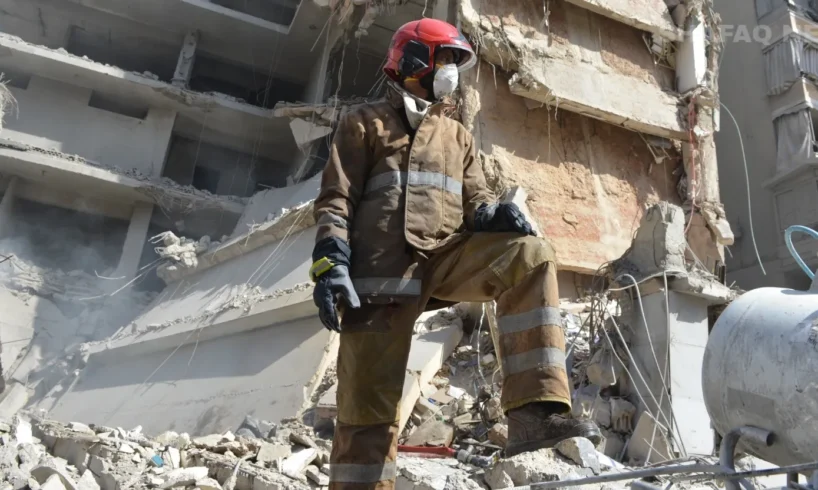
Shafaq News reporter documented the aftermath in
several bombed neighborhoods. Entire buildings had disappeared. Facades had
collapsed into the open air. Apartments spilled their contents —furniture,
family photos, clothes, school notebooks— into the streets.
In the smallest details lie the weight of the
tragedy: a child’s chair among the rubble, a refrigerator still standing
without a wall behind it, a family portrait covered with fine gray dust. These
were not just signs of explosions but remnants of lives that expected at least
one more ordinary day.
Standing near her home on the outskirts of the
suburb, which had not yet been hit, Maha tried to comprehend the destruction.
She compared the devastation to Dresden, the German city famously destroyed
during World War II. “They want it like Dresden,” she stressed, referring to
the scale of destruction. Though she does not belong to Hezbollah’s political
camp, Maha said what she witnessed went beyond military targeting. “This feels
like punishment and collective destruction,” she said.
Elsewhere in a shelter, another displaced man
described the psychological toll: “The problem is not only the cramped space or
the cold. It’s the feeling that you’re suspended between two possibilities —either
your house survives, and you feel guilty for leaving it, or it collapses, and
you feel part of yourself is buried under it.”
A Familiar Road of Displacement
Lebanon’s Ministry of Social Affairs says around
800,000 people have been registered as displaced from Beirut’s southern suburbs
(Dahyeh), southern Lebanon, and the Beqaa Valley —areas that have faced
near-daily Israeli strikes. However, many believe the actual number is higher,
as numerous families have not registered in official displacement records.
Amid what many displaced residents describe as a
slow official response, individuals and community groups have stepped in.
Volunteers distribute food, families host strangers in their homes, and shops
allow delayed payments. Some political parties in their areas of influence have
also organized shelter and assistance.
For the majority of people who were in the
suburb, displacement is not a new experience. Many are children or
grandchildren of those who fled wars in 1978 and 1982 or during the long years
of Israeli occupation in southern Lebanon. Palestinian refugees in nearby camps
carry an even older memory of exile dating back to 1948. In recent years,
Syrians have joined this long chain of displacement.
As a result, what is happening now feels less
like a new departure and more like the painful return of an experience that
never truly left.
Near Beirut’s biggest park, some families spend
long hours in their cars so they can remain close enough to return quickly if
the bombardment subsides. Some sneak back briefly to shower, collect medicine,
or simply check the door of their apartment. They have not completely left the
suburb; they remain on its edge, as if fearing that going too far would mean
admitting a permanent loss.
In one corner of a classroom shelter sat a newly
married couple who had wed only a month earlier. They once thought choosing
curtains would be the hardest part of their new life. “The one who built his
house with his own hands won’t let it be destroyed by bombing,” the husband
said. “We will return and rebuild.” His wife added firmly, “Leaving is not
defeat, it’s a position.”
When the war ends, the rubble will require more
than heavy machinery and engineers to clear it. It will demand something slower
and more difficult, the ability of people to imagine that these houses can once
again be homes rather than targets, and that what has fallen can be rebuilt
without remaining suspended in anticipation of the next war.
Written and edited by Shafaq News staff.