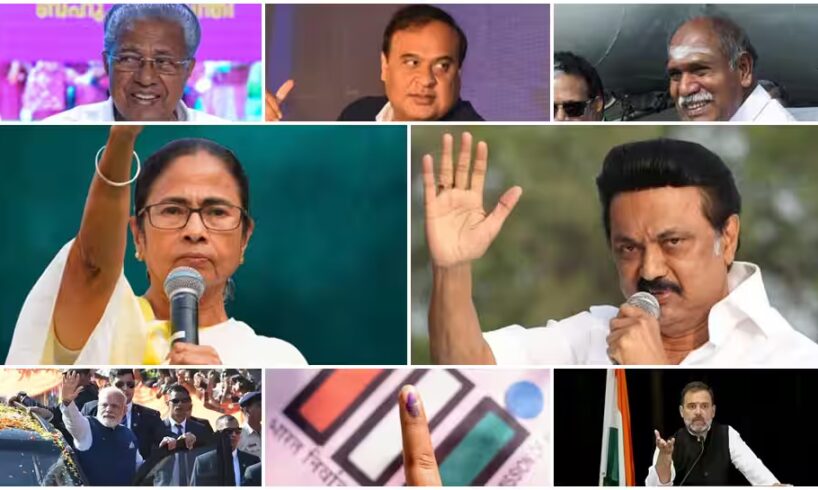
The Election Commission of India has set the poll bell ringing in the four states and one Union Territory. The dates are out and the political corridors are buzzing with the probabilities and strategy for the elections. The 2026 assembly elections will mark a high-stakes contest between heavyweight regional leaders and the influence of national parties like the BJP and Congress. While the BJP and the Congress will try to further consolidate their positions and gain new grounds, the regional satraps will look to retain their stronghold.
The Election Commission of India recently announced the schedule for Assembly elections in four states and one Union Territory, setting the stage for a politically significant electoral cycle. Assam, Kerala, and Puducherry will vote in a single phase on April 9. Tamil Nadu will go to the polls for all 234 seats on April 23, while West Bengal will hold voting in two phases — April 23 for 152 seats and April 29 for the remaining 142 seats. The results for all elections will be declared on May 4.
Bengal: Mamata Banerjee’s toughest test
Add Zee News as a Preferred Source
In West Bengal, the BJP and the Congress are once again up against Chief Minister Mamata Banerjee’s formidable might. As head of the All India Trinamool Congress, she has consistently defeated national rivals since ending the 34-year rule of the Communist Party of India (Marxist)-led Left Front in 2011.
Her political dominance continued in the 2021 Assembly elections, when the Trinamool Congress won 217 of the 294 seats despite a high-profile challenge from the Bharatiya Janata Party, which secured 77 seats. The Left and the Indian National Congress failed to win a single seat. In the 2024 Lok Sabha polls, Mamata Banerjee-led TMC also dominated the state, winning 29 of the 42 parliamentary seats while the BJP’s tally went down compared to 2019.
However, the 2026 contest may be more challenging. The BJP hopes to capitalise on anti-incumbency against the Trinamool Congress, which has governed the state for over 14 years. Given the violence-marred local elections and attacks against opposition leaders, rival parties have raised issues like law and order, women’s safety, and allegations of illegal cross-border migration. Incidents like the rape of a medical student at RG Kar Medical College and Hospital in 2024 have also become political flashpoints.
Bengal has been a fertile ground for ideological and identity-based politics and movements historically. Movements that emerged during the late colonial period and the communal tensions linked to the Partition of Bengal and later the Partition of India continue to shape political discourse.
Tamil Nadu: Dravidian fortress under Stalin
In the south, Chief Minister M. K. Stalin of the Dravida Munnetra Kazhagam represents another powerful regional force. Since taking over the party after the death of his father M. Karunanidhi in 2018, Stalin has consolidated the DMK’s dominance.
The party swept the 2019 parliamentary elections in the state and repeated the feat in 2024, winning all 39 Lok Sabha seats from Tamil Nadu. In the 2021 Assembly elections, the DMK alliance secured 159 of the 234 seats.
The coalition backing Stalin includes the Congress, the Communist Party of India, Communist Party of India (Marxist), the Indian Union Muslim League, and the Viduthalai Chiruthaigal Katchi. Together, they draw support from Dalits, minorities, working classes, and large segments of Other Backward Classes.
The opposition landscape, however, remains dynamic. The All India Anna Dravida Munnetra Kazhagam, led by Edappadi K. Palaniswami, continues to position itself as the principal challenger. Meanwhile, Union Home Minister Amit Shah has asserted that the BJP-led National Democratic Alliance aims to form the government in the state.
Yet Tamil Nadu remains widely viewed as a “Dravidian fortress”, where regional identity politics has historically overshadowed national party narratives.
Assam: National alliance advantage
The dynamics in Assam differ significantly. Here, the BJP-led alliance has established a strong foothold. The ruling coalition, comprising the BJP, Asom Gana Parishad, and United People’s Party Liberal, returned to power in the 2021 Assembly elections with 75 seats.
The alliance also performed strongly in the 2024 parliamentary polls, winning 11 of the state’s 14 seats. Analysts believe that regional parties outside the ruling coalition may struggle to gain traction unless opposition forces unite. The Congress is here not only up against the BJP but also regional NDA allies like the AGP and UPPL.
Kerala: Ideological battleground
In Kerala, Chief Minister Pinarayi Vijayan of the Communist Party of India (Marxist) faces perhaps his most difficult electoral test.
Vijayan leads the Left Democratic Front, which achieved a historic consecutive victory in 2021 — a rare feat in a state known for alternating governments. But the political landscape has shifted since then.
The BJP has emerged as a growing electoral force in the state, securing around 16 percent of the vote in the 2024 general election and winning its first Lok Sabha seat. Meanwhile, the United Democratic Front, led by the Congress, has made gains in recent local body elections.
The only bastion where the Left has survived and is in power is Kerala. The Left, despite being a national party, has been reduced to a regional force when it comes to its presence in power. In Jharkhand, it’s a junior alliance in the government led by the JMM.
Puducherry: Small territory, big stakes
The Puducherry election, though smaller in scale, also reflects the broader national-regional contest.
The BJP-backed All India NR Congress, led by Chief Minister N. Rangasamy, heads the National Democratic Alliance government in the 30-member Assembly. The main challenge comes from the DMK-Congress alliance.
For the BJP, Puducherry represents a strategic foothold in the Tamil-speaking political landscape, potentially helping it expand its influence into neighbouring Tamil Nadu.
A larger political message
Together, these elections underline a fundamental reality of Indian politics: while national parties dominate the parliamentary stage, state politics is often shaped by powerful regional leaders with deep social and cultural roots.
Whether it is Mamata Banerjee in Bengal, M. K. Stalin in Tamil Nadu, or Pinarayi Vijayan in Kerala, these leaders represent political traditions that have developed independently of national power centres. The 2026 elections will therefore not only decide who governs these states, but also test whether regional strongholds can continue to resist the expanding reach of national parties.