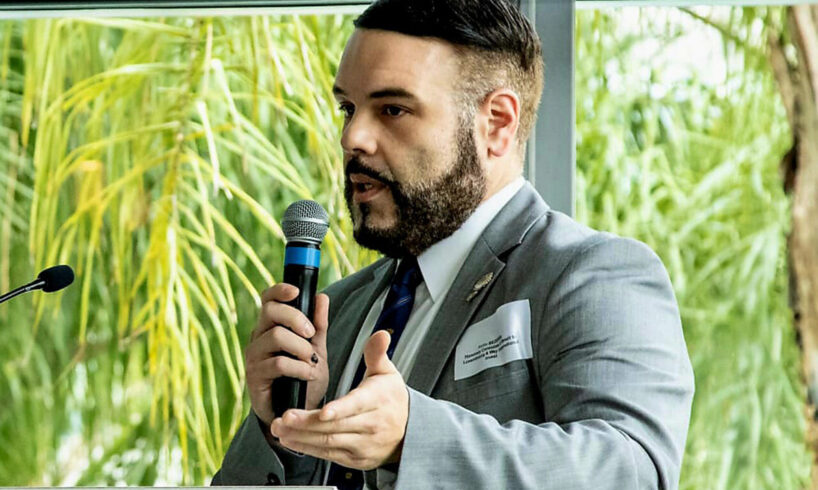
In recent years, many Brazilian nationals became eligible for Luxembourg citizenship through ancestry. Can you explain how that dynamic developed?
André Bezerril. —“That’s what really put Brazil on Luxembourg’s map. When I arrived in 1991, the community was small—mostly people here for banking or engineering—and some for family or social reasons. It grew as Luxembourg’s economy developed. The real boom came with the ‘ancestry discovery’. A legislative change in 2009, for a period through 2018, facilitated the recovery of nationality. It is not a naturalisation, it is a recovery of nationality.
If you look only at Brazilian citizens registered in Luxembourg communes with Brazilian passports, you are probably limited to around 2,000 to 2,500 people. But that mainly reflects the expat community. It does not include what is possibly the vast majority of Brazilians who stayed and either became Luxembourgish or have ancestry from another European country, or people who married a European citizen and received European nationality. So to give a figure is very difficult, but I would venture a guess of between 4,000 and 6,000 people, possibly more.
Interest in recovering Luxembourg nationality picked up in 2015–2016 and boomed in 2017–2018 as people realised the window was closing. While the 2018 deadline closed a key pathway used by many applicants (Article 89), nationality by descent remains possible today, although under more restrictive conditions (Article 7 and/or 23). The largest concentration of Brazilian-Luxembourg descendants comes from the southern states of Brazil: Santa Catarina, Paraná and Rio Grande do Sul, and also Espírito Santo.
So far, participation has been very limited but the next elections will most likely have more impact.
For dual citizens residing abroad, how does participation in Luxembourg’s elections work?
“Luxembourg allows remote voting. But one impediment is that, in order to vote, you have to have either a Luxembourg ID or a Luxembourg passport. So if you have just recovered the nationality but have not yet documented yourself, I do not believe that you can vote. For that reason, it has not had a big impact yet.
Having said that, the Brazilian community is very intrigued by Luxembourg, the culture and the country, and even if they do not intend to live here, I have seen a strong intent to participate. So I believe that at some point there will be a significant impact on politics from the Brazilian community.
How could this diaspora translate into political influence?
“We are talking about roughly 38,000 people. At one stage, a study pointed to something like 60,000 people of Luxembourg descent in Brazil, of whom 38,000 had the nationality. So there is still a large pool of descendants. If half of the diaspora were to vote in Luxembourg for national elections, that would already be significant given the size of the electorate. So far, participation has been very limited—perhaps under a thousand votes—but the next elections will most likely have more impact, and the ones after that even more, as more people obtain a passport and are able to vote.
Is it fair that non-resident citizens can influence Luxembourg’s elections?
“Historically, most democratic countries allow their citizens abroad to vote. It is difficult to put limitations on that, because it could be the case that you live abroad for a period and then return. You would not want to lose your rights as a Luxembourg citizen just because you are not living in the country for some time.
My honest opinion is that they are Luxembourgers and they should have equal rights. But it is important to inform them—not in a pedantic sense, but by sharing the experience of living in Luxembourg. There is a difference between understanding a country in theory and experiencing it in practice.
That sharing of experiences can really help to give perspective to these potential voters, so that they vote as they would if they lived in Luxembourg. And they have, of course, a strong likelihood of wanting to come to Luxembourg at some point, which would justify their involvement in politics.
Brazilian-Luxembourg community is very proud and sometimes more connected to historical Luxembourgish culture than actual Luxembourgers.
To what extent can the increase in applications for Luxembourg nationality be understood in light of Brazil’s political, economic and social developments?
“I think that is a different question. It is interesting for Brazilians to have a European nationality, like for many South Americans, because Europe is an enticing continent, culturally and economically. Historically, South Americans have been intrigued by their roots and by obtaining a second nationality, with the intent of possibly coming to work or to travel. But there is also a certain pride in being a descendant. I see that the Brazilian-Luxembourg community is very proud and sometimes more connected to historical Luxembourgish culture than actual Luxembourgers. In Brazil, they organise dance, music and culinary events that reflect old or 19th-century Luxembourgish culture.
Are these Brazilian–Luxembourg dual citizens mostly using the nationality for EU mobility, or is it about a deeper connection to Luxembourg?
“I’d say a deeper connection. The numbers speak for themselves: roughly 38,000 Brazilian–Luxembourg dual citizens in total, granted over at least the last 10 years, and about 34,000 of them are in Brazil today. Only a small percentage has actually come to Luxembourg—and even they might have gone elsewhere in Europe. So the fact that the majority remain in Brazil suggests it’s more about culture and roots than mobility.
Has it been easy for these citizens to obtain Luxembourgish nationality through ancestry?
“It depends on each case—some ancestries go far back. Once one family member does the hard work, it becomes much easier for the rest, which partly explains why it took years to gain traction. There are also people who support the Luxembourg-Brazilian community with the recovery of nationality and help perform the work while applicants are far away.
What factors can make obtaining the necessary documents longer?
“I have never followed a process from beginning to end, although I have seen some cases and discussed them with people who have done it. It depends on how far back the Luxembourgish ancestor is. There was immigration from Luxembourg to Brazil as early as the 1830s, so in many cases the challenge is the research needed to obtain all the documents from Luxembourg.
For Brazilians living in Brazil, there is also a practical issue: the Luxembourg embassy is in Brasília, and travelling there can be costly, especially for families. The planned consulate in São Paulo would therefore be very significant. I am told it could open between 2027 and 2028, which would make access to documents such as passports and IDs much easier.
Is coordination between Brazilian and Luxembourg documents or administrations a challenge?
“From that perspective, I do not think it is a challenge. Brazil and Luxembourg have very strong diplomatic ties. Brazil is part of the Schengen no-visa agreement for up to 90 days, and it is also part of the Hague Convention, so documents can be apostilled and are accepted in Luxembourg.
Last year there were official visits and exchanges between Luxembourg and Brazil. What were the main objectives and what came out of them?
“The really significant exchange was in April 2025, when there was a Luxembourg economic mission to Brazil, which I helped organise together with the Luxembourg Chamber of Commerce. It was initiated after Brazil Week at the Luxembourg Chamber of Commerce in September 2024. We had a Luxembourg delegation of around 30 people, a reception in São Paulo, business-to-business meetings, company visits and institutional meetings. The objective was to foster business between the Luxembourg delegation and Brazilian companies. They managed to sign contracts and conclude deals. One Luxembourg robotics company sold to one of São Paulo’s most advanced hospitals.
Later that month, Finance Minister Gilles Roth also went to Brazil and hosted an event in São Paulo, then met Brazil’s Finance Minister Fernando Haddad. There is a strong synergy developing between the Brazilian investment funds market and the Luxembourg investment funds market. Brazil has mirrored its funds industry strongly on Luxembourg’s model. Over the years, Brazilian legislation has eased to allow Brazilian funds to invest overseas and to receive overseas investments. That creates a dynamic where Brazilian funds can invest in Luxembourg funds, fostering business.
I have already been approached about the next Luxembourg Economic Mission to Brazil, projected for 2027, underlining Luxembourg’s interest in strengthening ties with Brazil’s economy and financial sector.
Looking at the scale of this dual-citizenship phenomenon, are there aspects that remain underestimated in Luxembourg?
“Not intentionally, but organically. There is an increase in the Brazilian population here, even if many have dual nationality. Even if somebody has Luxembourg nationality, living here for the first time presents the same challenges as for any newcomer. There is a lot to support them with. Housing is a big issue, like it is for everyone in Luxembourg, and language is another one, which is why we always encourage Brazilians to learn French as soon as possible. On the political side as well, Luxembourgish-Brazilian nationals who live in Brazil and want to have an influence need to be informed. Brazil and Luxembourg have extremely different political dynamics, so this exchange of information is important.
I’ve been in the role for almost ten years, and supporting the community is something that is constantly in the back of our minds.
We try to address this through concrete initiatives. For example, we are organising an event on May 16 with the OGBL at their headquarters. It’s a free knowledge-sharing session aimed at supporting the Brazilian community, focusing on employment rights and on helping people understand how to regularise their situation in Luxembourg—whether through work permits, student status or other forms of residency. The idea is to give people the tools and information they need to navigate the system.
As honorary consul of Brazil, I’ve been in the role for almost ten years, and supporting the community is something that is constantly in the back of our minds. It’s also, in a way, a family effort. My wife, Amanda Campagnani, is very active in the associative sector and helps a lot with the work we do for the community. She runs initiatives such as Educalux, which supports lusophone children. And now my daughter, Alana, is also involved—she’s very engaged, part of the Youth Parliament and interested in strengthening the connection between the Brazilian community and Luxembourg. It’s something that naturally extends beyond my role as consul.”