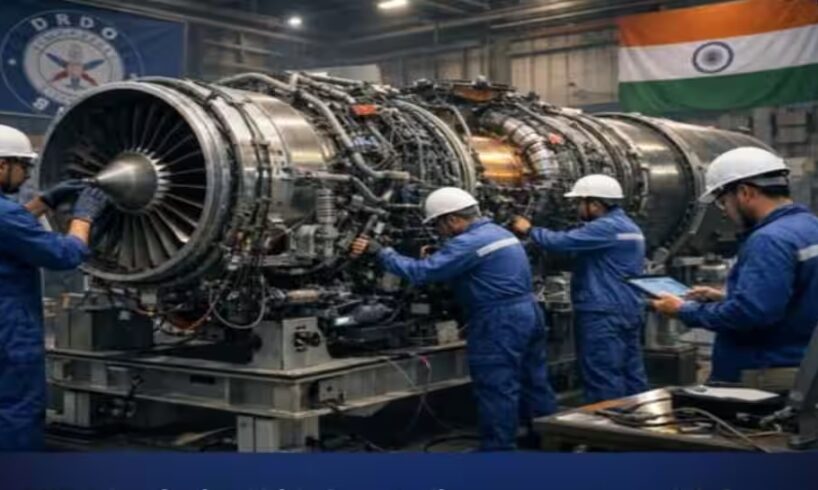
New Delhi: In a major step, India has moved forward in developing its own fighter jet engine. The Defence Research and Development Organisation (DRDO) is leading the push in one of defense technology’s most challenging areas of jet engines. The Gas Turbine Research Establishment (GTRE), a lab under the DRDO, has reached out to both domestic and international companies for input on setting up a National Aero Engine Test Complex.
This move addresses a long-standing gap that has held back India’s ambitions in military aviation for decades. The DRDO is already developing an advanced and high-thrust indigenous aero engine, and the proposed testing facility will be used to examine the entire engine as well as its individual components.
The planned National Aero Engine Test Complex will be a large and integrated facility where the full engine, along with parts like the fan, compressor, combustor, turbine and afterburner, can be tested under conditions that mimic actual flight. The system will recreate high-altitude environments and include advanced air-heating and cooling setups.
Add Zee News as a Preferred Source
In simpler terms, engineers will be able to test engines on the ground as if they were flying at 40,000 feet.
Decades of struggle
India has been working for years to develop a fully indigenous jet engine. The earlier Kaveri engine programme started with high hopes but ran into problems like insufficient thrust and reliability issues. A major and often overlooked reason for these setbacks was the lack of advanced testing facilities within the country.
Joining elite club
Jet engines are among the most complex technologies in the world. Only a handful of countries, including the United States, the United Kingdom, France, Russia and China, have mastered the technology. Developing this capability puts New Delhi on the path to join that elite club.
The ability to develop, test and operate such engines under extreme conditions (high altitude, intense heat, pressure changes and long-duration testing) is important. Without world-class testing infrastructure, even the best designs cannot be fully validated.
Major roadblock for Tejas and beyond
Most of India’s frontline fighters, including Tejas, rely on engines from foreign companies like General Electric. While these partnerships are necessary, they come with limitations. Dependence on external suppliers, restrictions on upgrades and limited access to technology can create major obstacles.
In extreme cases, geopolitical tensions or supply disruptions could directly affect military readiness.
A big leap toward 5th-generation fighters
DRDO’s new initiative goes beyond just creating a testing facility. The goal is to gradually reduce reliance on foreign suppliers. Officials hope that projects like this can accelerate indigenous engine development, shorten testing cycles and improve performance reliability. This is especially critical as India aims to equip its future 5th-generation fighter jets with engines made domestically.
There is also a broader economic and technological angle. By inviting companies from around the world, India is opening doors for collaboration, knowledge sharing and potentially technology transfer. This could help build a strong domestic aerospace ecosystem, create high-skill jobs and position India as a serious contender in advanced propulsion systems.
Officials describe this as a foundational investment. They say if India wants to join the select group of countries that design, build and maintain their own jet engines, it must develop these “behind-the-scenes” capabilities.