2026-03-20T10:35:07+00:00
font
Enable Reading Mode
A-
A
A+
Shafaq News-
Baghdad
Rockets and
drones striking diplomatic sites in Iraq are no longer sporadic incidents but
part of a sustained pattern that is beginning to reshape the country’s external
engagement, as repeated targeting of embassies and foreign facilities prompts a
gradual pullback by international partners.
Inside Baghdad’s
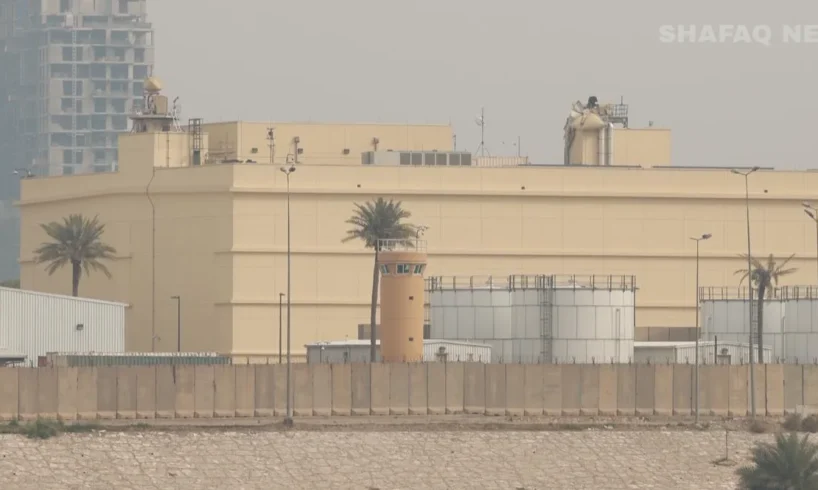
Green Zone, the US embassy has been repeatedly targeted in recent weeks, with
Katyusha rockets and unmanned aerial vehicles causing fires and material damage
within the compound. The scope of targeting has widened beyond the embassy to
include the government-run Al-Rashid Hotel, which hosts diplomatic delegations,
as well as the US Diplomatic Support Center near Baghdad International Airport.
The same
trajectory is visible in the Kurdistan Region. In Erbil, air defenses have
intercepted drones over a city that hosts the US consulate and coalition
forces, while a drone strike damaged the UAE consulate without reported
fatalities. Incidents in both Baghdad and Erbil point to a coordinated
expansion that places Iraq’s main diplomatic hubs under pressure.
The scale of
attacks has intensified sharply. Since late February, nearly 300 operations
claimed by the Islamic Resistance in Iraq have targeted US interests. In some
cases, more than 30 attacks have been recorded within a single day, while
others have reached key infrastructure, including oil fields and airports.
This surge
reflects Iraq’s growing role as a theater for indirect confrontation between
Washington and Tehran. Armed factions aligned with Iran have escalated
operations to project deterrence and shape the regional balance, effectively
turning Iraqi territory into a pressure point in a wider strategic contest.
Diplomatic
repercussions have already begun to take shape due to the targeting, with
Washington ordering the departure of non-essential personnel from its embassy
in Baghdad and consulate in Erbil on March 2, raising its travel advisory to
Level 4 and limiting services to emergencies. NATO also suspended its training
mission and withdrew hundreds of personnel on March 18, describing the move as
temporary.
Read more: Drone incidents reported across 14 Iraqi provinces in latest escalation
“Iraq is not a
party to this conflict,” political analyst Ahmed Youssef told Shafaq News,
warning that the attacks reflect attempts to draw the country into a
confrontation between the United States and Iran. He said targeting diplomatic
missions, hotels, and energy infrastructure expands the scope of the conflict
inside Iraq and weakens the state’s standing internationally.
Haider
Al-Amiri, a specialist in international relations, described the situation as
part of a broader regional conflict shaped by overlapping interests and
retaliatory dynamics, pointing out that Iraq remains at the center of these
tensions, while stressing that attacks on diplomatic missions remain “a
rejected mistake,” even in the context of ongoing strikes against armed
factions, including the Popular Mobilization Forces.
From within
Iraq’s political sphere, Mohammed Al-Shammari of the State of Law Coalition
pointed to internal fragmentation, saying the absence of a unified national
position has left the country navigating between distancing itself from the
conflict and becoming indirectly entangled in it. “Continued diplomatic
withdrawals would carry both political and economic costs.”
Authorities in
Baghdad and Erbil have strongly condemned the recurrent attacks. Caretaker
Prime Minister Mohammed Shia al-Sudani ordered security forces to pursue those
responsible and held an emergency meeting focused on protecting diplomatic
facilities and vital infrastructure. The Foreign Ministry has reiterated Iraq’s
rejection of attacks on diplomatic missions and confirmed that investigations
are ongoing.
Sabah Al-Numan,
spokesperson for the commander-in-chief of the armed forces, described the
incidents as “terrorist acts aimed at destabilizing the country,” while Supreme
Judicial Council President Faiq Zaidan warned that such attacks constitute
clear violations of international law that could lead to severe diplomatic
consequences, including sanctions or a rupture in relations.
The Sunni
Al-Azm Alliance leader Muthanna al-Samarrai described the attacks as “a threat
to Iraq’s standing and its external relations,” calling for firm measures to
protect diplomatic missions.
The US State
Department has also urged Iraqi authorities to take decisive measures to secure
diplomatic missions, warning that continued attacks undermine stability and
increase the risk of broader regional escalation.
Diplomatic
missions serve as Iraq’s primary channel to the outside world, supporting
political coordination, investment, and international cooperation. Their
reduced presence is already altering how foreign actors engage with Baghdad.
Each new attack
narrows that space further, translating security gaps into diplomatic
consequences that extend beyond the immediate damage on the ground.
Read more: Iraq’s Islamic Resistance after Ali Khamenei: loyalty, fragmentation, and the test of Mojtaba’s leadership
Written and
edited by Shafaq News staff.