WEST PALM BEACH, United States (AP) — At war with Iran, US President Donald Trump is cycling through an increasingly desperate list of options as he searches for a solution to the crisis in the Strait of Hormuz. He has jumped from calls to secure the waterway through diplomatic means to lifting sanctions and now escalating to a direct threat against civilian infrastructure in the Islamic Republic.
Trump and his allies insist they were always prepared for Iran to block the strait, yet the Republican president’s erratic strategy has fueled criticism that he is grasping for answers after going to war without a clear exit plan. On Saturday came his latest attempt, via an ultimatum to Iran: Open the strait within 48 hours or the United States will “obliterate” the country’s power plants.
Trump’s aides defended the threat as a hard-edged tactic to press Iran into submission. American opponents framed it as the failure of a president who miscalculated what it would take to get out of a geopolitical mire.
“Trump has no plan to reopen the Strait of Hormuz, so he is threatening to attack Iran’s civil power plants,” said Democratic Senator Ed Markey, adding: “This would be a war crime.”
“He’s lost control of the war and he is panicking,” said Democratic Senator Chris Murphy, responding to Trump’s post.
Get The Times of Israel’s Daily Edition
by email and never miss our top stories
By signing up, you agree to the terms
Over the course of about a week, Trump has repeatedly shifted his approach on the crucial waterway for global oil and gas transport. There is growing urgency for Trump as soaring oil prices rattle global markets and pinch American consumers months before pivotal midterm elections.
Trump and diplomacy
Trump tried his hand at a diplomatic solution a week ago when he called for a new international coalition to send warships to the strait.
Allies turned him down. Trump then said the US could manage on its own. On Friday, he suggested other countries would have to take over as the US eyes an exit. Hours later, he indicated the waterway would somehow “open itself.”
“You can’t all of a sudden walk away after you’ve kind of created the event and expect other people to pick it up,” Republican Senator Thom Tillis told ABC’s “This Week.”
US President Donald Trump steps off Air Force One, March 20, 2026, at Palm Beach International Airport in West Palm Beach, Florida. (AP Photo/Mark Schiefelbein)
Trump’s Treasury Department on Friday made its latest attempt to get a handle on soaring gas prices, by lifting sanctions on some Iranian oil for the first time in decades. That relieved some of the pressure that Washington traditionally has used as leverage against Tehran.
The goal was to send millions more barrels of oil into the global market. It is not clear, however, how much of a dent that would make in lowering pump prices or how the administration could prevent Iran from cashing in on the renewed sales.
The administration earlier temporarily lifted sanctions on some Russian oil.
An ultimatum to Iran
Trump’s ultimatum, conveyed while he spent the weekend in Florida, carries a threat of remarkable aggression. His previous messaging mostly focused on US success in hitting Iran’s air force, navy and missile production. This time, the threatened target is the energy infrastructure that powers hospitals, homes and more.
His social media post — 51 words, much of it in capital letters — did not have the appearance of a message that underwent the careful legal scrutiny needed to justify an attack on civilian infrastructure, said Geoffrey Corn, a law professor at Texas Tech University and a retired lieutenant colonel in the US Army who served as a military lawyer.
“It certainly has a feeling of ready, fire, aim,” Corn said of Trump’s moving strategy. “He overestimated his ability to control the events once he unleashed this torrent of violence.”
The shattered structure of a police station is seen after it was hit in a US-Israeli strike in Tehran, Iran, March 15, 2026. (AP Photo/Vahid Salemi)
That type of widespread attack would probably be a war crime, Corn said. For military leaders, it could force a choice between obeying an order to carry out a war crime or refusing and facing criminal sanction for willful disobedience, he said.
Laws governing warfare do not explicitly forbid attacks on power plants, but the tactic is allowed only if an analysis finds that the military advantages outweigh the civilian harm, legal scholars say. It is seen as a high bar to clear because the rules of war are, at their core, designed to separate civilian and military targets.
Iran’s UN ambassador, in a letter to the Security Council, warned that the deliberate targeting of power plants would be inherently indiscriminate and a war crime, according to the state-run IRNA news agency.
The White House has already faced intense backlash after the US was blamed for a missile strike on an Iranian elementary school that killed more than 165 people.
Trump aides justify latest attempt to rein in the crisis
Trump provided scant detail on which plants might be targeted and how. He gave Iran until Monday to reopen the strait or else the US will strike “various POWER PLANTS, STARTING WITH THE BIGGEST ONE FIRST!”
Trump’s team came to his defense Sunday, offering justification for striking Iran’s energy grid.
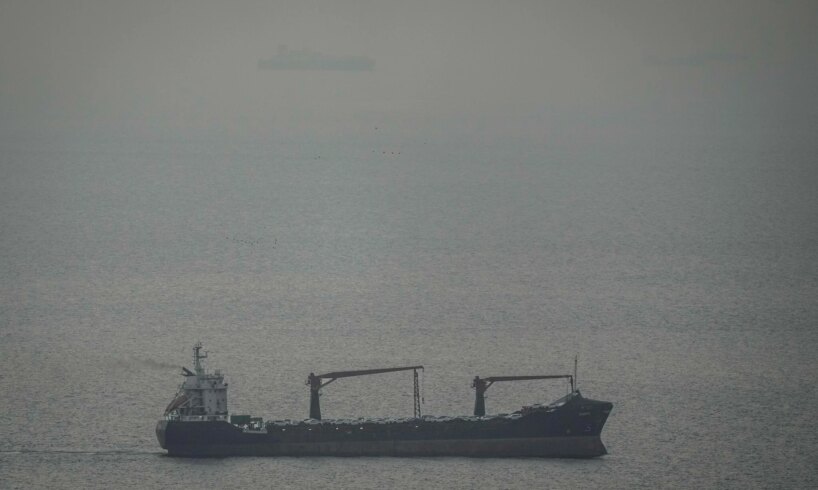
A person points at a page on the Marinetraffic website that shows commercial boats traffic on the edge of the Strait of Hormuz near the Iranian coast, in Paris on March 4, 2026. (JULIEN DE ROSA / AFP)
Mike Waltz, the US ambassador to the United Nations, said Iran’s Revolutionary Guard controls much of the country’s infrastructure and is using it to power the war effort. He said potential targets include “gas-fired thermal power plants and other types of plants.”
Speaking on Fox News, Waltz said he wanted to get ahead of “hand-wringing” from the global community, calling the Revolutionary Guard a terrorist organization. “The president is not messing around,” he said.
NATO’s secretary-general, Mark Rutte, who has allied himself closely with Trump, tried to calm tensions. He said he understood Trump’s anger and stressed that more than 20 countries are “coming together to implement his vision” of making the strait navigable as soon as possible.
Israel’s ambassador to Washington, Yechiel Leiter, cautioned against an all-out attack like the one Trump threatened. “We want to leave everything in the country intact, so that the people who come after this regime are going to be able to rebuild and reconstitute,” he told CNN’s ”State of the Union.”
Trump’s threat could prove counterproductive: If it’s carried out, Iranian leaders said they would completely close the strait and retaliate against US and Israeli infrastructure.
You appreciate our wartime journalism
You clearly find our careful reporting of the Iran war valuable, at a time when facts are often distorted and news coverage often lacks context.
Your support is essential to continue our work. We want to continue delivering the professional journalism you value, even as the demands on our newsroom have grown dramatically during this ongoing conflict.
So today, please consider joining our reader support group, The Times of Israel Community. For as little as $6 a month you’ll become our partners while enjoying The Times of Israel AD-FREE, as well as accessing exclusive content available only to Times of Israel Community members.
Thank you,
David Horovitz, Founding Editor of The Times of Israel
Join Our Community
Join Our Community
Already a member? Sign in to stop seeing this