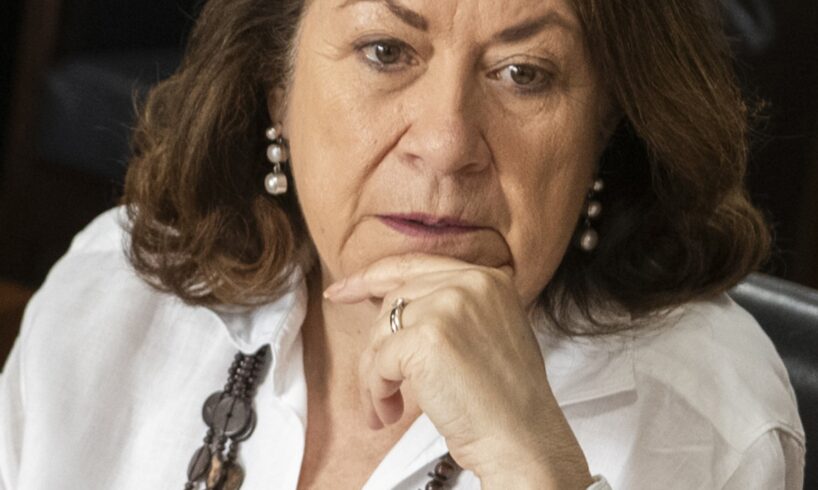
Miriam Belchior, President Lula’s new chief of staff, was in practice the key official directing the team that manages the federal administration. The new minister, previously the executive secretary in the same office, is now tasked with keeping the government apparatus running at a time when 20 ministers are expected to step down to run for elective posts, as Lula has little time to deliver results before the restrictions imposed by electoral legislation.
Brazil needs further fiscal adjustment, vice president saysSenate race in São Paulo intensifies within Lula camp
A long-time member of the Workers’ Party (PT) with extensive experience in previous administrations, Miriam Belchior was personally appointed by President Lula in January 2023 to the number 2 position in the Chief of Staff Office. But, even with a direct line to the president, she was always strict with protocol and never overstepped the boundaries with her direct superior. Thus, it didn’t take long for her to become the right-hand woman of Rui Costa, who is stepping down to run for the Senate for Bahia.
At 68 years old, Belchior is linked to the so-called “ABC group” of São Paulo, a group of specialists and union members who worked in city halls in São Paulo’s manufacturing belt. Throughout her public life, she has been “tested” in various fields and has held strategic positions. She was a special advisor to the Presidency in Lula’s first administration; and she was Dilma Rousseff’s minister of planning, budget, and management between 2011 and 2014, and president of Caixa Econômica Federal, a state-owned bank, from 2015 to May 2016. Between 2003 and 2010, she worked in the Chief of Staff Office, where she was responsible for liaison and monitoring in the administration’s strategic projects, including in the Growth Acceleration Program (PAC). She holds a master’s degree in public administration from the Getulio Vargas Foundation.
In recent years, Belchior had already taken command of the Chief of Staff Office whenever the incumbent was absent from Brasília. With autonomy and Lula’s trust, she became one of the administration’s most influential officials, even if she stayed away from the spotlight. She became one of the main sources for cabinet members when the subject involved the budget or when it was necessary to gauge the political temperature of a proposal within the administration. Routinely, ministers used to go to her office to “ask for her blessing” on projects.
She thus built a network of trust within the administration. Before taking issues to Rui Costa, for example, ministers and executive secretaries frequently turned to Belchior for a prior assessment. She functioned as a technical and political filter.
Part of this role came from her internal coordination work in the administration. She met monthly with the ministries’ executive secretaries to align priorities and avoid overlapping agendas. While Costa was known for his rigorous monitoring of policies, Belchior went further and, according to one source, “looked at the details with a magnifying glass.”
The two share a managerial focus, but with differences in style. Belchior is described by some as more affectionate in her dealings and is considered a “mother figure” by her closest team. Rui Costa, for example, rarely celebrates personal dates, such as birthdays. She, on the contrary, usually organizes breakfasts and small get-togethers. Outside her closest circle, however, her behavior is more rigid.
In practice, her office has always been a place where colleagues went to “beg” for more funds, and budgetary matters usually found a way to her desk. She dealt closely, for example, with the billion-dollar crisis at Correios (Brazil’s post office service), the need of resources for the public broadcaster EBC, and the launch of the New Growth Acceleration Program (PAC) in 2023.
Organizing the 2025 UN Climate Summit, COP30, was one example of her central management role. Amid criticism regarding the progress of preparations and concerns about the city’s infrastructure, Belchior settled in Belém at the beginning of the event to closely monitor the administration’s actions, while Rui Costa remained for a period of about a week.
In the administration’s actions aimed at assisting Rio Grande do Sul after the severe flooding in the state in 2024, Belchior also played a strategic role in the implementation of the Assisted Purchase Program, a line of the “My House My Life — Rebuilding” housing program that provides homes (new or used) for households who lost theirs in climate disasters. According to reports, in meetings involving other areas of the administration, she showed particular concern about the legal framework to make ideas viable. The fear was that Congress would question the actions announced by the administration.
The episode shows, according to sources in the administration, how she was entrusted with the mission of assessing the potential long-term impacts of measures, in contrast to a more immediate, short-term approach of her predecessor. Her caution focuses primarily on fiscal matters to shield the administration from setbacks on this issue, which in the Dilma administration, of which she was a part, ended up giving rise to an impeachment process.
With considerable autonomy in the Chief of Staff Office, she also played a leading role in liaison with other areas of the presidential palace and the cabinet. Belchior often seeks out the presidential communication office (Secom) when she feels it necessary to adjust communication approaches. Even behind the scenes, she “nudges” the department headed by Sidônio Palmeira to suggest which direction and narrative should be adopted. Because she sees communication as having a strategic role in the administration, she often offers her “two cents.”
Given her decades-long relationship with Lula, Belchior is not shy in front of the president. When she disagrees with Lula, she expresses her opinion and is not intimidated by the president’s arguments. She considers all scenarios to avoid surprises. But if he ends up discarding her arguments, she fulfills what was asked of her.
Discreet, Belchior avoids public exposure. Clinging to tradition, she likes to conduct meetings with detailed PowerPoint presentations and is also fond of spreadsheets and printed documents. Even so, she manages to keep the president’s attention, even in long and technical explanations.
According to an aide, if you bring Belchior numbers and research, it is easier to convince her to make a decision. An unsupported personal opinion, for her, weakens the debate. She insists on questioning her colleagues in meetings, and they then need to make an effort to convince her, which behind the scenes has already generated some complaints. On these occasions, “sergeant major” and “technician” are the words most used to describe her. But there are also those who prefer, in addition to highlighting the “Franciscan life” she leads, to refer to her in the presidential palace’s corridors as the “lady of management.”
In recent years, there have also been ministers or executive secretaries who never hid the fact that they preferred dealing with her rather than meeting with Rui Costa. However, this did not mean that there was any kind of disrespect for hierarchy. Just as she never sat in the minister’s chair when she temporarily assumed the position, Belchior also never brought matters to the president without first discussing them with her direct superior.
The closeness with Rui Costa began during the transition period, when she was part of the team responsible for structuring the new administration and worked alongside Aloizio Mercadante, now president of the Brazilian Development Bank (BNDES), in coordinating the technical groups.
This profile helped her avoid internal conflicts. Unlike Rui Costa, pointed out by allies as a possible name for the Presidency in 2030, Belchior was never seen as a political threat.
The Chief of Staff Office should now become even more inward-looking, more focused on bureaucratic matters, and without much fanfare. The intention is for Belchior to keep most of the office’s team and make only a few changes. A homegrown solution, she is Lula’s bet that there will be no surprises until the second round of this year’s election. The cake is already ready, and now the administration will only add the icing, according to an administration source.
Reserved in her personal life as well, Miriam Belchior speaks little about her family, and those who are close to her do not recall extravagances. She was married for about ten years to the former mayor of Santo André, Celso Daniel, who was murdered in 2002, a few months after they separated. Currently, the future chief of staff is in a relationship with the economist Doria Carneiro, with whom she has a son. She declined to be interviewed for this story.