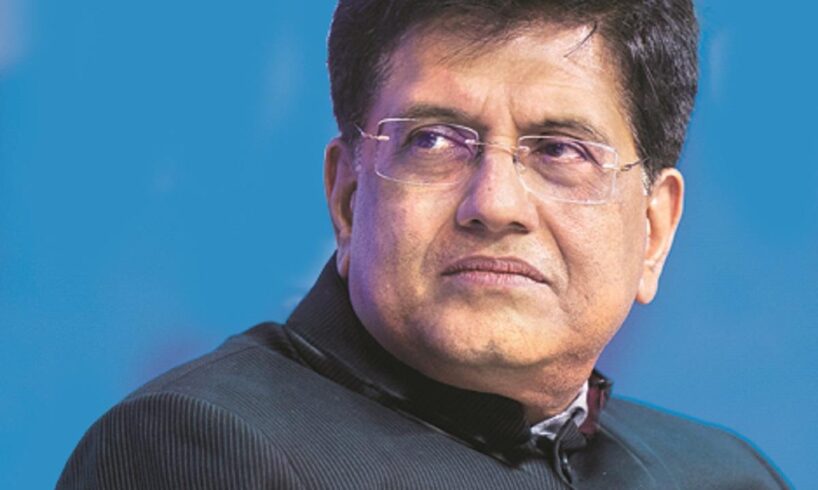
Commerce and Industry Minister Piyush Goyal said on Friday that the government may review around 50 million pending cases relating to minor offences following the passage of the Jan Vishwas (Amendment of Provisions) Bill, 2026, encouraging prosecutors to seek closure of such cases under the new framework.
Addressing a press conference, Goyal said prosecutors could approach courts to close such cases in light of the new provisions, which seek to reduce criminal proceedings in matters involving minor regulatory violations.
“At the local level, we encourage officials or prosecutors to try and finish these cases based on the new law,” said Goyal.
He encouraged individuals affected by such cases to approach prosecuting offices, stating that authorities could act under the new provisions and close them.
The Jan Vishwas initiative seeks to decriminalise a range of minor regulatory offences by replacing criminal penalties with civil penalties across multiple central laws. It aims to reduce litigation and ease compliance for individuals and businesses.
Goyal also urged states to undertake similar reforms, noting that 12 states have already introduced their own versions of Jan Vishwas legislation to decriminalise minor offences.
He added that the Centre remains open to suggestions and is willing to review additional central laws as part of the broader effort to simplify the regulatory framework and reduce litigation.
Goyal said the government’s objective was to move away from criminal punishment in cases where there was no deliberate intent to break the law and instead adopt a compliance-based enforcement approach.
In such cases, regulators could issue warnings, improvement notices or impose small penalties, which may escalate if violations are repeated, he said.
Criminal prosecution would be reserved for serious offences that cause harm to the public, specific sections of society, or public property.
“All these thousand sections, in some way or the other, were a source of uncertainty, potential rent-seeking and harassment,” the minister said, adding that several provisions were framed with a “colonial mindset” where punishment prevailed over fairness.
The remarks come after Parliament passed the Jan Vishwas (Amendment of Provisions) Bill, 2026 this week, marking one of the government’s largest efforts to decriminalise regulatory offences and shift enforcement towards civil penalties.
The Bill seeks to amend 784 provisions across 79 Central Acts administered by 23 ministries. Of these, 717 provisions are proposed to be decriminalised, while 67 provisions are being amended to simplify procedures and promote ease of living.
The move builds on the earlier Jan Vishwas (Amendment of Provisions) Act, 2023, which decriminalised 183 provisions across 42 central laws by replacing imprisonment clauses with monetary penalties.
“This Bill is the outcome of sustained, constructive dialogue between industry and policymakers, and reflects the government’s commitment to genuinely make it easy to do business in India. These measures will substantially ease the compliance burden on businesses, accelerate dispute resolution, and reduce the caseload on an already stretched judicial system,” said Chandrajit Banerjee, director general, Confederation of Indian Industry (CII).
The Bill is expected to boost investor confidence by assuring businesses they will not face criminal action for minor compliance lapses, Goyal added.