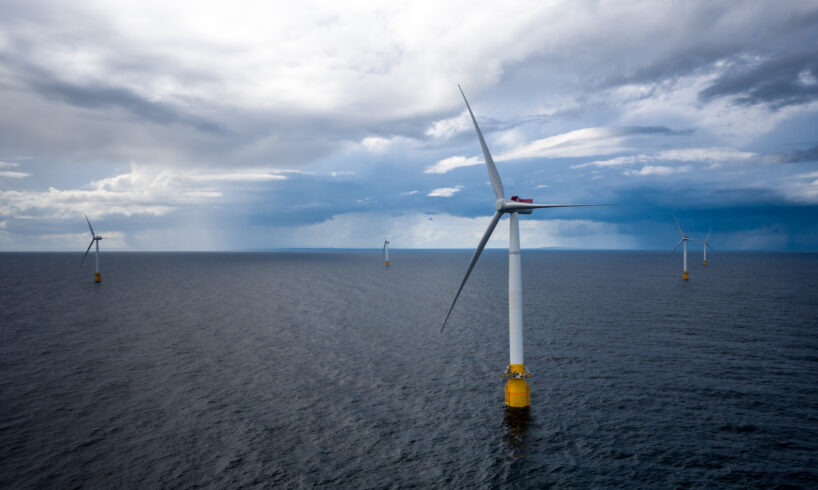
In November Shell pulled out of the Campionwind project. The company had held out the prospect that the development of the floating windfarm would generate £3bn work for Scottish firms.
Soon after Shell dropped its bombshell, French oil giant TotalEnergies and partners put the giant West of Orkney project on pause.
The moves reflected giants’ concerns about the economics of wind projects off Scotland.
Read more
To make matters worse, German utility EnBW has just withdrawn from two projects it was working on in the Celtic Sea with BP. These were meant to be the core of an offshore windfarm business that the firms had said would run from Aberdeen.
The moves came after oil and gas firms decided to refocus on their roots after a period in which they enthused about the potential of renewables.
The surge in oil and gas prices triggered by the US Israeli war on Iran has provided a boost to the profitability of majors’ core operations.
But campaigners think the resulting disruption has made it more important to develop low carbon energy sources to reduce Scotland’s imports of oil and gas.
Champions of renewables think Scotland is well placed to capitalise on the huge opportunities that could be presented. They say people who focus on the Campionwind setback ignore the progress that has been achieved on many other projects.
“It is only one project that’s handed back said the keys,” said Colin Palmer director of offshore at Scottish Renewables. He reckons the landmark ScotWind leasing round that was completed in 2022 has triggered a huge increase in investment in offshore wind.
“ScotWind happened just over four years ago and there’s been hundreds of millions of pounds spent by developers, they’ve set up project teams, project offices,” said Mr Palmer.
He noted: “At this point in time we’ve got 14 gigawatts that’s in planning. There’s going to be a lot more projects coming in for consent over the next year or two; I actually think that shows how committed and how much effort developers have been putting in.”
Scottish Renewables offshore director Colin Palmer (Image: Scottish Renewables)
Mr Palmer reeled off a list of eight proposed developments that are in the planning system, including floating wind projects such as Buchan.
“There’s been so much work done to get to that point and certainly from the discussions I’ve had people are not doing this just for the sake of it. They want these projects to move forward,” said Mr Palmer.
There are seven windfarms off Scotland with a total capacity of 1.9GW currently, including small demonstrator projects. Two are in the construction phase.
Offshore Energies UK is confident that oil and gas firms have not lost interest in the windfarm business.
“You have players who are still there,” said Thibaut Cheret, renewables manager at the trade body, which developed out of Oil and Gas UK.
Offshore Energies UK renewables manager Thibaut Cheret (Image: OEUK)
Mr Cheret added: “If you look at somebody like TotalEnergies their global renewables portfolio is very large and the same for Equinor, so you have players who are really in for the long term.”
Mr Cheret noted that Equinor bid successfully for acreage in the Celtic Sea in a leasing round for floating wind projects that was held last year.
Highlighting continued enthusiasm for floating wind in the energy industry, he noted: “Is it going to go as fast as we thought when ScotWind arrived, probably not, but it’s still something we need.
“We will run out of space eventually in shallow water so we will have to go deeper.”
Supporters say floating wind farms could be deployed far offshore allowing them to harness stronger and more consistent winds than facilities fixed to the seabed. However, they recognise that the floating wind drive has been hampered by big increases in costs that firms have faced since Russia launched its full-scale war on Ukraine in 2022.
But Mr Palmer predicts that costs will fall as the technology is deployed more widely, as happened with windfarms fixed to the seabed.
“It’s been pretty remarkable .. how costs have come down,” he observed.
“Floating offshore wind is closer to the start of its journey.”
Mr Palmer is confident that Scotland can draw on the offshore expertise developed by its oil and gas sector to become a global leader in floating wind. He reckons the technology will be adopted around the world in coming years.
However, champions of floating wind highlight a challenge on the cost front that represents a serious impediment for Scottish schemes.
“Scotland is facing a more specific issue, which is the transmission [pricing] regime,” said Mr Cheret.
Mr Palmer at Scottish Renewables agrees that the costs of connecting Scottish developments to the national grid can be prohibitive.
“That’s a really significant issue. There’s absolutely no getting away from that,” he observed.
“As you get further away from London, the further up you are, your costs associated with connecting increase.”
Critics note that the problems caused by the level of transmission charges are compounded by the fact that they are subject to changes that seem impossible to predict.
Sasha Bond-Smith at the Wood Mackenzie energy consultancy said ScotWind projects would be key to the UK achieving its offshore wind ambitions but their competitiveness could be undermined by grid charges.
With the current system scheduled to remain in place until 2029, Mr Bond-Smith cautioned: “Progress is stalled by a coordination deadlock: grid operators require committed capacity before expanding infrastructure, while developers need grid connections before committing to projects.
“Without a long-term roadmap that includes coordinated action on grid infrastructure and tender design adaptations, the pipeline lacks urgency as there is no clear route-to-market.”
Scottish Renewables has said the regulator should take immediate action to reduce the charges to secure Scotland’s role in delivering economic growth and clean power in the UK.
Mr Palmer noted the regulatory and policy regimes in the UK are generally considered to be supportive otherwise.
The Pentland floating wind project and the proposed Berwick Bank fixed bottom development won support in the latest round of the Contracts for Difference programme. The scheme provides revenue guarantees for developers, which are funded by householders.
Offshore industry players may also need to do more to help themselves.
OEUK is leading an initiative to develop a system of alliance contracting to help find more effective ways of sharing the risks associated with projects. It wants to standardise contract terms.
Sector watchers have highlighted concerns about planning delays in Scotland and the need to improve the infrastructure in place to support windfarm developments. This could involve developing port facilities and plants for manufacturing turbine blades and the like.
However, some fear the country may face the kind of chicken and egg problem in respect of such facilities that the transmission charge challenge reflects.