Shafaq News
On March 26,
Iraq and the United States announced the formation of a High Joint Coordination
Committee, committing both governments —in the official language of the Joint
Operations Command— to “intensify cooperation to prevent terrorist
attacks, ensure Iraqi territory is not used as a launching point for
aggression, and keep Iraq outside the scope of the ongoing military conflict in
the region, with full respect for its sovereignty.”
Within hours,
US airstrikes struck Popular Mobilization Forces (PMF) positions in Wasit
province —and before the night was over, Iraqi armed factions hit US facilities
across Iraq, including in Baghdad and Erbil. More strikes from both sides
followed the next morning.
The speed of
the collapse reflected a structural problem that predates the current conflict
and has outlasted every bilateral security framework Baghdad and Washington
have signed since 2003: the Iraqi state does not exercise full authority over
all armed actors operating under its nominal command, and Washington has never
accepted the distinction Baghdad insists upon —that the PMF is a state
institution entitled to sovereign protection, not an Iranian proxy subject to
military targeting.
The current
US-Israel war on Iran, which began on February 28, has also forced this problem
into full view.
Read more: Iraq’s neutrality fades: Formal war involvement draws closer?
A Framework
Built On Shifting Ground
The new
committee is the latest iteration of a security architecture rooted in the 2008
Strategic Framework Agreement (SFA) and the Status of Forces Agreement (SFO)
—treaties that established the terms of US military presence in Iraq and have
governed bilateral cooperation ever since. Successive arrangements followed:
the July 2021 Strategic Dialogue, a Higher Military Commission formed in
2023–2024, and, most recently, a new bilateral security agreement proposed by
Iraq in 2025 —confirmed publicly by Iraqi Defence Minister Thabet Al-Abbasi,
who described it as establishing “a lasting security partnership and deep
intelligence cooperation.” As of late March 2026, the proposal remains
under review by the Trump administration, with no official US confirmation of
receipt or negotiation.
Each of these
frameworks rested on the same core assumption: that Baghdad, as the sovereign
authority, could enforce the terms to which it was agreeing, but encountered
the same obstacle.
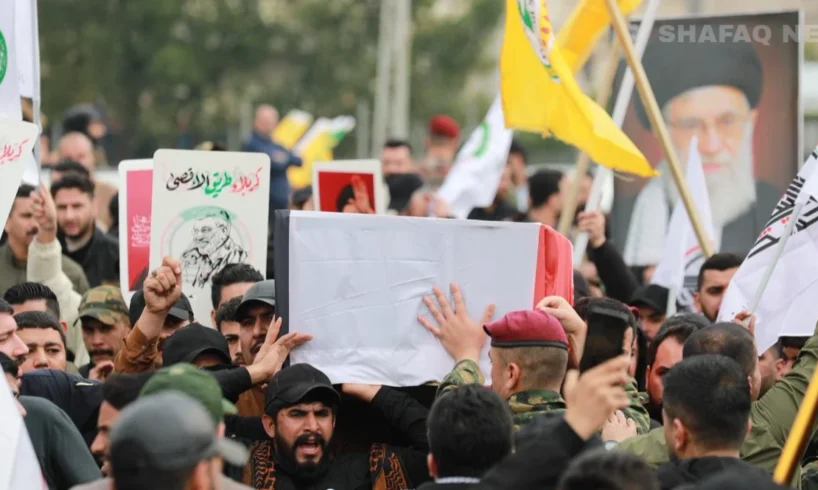
The PMF, known
in Arabic as Al-Hashd Al-Shaabi, sits at the center of that obstacle. Formed in
2014 following the fall of Mosul and a religious decree by Grand Ayatollah Ali
al-Sistani calling on Iraqis to defend their country against ISIS, the force
was formally incorporated into the Iraqi Armed Forces by parliamentary law in
2016 and placed under the authority of the prime minister as commander-in-chief
of the armed forces. With approximately 165,000 fighters, it is one of the
largest components of Iraq’s security architecture —and the most politically
contested.
The Loyalty
That No Law Has Resolved
Many of the
PMF’s most powerful brigades —grouped under the Islamic Resistance in Iraq,
most notably Kataib Hezbollah and Harakat Hezbollah Al-Nujaba, both designated
as terrorist organizations and sanctioned by the United States— operate under
the doctrine of Wilayat al-Faqih, the principle of clerical guardianship that
places ultimate political and religious authority in the hands of Iran’s
supreme leader. Several factions have declared their allegiance publicly.
It is a dual
loyalty that no prime ministerial decree, parliamentary law, or bilateral
security framework has managed to dissolve. A reform bill introduced in March
2025 —specifically designed to consolidate command authority over the PMF under
the prime minister and reduce the force’s exposure to external influence—
failed to pass. The political coalition required to enact it does not exist:
the factions whose external loyalties the bill sought to curtail hold enough
parliamentary weight to prevent their own reform.
Ahmed Youssef,
a political analyst, told Shafaq News that the involvement of armed factions in
the current conflict “has created a reality outside the state’s authority
—one that reflects neither government policy nor public interest.” That
reality, he said, predates the current war.
Read more: Iran–US talks and future of Iraqi armed factions: Sovereignty vs. Resistance
Al-Sudani’s
Diminishing Margin
Caretaker Prime
Minister Mohammed Shia al-Sudani has maintained Iraq’s neutrality position with
consistency under conditions that would strain any government. Airstrikes on
PMF positions —condemned by al-Sudani as “systematic aggression”—
have hit facilities across at least seven provinces since February 28, killing
close to 170 fighters by late March according to Iraqi health authorities and
PMF statements. Simultaneously, the US chargé d’affaires and Iranian ambassador
were summoned to the foreign ministry, a formal complaint was filed with the UN
Security Council, and al-Sudani reiterated that decisions of war and peace belong
exclusively to the Iraqi state.
None of it
altered the trajectory. Iran-aligned factions continued strikes on US-linked
targets across Iraq —including a drone attack on Baghdad International Airport
the same night the coordination committee was announced. The pattern is one of
continuous exchange between two armed actors operating inside Iraqi territory,
with the state registering objections it cannot enforce.
The fracture
within Iraq’s political landscape sharpens the picture. Hussein al-Sheehani, a
member of the Sadiqoon bloc— the political wing of Asaib Ahl Al-Haq, one of the
most powerful Iran-aligned PMF factions— called for restraint while warning
that US strikes represent a “serious escalation” capable of
triggering responses beyond control.
Speaking to
Shafaq News, Al-Sheehani acknowledged the pressure on factions, pointing out
that past experience had shown “a consistent pattern of the United States
acting unilaterally and outside agreed rules of engagement.” Even so, “factions
must exercise self-restraint…patience and deference to the state remain the
better course to keep Iraq from being pulled into a regional conflict.”
Protecting
Iraqi sovereignty, he added, must be a shared priority, and dialogue the only
viable path through the current period.
The tension in
that statement captures al-Sudani’s daily reality: a faction that sits inside
his political coalition, draws a state salary, and answers to a foreign
clerical authority simultaneously reserves the right to act outside his
authority.
Hassan Fad’am
of the Shiite Wisdom Movement (Al-Hikma) —a faction closer to al-Sudani’s
centrist position —went further, rejecting neutrality and arguing that Iraq
should align politically with Iran.
“Since the war
on Iran began, Iraq had played an essential role through diplomatic efforts to
prevent the country from being drawn into the conflict, but unfortunately, we
came under bombardment, and our security forces suffered casualties,” he
told Shafaq News.
“We side with
the wronged party, which is our neighbor Iran, and we must stand with it
politically, in the media, and on humanitarian grounds —and that is the role
Iraq has played since the battle began.”
That voice does
not come from the resistance factions. It comes from the moderate wing of
Iraq’s Shiite political establishment, and it illustrates precisely how narrow
the coalition available to the caretaker premier actually is.
What The
Committee Cannot Fix
The High Joint
Coordination Committee retains value as a diplomatic channel, a mechanism for
communicating red lines, registering objections, and preserving the formal
architecture of the bilateral relationship. Counterterrorism cooperation,
intelligence sharing, and advisory roles continue. If the broader regional
conflict de-escalates, the committee may provide a usable diplomatic off-ramp.
Its limits are
structural. Washington does not distinguish between the PMF as a state
institution and the PMF as an Iran-aligned network when selecting targets.
Baghdad insists on that distinction when filing protests. The agreement
requires both parties to act based on Iraqi sovereignty —a sovereignty that one
party treats as incomplete and the other cannot fully exercise.
That is the
contradiction the committee was built to manage not to resolve.
Every security
framework between Baghdad and Washington has eventually run into that wall. The
more consequential measure of this conflict, whenever it ends, will be whether
the wall itself is any closer to being addressed. The failed reform bill, the
unresolved factions, the publicly declared external loyalties: none of that has
changed. Until it does, the next framework will face the same fate as every
previous one.
Read more: Why Iraq’s PMF disarmament is a different battle from Lebanon’s Hezbollah
Written and
edited by Shafaq News staff.