JAKARTA – The Indonesian Military (TNI) is open to the possibility of reducing the number of peacekeepers to be deployed to Lebanon in May, as more Indonesian blue helmets were injured in the southern part of the country amid the escalating conflict in the Middle East.
Three Indonesian soldiers serving in the UN Interim Force in Lebanon (UNIFIL) were wounded on April 3 in a blast at a UN facility near El Adeisse in southern Lebanon, two of them seriously injured. The cause of the blast remains under investigation, according to UNIFIL.
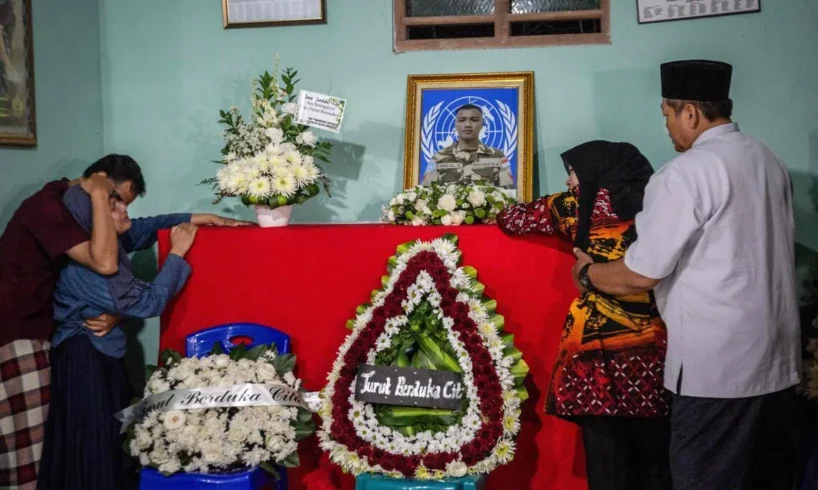
The incident followed the deaths of three Indonesian peacekeepers who were killed in two separate explosions on March 29 and March 30 in southern Lebanon, where Israel has been expanding its ground invasion of the country.
The three fallen soldiers were flown to Jakarta for a military ceremony on the night of April 4 attended by President Prabowo Subianto and former president Susilo Bambang Yudhoyono, both of whom were former army generals. Their bodies were laid to rest in their respective hometowns on April 5.
The two incidents in March also injured three other Indonesian peacekeepers.
Despite the fatalities and injuries, the TNI Peacekeeping Mission Center (PMPP) said plans remain under way for the peacekeeping troop rotation, with 753 Indonesian soldiers currently stationed in Lebanon set to be replaced by a new batch scheduled for deployment on May 22 and May 30.
However, PMPP commander Iwan Bambang Setiawan said discussions might be on the table on whether to reduce the number of personnel deployed, since most of the troops in Lebanon have “largely been confined to bunkers” because of hostilities between the Lebanese armed group Hezbollah and the Israeli Defense Forces.
“The current situation may become a consideration for the TNI commander (Gen Agus Subiyanto) to decide whether to maintain the same number of officers or reduce it, as effectiveness is also affected by field conditions,” Major-General Iwan told The Jakarta Post on April 5.
“Our troops can no longer move freely. Most of them are sheltering in bunkers from gunfire coming from both (Hezbollah and Israel),” he added.
Maj-Gen Iwan also said he would discuss the potential personnel reduction with the UNIFIL commander in charge in Lebanon on April 15, though he said the final call would come from the President through the TNI commander.
This came on the heels of domestic calls for further action from the government after the death of the three peacekeepers, with Nahdlatul Ulama (NU) calling for the postponement of the upcoming military deployment.
“A thorough investigation into the attack is necessary, and the UN must guarantee the safety of all peacekeepers. Without adequate guarantees, deployment next month should be postponed,” NU executive Imron Rosyadi Hamid said on April 5.
TNI spokesperson Aulia Dwi Nasrullah and State Secretary Prasetyo Hadi were not immediately available for comment.
President Prabowo Subianto has condemned the attacks, saying that they undermine global peace efforts and threaten the safety of peacekeeping personnel operating under UN mandates.
“We strongly condemn every heinous act that destroys peace and causes the loss of our nation’s finest soldiers,” Mr Prabowo said on Instagram on April 4.
Foreign Minister Sugiono said that Indonesia had formally requested a UN Security Council meeting to push for a comprehensive probe into the attacks.
“We have demanded a thorough investigation. There must be security guarantees for UN peacekeepers, as they are tasked with maintaining peace (and not engaging in combat),” Mr Sugiono said on April 4.
International relations expert Andrea Abdul Rahman said the UNIFIL deployment is now a “dilemma” that the government must face with a balancing act as it risks either domestic pushback or not committing to the UN mandates.
“Delaying the peacekeepers’ rotation could be a strong political statement against Israel’s aggression in Lebanon, but it risks undermining our commitment to the UN mandates on sending the troops,” Mr Andrea said on April 5.
What Indonesia needs to alleviate domestic concerns, he said, is a “strong and clear” condemnation from the government, citing the President and his Cabinet members’ unwillingness to mention Israel as the perpetrator behind the fatal attacks.
“First and foremost, Indonesia must not only condemn the attack strongly, but strongly condemn Israel for attacking Indonesian UNIFIL troops,” he added.
However, defence analyst Rizal Darma Putra of the Indonesia Institute for Defense and Strategic Studies said what constitutes “violations” of the UN mandate depends on further evaluation of the mission’s effectiveness in Lebanon.
“If the mission is still considered effective by both Indonesia and the UN based on their evaluations, then it can proceed. But if the current conditions endanger troops, deployment cannot be forced,” Mr Rizal said.
“The mandate cannot be treated as a rigid obligation.” THE JAKARTA POST/ASIA NEWS NETWORK