India’s naval diplomacy, supported by sustained capacity-building under the Indian Technical and Economic Cooperation (ITEC) programme, continues to play a central role in shaping its strategic partnership with Mauritius. A telling indicator of this shift is the training of Mauritius’s 516 National Coast Guard (NCG) officers in India over the past nine years, a figure that reflects the depth of cooperation built quietly through the Indian Technical and Economic Cooperation (ITEC) programme.
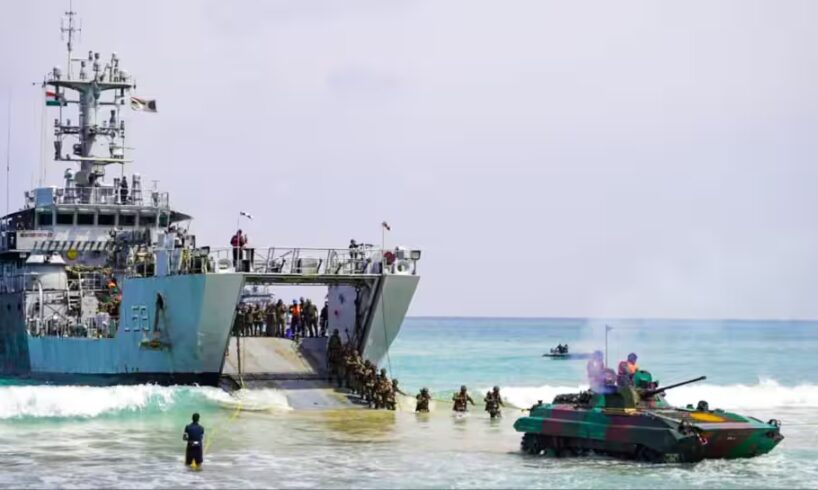
That long-term investment was on display during the recent visit of the Indian Navy’s stealth frigate, INS Trikand, which arrived in Port Louis as Mauritius marked its 58th National Day on March 12. At the Champ de Mars, where the main celebrations were held, the Indian Navy contingent joined the parade, accompanied by a naval band and a helicopter flypast. The participation was ceremonial, but it also reflected a familiarity that has developed over decades—India’s presence at these celebrations is no longer unusual but expected.
What stood out, however, was not just the ceremony. Behind the scenes, there was a steady exchange of skills and practices. Officers from the Mauritius National Coast Guard trained with the crew of INS Trikand in areas that are less visible but essential—watchkeeping, firefighting, and damage control. These are the kinds of engagements that rarely make headlines but shape how forces operate together in real situations.
Add Zee News as a Preferred Source
Over time, this mix of training, asset support, and joint activity has become the backbone of India–Mauritius maritime ties. India has helped maintain and repair Mauritian vessels, conducted hydrographic surveys, and supplied patrol platforms to strengthen coastal security.
For Mauritius, the stakes are high. Its Exclusive Economic Zone stretches across roughly 2.3 million square kilometers, with additional shared waters with Seychelles. The ocean is central to its economy, contributing over a tenth of national output. Protecting that space—from illegal fishing to trafficking—requires capabilities that are still developing, and this is where India’s role has become significant. Cooperation through platforms like the Information Fusion Centre – Indian Ocean Region has also helped plug Mauritius into a wider regional security network.
India’s involvement has not been limited to training or patrols. It has supported the installation of coastal radar systems in Mauritius. In the year 2024, India has also helped to develop a new airstrip and jetty that were inaugurated on Agaléga Island.
There is also a humanitarian dimension to the relationship. In Dec 2024, when Cyclone Chido struck the nation, the Indian Navy responded quickly with rescue efforts. Such quick responses have reinforced India as a first responder to the crisis. China, for example, has increased its influence via trade deals and technological collaborations, exemplified by companies like Huawei establishing a presence. Simultaneously, geopolitical shifts, including the return of the Chagos Archipelago to Mauritius, have complicated regional relationships—something India has consistently supported, backing Port Louis.
Against this backdrop, naval diplomacy has taken on greater significance. Regular port calls, training exchanges, and joint exercises are no longer isolated events but part of a broader pattern. The visit of INS Trikand fits into this continuum—less a standalone gesture and more a reflection of an ongoing relationship that is being built incrementally. What emerges is a partnership that is not defined by a single agreement or moment but by sustained engagement over time. Training programmes like ITEC, operational coordination at sea, and support during crises together tell the story of how India and Mauritius are shaping their maritime relationship—quietly but with clear strategic intent.
ALSO READ | Delhi traffic advisory: Heavy delays expected in Paharganj and Sadar Bazar area; check detour options