As per legal nuances, after his resignation is accepted, Justice Varma would be entitled to pension and other benefits that a high court judge gets upon retirement.
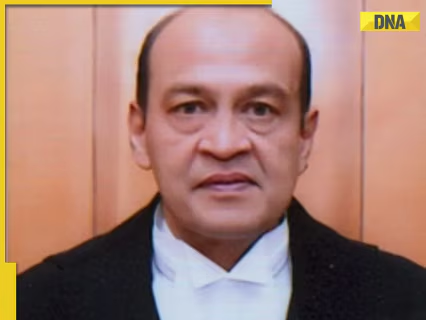
Allahabad High Court judge Justice Yashwant Varma has tendered his resignation to the President of India. He had been facing an inquiry by a committee set up by Lok Sabha Speaker Om Birla after a huge stash of cash was recovered from his home last year. As part of an impeachment-related inquiry, a parliamentary committee initiated an examination of allegations linked to the alleged cash haul, but he resigned before the process began.
As per legal nuances, after his resignation is accepted, Justice Varma would be entitled to pension and other benefits that a high court judge gets upon retirement. The inquiry panel to defend himself against the corruption charges was to be held between April 10 and April 14. Had parliament removed him, he would have been deprived of the benefits.
How much pension will Justice Yashwant Varma get?
Yashwant Varma retains the “Retired Judge” title and perks as the resignation, accepted by President Droupadi Murmu, sparks controversy as it bypasses impeachment, allowing him to keep these benefits. An impeachment motion could’ve stripped him of these privileges. As a retired High Court judge, his pension is determined by the High Court Judges Act, 1954, and recent Supreme Court mandates. He reportedly will get Rs 13.5 lakh annual pension, one-time gratuity and lifelong medical facilities for the family.
Justice Yashwant Varma Slams Cash Recovery Allegations as “One-Sided
Justice Yashwant Varma has strongly contested the allegations arising from the cash recovery controversy, terming the ongoing inquiry “unfair, one-sided and based on presumptions”, while asserting that no evidence establishes any link between him and the alleged cash found at his official residence. In a detailed 13-page representation submitted before the in-house inquiry committee, Justice Varma denied ownership, possession, or knowledge of the cash allegedly discovered in a storeroom within his allotted government premises. He maintained that the proceedings against him were built on “unsupported insinuations” and failed to meet even the basic threshold required to establish misconduct.
Recounting the incident, the judge stated that a fire broke out in the storeroom on March 12, 2025, while he and his spouse were away on a pre-planned vacation in a remote area with limited connectivity. He said he was informed of the incident only after the fire had been brought under control and had no prior knowledge of any alleged recovery of cash at the site. Justice Varma explained that the storeroom was used for keeping unused household items and was accessible to multiple individuals, including domestic staff and maintenance personnel.
He emphasised that the overall security of the premises, including CCTV monitoring and deployment of CRPF personnel, was not under his direct control, making it untenable to attribute possession of any recovered material to him. Raising serious objections to the manner of inquiry, the judge alleged selective reliance on evidence and exclusion of material favourable to him. He pointed out that several key witnesses, including police officials and security personnel, were either not examined in his presence or were subsequently dropped without any explanation. He also noted that attempts to obtain CCTV footage and related records were unsuccessful, thereby weakening the evidentiary basis of the case.
(With ANI inputs)