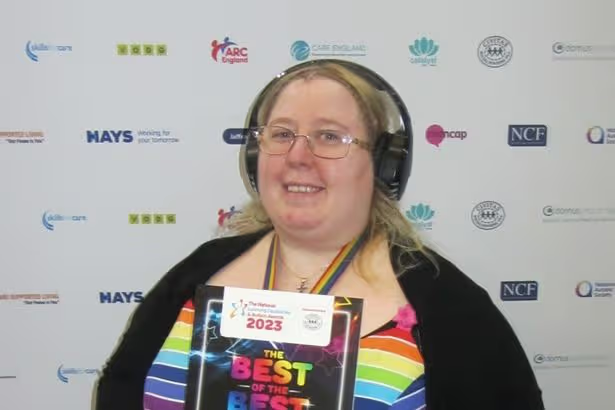
Vicki has spoken out about her diagnosis
Vicki who is a resident at Cygnet Elms(Image: Cygnet Elms)
A Birmingham-based woman has shared her pride in her autism diagnosis in a heartfelt reflection during World Autism Acceptance Month.
Vicki, who currently resides at Cygnet Elms, a care service in Birmingham, explained how she was knew she was “very different” to others when she was a young age.
She said: “I knew that I was very different to other people and that other people were experiencing different things to me.
“I could see that other people would be able to do things easily, that I found really hard – like going to the shop, going outside or processing school.”
Vicki was initially diagnosed with ADHD, however, she explained it was as though her “autistic needs were not being addressed,” which ultimately lead to her autism diagnosis.
READ MORE: The ‘scary’ Birmingham tunnel residents won’t walk through ‘even in the daytime’
“I was first diagnosed with ADHD as those symptoms were more obvious at first. However, after being medicated for my ADHD, it became clear and evident that my autistic needs were not being addressed.
“It was especially evident that I struggled with sensory sensitivities especially noise sensitivity and the struggles with regulating myself.”
Vicki admitted it was not easy at first being diagnosed with autism, sharing how she felt “ashamed” of her diagnoses.
She said: “For a long time, I was ashamed of my diagnoses. All of them. I didn’t want to be different from others and I was so desperate to fit in and be ‘normal’, not realising that normal doesn’t exist.
“I felt as though the diagnosis of Autism would mean that I was less than other people and wouldn’t be valued or able to find or maintain jobs and friendships and access day to day life.”
Vicki’s opinion on her diagnosis has since evolved completely, with the woman admitting with the help of companies such as Elms, her opinion of autism has changed – so much so she is even studying it at PhD level.
“With companies like Elms, and Open Theatre Company, my opinion of my Autism has changed. I am now proud to be autistic and I champion autism- even to the point of studying it at PhD level!”
She added, while she is proud of her diagnosis, she has found there are misconceptions regarding autism.
“People assume that because you are autistic you can’t do things. Or the opposite- people assume that because I am academically advanced (studying a PhD) that I can do things that I actually find really challenging – like practical things such as crossing a road, cooking, cleaning, or even processing information,” she said.
She went on: “One of the greatest things about living with autism is that I can use it to inspire others.
“Autism can be really disabling for me – such as struggling with crossing roads due to the sensations of the wind, that child screaming, that motorbike revving, that siren, the speed of the car, and the need to catch a bus – all which overwhelm me to the point that I forget the basics of how to be safe.
READ MORE: Birmingham’s biggest halal food court opens its doors to floods of Brummies
“However, being autistic is also my superpower as it provides me with a wealth of creativity that I can use to help me problem solve and share my life stories with other people in a creative way.”
“One of the worst” misconceptions Vicki explained for her is a phrase which is often thrown around.
She said: “There are still a lot of common misconceptions. One of the worst ones is that ‘everyone is a bit autistic,’ and another worst one is ‘high functioning / low functioning’ labels.
“These common misconceptions do not help the autistic community as it is now acknowledged that ‘once you know one person with autism, you know that one person with autism’ meaning that you cannot assume things about a person due to their diagnosis as we are all different and our experiences are different.”
She concluded: “Autism is both disabling and a superpower. It is not one or the other. It is both.
“I really struggle with some aspects of life due to being autistic, but I wouldn’t be doing my PhD if I wasn’t autistic- as I wouldn’t have the patience and determination and special interest in it – giving me the hyperfocus I need to complete such a high level degree!”