“The High Street is now a sad shadow of what it once was”
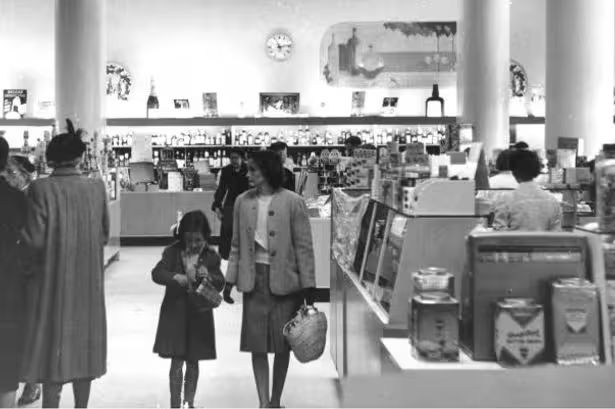
The food hall at Dingles(Image: PlymouthLive)
In that Kodachrome colour of the past, in my mind’s eye, I can imagine it all again. Saturday! The freedom day when a bus into town would be eagerly anticipated.
Down to Pete Russell’s Hot Record store leafing through the new blues and rock albums although the predominant music playing as you entered the small shop was nearly always jazz.
A mosey round John Conway’s to look at the new fashion wear especially the jean selection.
The strange draw of the pannier market with its bustling, crowded thoroughfares, intoxicating smells, stalls of American comics and fairground thick, cheap chocolate bars.
And then often to meet friends for coffee in Dingles. We didn’t perhaps take much notice of the grandeur of the building or the Portland stone exterior. Knew little about the history of Dingles only things we’d picked up from parents or aunties.
That the shop was scattered on various sites during the war, that the original Bedford Street site had been destroyed by the Luftwaffe and didn’t become the Dingles we knew until 1951.
I liked to approach Dingles from the New George Street entrance. It was not a conscious decision, just the most natural one. Perhaps it was the hustle and bustle of those pavements and the appeal of many of the other shops that led me that way the most often.
IN PICTURES: Take a tour of Plymouth’s Dingles store as it was in the 1970s
Past John Yeo and Spooners with a bridge later joining the two on the higher floors. Both had their appeal with large fashion departments and the Spooner’s Verandah restaurant was a place for waitress service teacakes and tea, its decor and sedate comfort was a luxurious toe dip into an older world.
And, of course, the two shops gave employment opportunities to so many of Plymouth’s teenagers. Saturday jobs, summer vacation positions.
A chance to taste the world of work often under the guidance of kind and patient older staff. Across the street Fuller’s restaurant where our parents would sometimes take us for a special occasion sitting in partitioned booths and waitress service and a special treat of a Knickerbocker Glory.
Although Royal Parade may have had more of an airy and open feel it felt more unused and somehow not quite so alluring. Through the heavy glass doors then and into the wonderland that was my favourite Plymouth department store.
From the archives: fashionable women outside Dingles in Plymouth(Image: Sally McClellan/Dingles Heritage Collection)
The geography of the shop is somewhat hazy in my memory and different eras merge a little into one another. But here on the left is the Food Hall, reminiscent I am to discover later in life of a mini Harrods. Refined and elegant older citizens mix with gauche teenagers like myself.
I’m usually on a mission to purchase something for my mother, often hog’s pudding or clotted cream. But prosaic and exotic products mix happily on the shelves and behind the counters. It is where you are more likely to bump in to an auntie rather than a friend though.
So on past the cosmetics where the glamorous and sophisticated girls offer advice and demos. I learn later that there are even fashion shows from time to time. The great Vidal Sassoon even paid a visit once.
Always up the escalator not knowing it was the first to be constructed in the country, post war, and drawing crowds of admirers. Glimpses of the ground floor and then emerging onto another level. There was a record department with listening booths and where I picked up on first day of release a copy of ‘Sgt. Pepper’s Lonely Heart’s Club Band’. It was 1967 and I was fifteen. Halcyon days.
Meeting friends in the cafe where we lingered too long over a cup of coffee much to the chagrin of waiting more elderly customers. Flirting, gossiping, joking, the young’s prerogative.
When departing, I nearly always left the store via the marbled staircase fire exit with its brass topped rails and where on the top floor the offices were situated. Paintings of west country scenes faced you as you clattered down the steps. It was quite an austere atmosphere but somehow tranquil before emerging onto the ground floor.
And how many Plymothians, did and still do, always refer to ‘Dingles’ never the ‘House of Fraser’ as if somehow that would be a betrayal?
And how many of us recall with nostalgic fondness those shops in New George Street?
Like Moon and Sons, where sheet music, pianos and gramophones were the order of the day.
From the British Record Shop Archive I learn that in the 1920s an Aircraftsman Ross, aka T.E. Lawrence (of Arabia), would visit the store on a weekly basis with the purpose of listening and purchasing records always requesting the same assistant, Joan Chase, to listen with him in the booth.
Such days are over. The High Street is now a sad shadow of what it once was.
All the shops linger on only in collective memory. But how enriching an experience they were. And not only for the shoppers I suspect but all of those employees who spent their lives serving others but hopefully, and I suspect, very probably, often enjoying themselves immensely and carrying with them lifelong friendships, romances and memories of better days.
Richard Gourd is a songwriter who grew up in Plymouth and now lives in Taunton