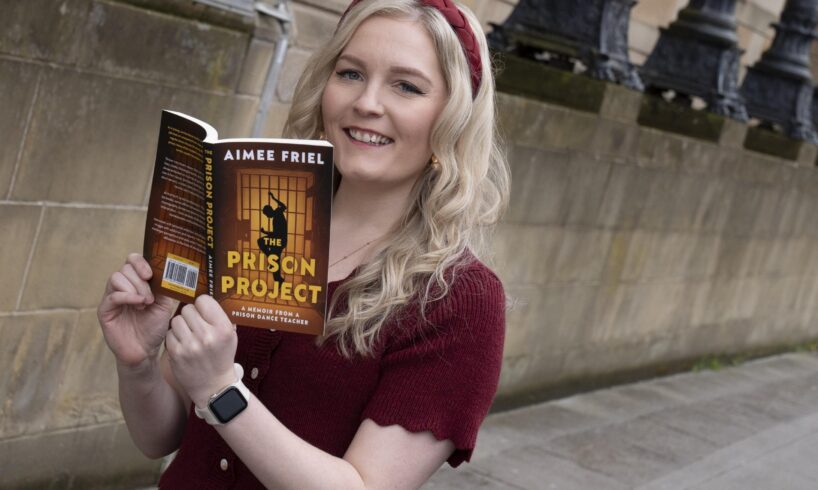
“I’d barely been out of college a few weeks, I hadn’t had a proper boyfriend, or a girls’ holiday, or even a full-time pay cheque yet,” she writes in her newly-published book, The Prison Project.
“I was quiet in school, with a small circle of friends … I’d had quite a shielded upbringing.”
She adds: “Confidence was key – and at first, I had to fake it.”
Aimee Friel (Image: Mark F Gibson/Newsquest)
Aimee, who is from Kirkintilloch, was employed to teach hip hop and contemporary dance to young offenders, as part of their rehabilitation.
She was 21 at the time, the same age as many of the young men she was supporting.
“It was daunting,” she admits. “My parents were worried. I was intimidated at first, definitely.
“I always knew I wanted to work in the community – I definitely see dance as a tool to help people – but this was a huge challenge.”
She pauses. “I didn’t expect to enjoy it as much as I did.”
Aimee Friel inside the Mitchell Library (Image: Mark F Gibson/Newsquest)
Aimee, now 29, has written a memoir about her experience, navigating tales of heartbreak and chaotic lives with moments of humour and joy.
“I started writing everything down because I didn’t want to forget it, although I never considered publishing it until my gran read it, and told me how much she enjoyed it,” says Aimee, smiling.
“My gran is great and always brutally honest, so the fact that she loved it so much planted a seed that maybe, it really could be a book.”
Aimee Friel pictured at the Mitchell Library (Image: Mark F Gibson/Newsquest)
The book, published by The Book Guild, also tackles issues such as trauma and so-called ‘toxic’ masculinity, highlighted in recent dramas like Netflix’s Adolescence and documentaries such as Louis Theroux’s Inside the Manosphere.
“I was writing this long before the ‘manosphere’ was being talked about openly, but ‘toxic masculinity’, the ways young men talk to and about women, are things I experienced and have written about in the book,” says Aimee.
“I was quite shocked by some of the things I heard. Our dance class was a way of helping to plant small seeds in their minds that talking like that was not acceptable.”
It was sobering, she agrees, to be in a room with young people roughly her age, whose lives had taken very different paths.
“I was worried they wouldn’t respect me, and at first, there was some reticence to getting involved in a dance class,” she says.
“But as time went on, they definitely saw me as an equal, and we built up trust. It is not about excusing their crimes, it is all to do with rehabilitation.”
Aimee’s love of dance began at high school.
“I was not one of those children who is in a tutu from the age of two,” she says, with a laugh. “I remember learning a bit about dance at a sports day at school, and it was around the time Diversity had been on Britain’s Got Talent and hip hop was popular. I gave it a try and loved it – I thought the teacher was the coolest person I had ever met.
“I think there still are misconceptions around dance – I’d get the odd comment along the lines of, ‘oh, what do you do all day, is it just messing about in a leotard?’ but I have seen first hand the positive impact it can have on people.”
Aimee’s experience in the prison inspired her to change career, and she is now a primary school teacher.
“I want to keep working with young people,” she says. “I saw the difference you can make to someone’s like just seeing them once a week, so imagine what you can do if you are there for them every day?
“Working in the prison was a huge challenge but it has definitely taught me a lot. Hearing stories from the prisoners about their childhoods has made me see any child that I’ll teach through a different lens.”