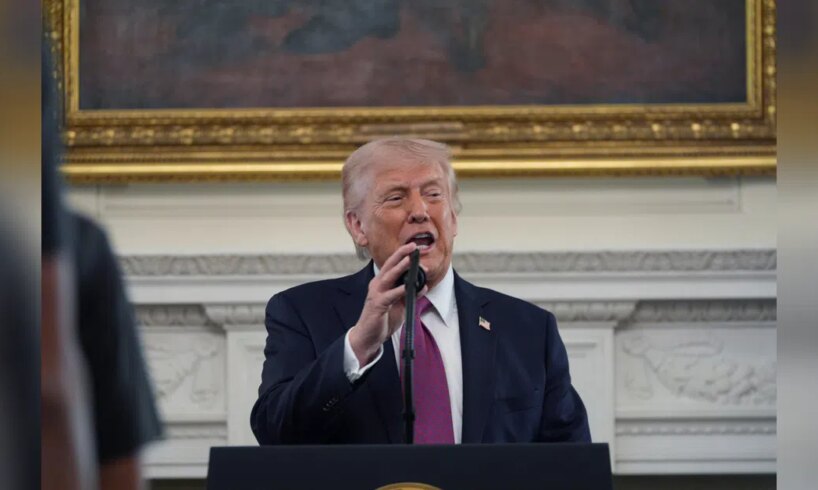
The Ministry of External Affairs (MEA) on Thursday called US President Donald Trump’s social media post on Indians “obviously uninformed, inappropriate and in poor taste”. “They certainly do not reflect the reality of the India-US relationship, which has long been based on mutual respect and shared interests,” official spokesperson Randhir Jaiswal said in a statement.
The US President had reposted the transcript and video of American political commentator and radio host Michael Savage’s podcast ‘Savage Nation’ earlier in the day, which described Indian and Chinese immigrants as “gangsters with laptops” who have “stepped on our flag”.
“They’ve done more damage to this nation than all the mafia families put together. In my unhumble opinion. Gangsters with laptops. They’ve robbed us blind, treated us like second-class citizens, let the trud world triumph, stepped on our flag, et cetera,” Savage wrote.
Hours after Trump reposted the racist comment, where he referred to India, China and other nations as “hell holes,” the US Embassy in New Delhi sought to control the damage done by the controversial post.
The president has said, “India is a great country with a very good friend of mine at the top,” the spokesperson of the US embassy said.
The spokesperson’s statement came in response to queries from the Indian media about Trump reposting Savage’s podcast. The spokesperson did not specify where and when Trump made the remarks that India is a great country.
Earlier in the day, the Congress party flagged the offensive remarks. In a social media post, it said that the statement is “extremely insulting and anti-India.” “It hurts every Indian. Prime Minister Narendra Modi should take up this matter with the US President and register a strong objection,” the Congress said.
Savage had made the comments in the context of a case in the US Supreme Court challenging birthright citizenship. In his podcast, Savage called for changes in the US’ birthright citizenship law.
He alleged that people from India and China migrate to the US to “drop a baby in the ninth month,” and the law turns them into “instant” US citizens. “They’ve robbed us blind, treated us like second-class citizens, let the trud world triumph, stepped on our flag, et cetera,” Savage wrote.
“A baby comes here becomes an instant citizen, and then they bring the entire family in from China or India or some other hellhole on the planet,” Savage’s comment read.
The Congress said that given the PM’s “track record so far, it cannot be expected that he will say anything in front of Trump.” Trump has repeatedly made insulting remarks about India, and Modi has remained silent. Narendra Modi is a weak PM, and the entire country is bearing the brunt of it,” the Congress said.
Congress president Mallikarjun Kharge said that Indians have played a vital role in America’s success. “What is stopping us to raise this at the highest levels of the American government?” Kharge asked, adding that he sincerely hoped that the PM reacts to “this intimidation and indignation of 1.4 billion people.”
On the India-US trade negotiations, the MEA said that the two countries are engaged in constructive talks. A 12-member Indian trade delegation made a three-day visit to the US this week.
“These engagements are ongoing and constructive,” Jaiswal said. “Both sides are working towards a balanced, mutually beneficial and forward-looking trade agreement, taking into account each other’s concerns and priorities, and to achieve a trade target of $500 billion by 2030,” he said.
In Washington, US Trade Representative Jamieson Greer said that India is a “tough nut to crack”. The 12-member Indian delegation, led by Additional Secretary Darpan Jain held talks on the fine print of the trade deal with the US team led by Brendan Lynch, Assistant USTR for South and Central Asia. The three-day talks concluded on Wednesday.
“As part of this deal, they want to protect a lot of that. There are things, though, where I think we can find mutual agreement. DDGs (distillers dried grains) is a good example of this,” he said. Greer was responding to questions by lawmakers on exports of DDGs, which are used as high-protein livestock feed, soybean meal and ethanol.