
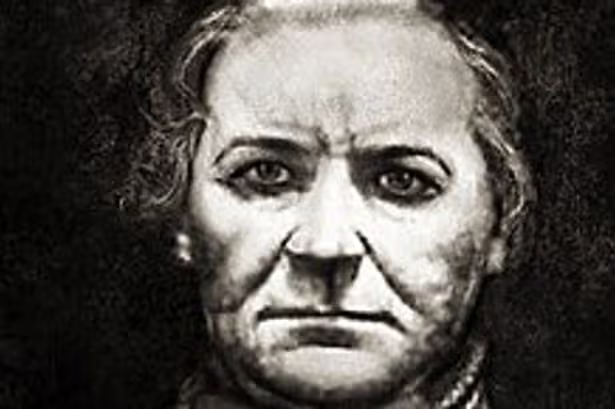
Amelia Dyer’s crimes were fuelled by the shame associated with single motherhood in Victorian Britain
Abigail Neep South West Regional News Reporter
12:01, 25 Apr 2026
Amelia Dyer was hung for her crimes
The discovery of a baby girl’s body in the River Thames 156 years ago uncovered a chilling series of murders committed by a Bristol woman, who said “You’ll know all mine by the tape around their necks.”
In 1869, two bodies were found near Caversham Lock inside boxes that were not weighed down enough to sink.
Inside a bag containing the body of a baby girl, a label for Temple Meads station provided a crucial clue that eventually traced back to one of history’s most prolific serial killers, a woman born and raised in Pye Marsh, what is now St George.
The woman’s name was Amelia Dyer. In 1896 she was tried and hanged for just two murders but there is little doubt she carried out numerous others. Some historians hold her accountable for around 400 infant deaths – a feat that earned her the nickname “Angel maker”.
But this unsettling epithet is a name of some irony, as Dyer was once a respected member of the Salvation Army and considered as a maternal figure in Bristol, she had a background in nursing and a history of taking expectant mothers into her care.
Dyer was the daughter of a master shoemaker and enjoyed a good lifestyle and education, her husband worked in a vinegar factory and she had one child herself.
She moved to Long Ashton, where she set up a ‘baby-farm’ after training as a midwife and nurse.
Dyer took in expectant mums, many of whom were unmarried and facing social stigma, from homes around Totterdown and Brislington.
Baby farming was a common, and often profitable, business in Victorian Britain that was said to be fuelled by the shame associated with single motherhood.
Amelia Dyer is thought to have murdered over 300 babies
Operating largely outside of modern regulation, these ‘farmers’ acted as adoption agents for an upfront fee. While some may have acted in good faith, the practice was frequently abused.
Since the farmers profited from the initial fee, it was often in their interest for the children left in their care not to survive.
Furthermore, some mothers would request that their babies be killed immediately after birth, knowing that coroners of the era often lacked the expertise to distinguish between suffocation and stillbirth, and to avoid the stigma altogether.
For almost three decades between the 1860s and 1880s, Dyer made between £5 and £80 for each child she claimed to look after and became a maternal figure with a house full of children, but many of these babies were dying.
After a doctor became suspicious about the number of death certificates he was issuing for babies in her care, Dyer was jailed for six months hard labour for neglect.
But it was just neglect, the babies were being murdered.
Now, abusing drugs and alcohol, Dyer changed tactics. She began moving around the country, she changed her name and even faked a mental illness to get into an asylum, escaping arrest.
She was killing the babies in her care by asphyxiation with white tape.
She wrapped their bodies in paper parcels or carpet bags, and dumped their bodies in the River Avon and River Thames, abandoning all attempts to make their deaths seem natural.
Her downfall came on March 30, 1896, when a bargeman discovered a package floating in the Thames.
Inside was the body of a baby girl later identified as Helena Fry, and Reading Borough Police Chief Constable George Tewsley assigned his detectives to the case.
Detective Constable Anderson carried out a microscopic examination of the wrapping paper and was able to decipher a faintly written name and address. A label for Temple Meads Station was also recovered.
That evidence led directly to Amelia Dyer’s home in Reading.
When officers arrived, they found no bodies, despite being met by what reports described as the stench of rotting flesh.
Knowing Dyer would likely flee if she became suspicious, police placed the house under surveillance and sent a young woman undercover as a decoy client seeking her services.
When Dyer opened the door expecting a mother, she instead found detectives waiting.
She was arrested and charged with murder, and her son-in-law Arthur Palmer was charged as an accessory.
Police ordered for sections of the Thames to be dredged, and six more bodies were recovered.
As police searched the river, Dyer famously told them: “You’ll know all mine by the tape around their necks.”
Inside Dyer’s house, officers also found letters from mothers, evidence of adoption arrangements and mountains of baby clothes suggesting she had murdered many more children.
At the inquests into the deaths of the children in Reading, which took place in early May, no evidence was found that her daughter, Mary, or Arthur Palmer was involved in the crimes and Arthur was discharged as the result of a confession letter written by Dyer from prison.
The confession, along with letters and personal artefacts, survives in the Thames Valley Police’s archives.
It said: “Will you kindly grant me the favour of presenting this to the magistrates on Saturday of the 18th. I have made this statement out for I may not have the opportunity then, I must relieve my mind.
“I do know and feel my days are numbered on this Earth but I do feel it an awful thing drawing innocent people into trouble.
“As God Almighty is Judge in Heaven as on Earth neither my daughter Mary Ann Palmer or her Husband Arthur Ernest Palmer I do most solemnly declare neither of them had anything at all to do with it.”
Amelia Dyer’s confession letter after her arrest(Image: Thames Valley Police)
Dyer pleaded insanity at her Old Bailey trial.
Her defence pointed to hymn-singing and religious displays in prison as evidence that she was mentally unwell, but prosecutors argued the behaviour was devious play acting, similar to the pattern she had used before when suspicions rose around her.
Her confession to the Chief Superintendent continued: “I do hope to be forgiven, I myself and I alone must stand before my maker in Heaven to give a answer for it all, witness my hand, Amelia Dyer.”
It took just ten minutes for the jury to convict her and she was hanged at Newgate Prison on June 10, 1896.
In the years that followed Parliament passed legislation including the Infant Life Protection Act (1897) and the Children’s Act (1908) with requirements that local authorities must be notified within 48 hours of any change of custody or death of a child under the age of seven.
Strengthened adoption and fostering rules meant that baby farming became a thing of the past.