Shafaq News
In Baghdad, governments are not born
from ballot boxes alone; they emerge from a long chain of understandings,
guarantees, and mutual anxieties, and it was into this chain that Kurdistan
Region President Nechirvan Barzani pressed his weight during a two-day visit to
the capital that, in its timing and the breadth of its meetings, amounted to
something more deliberate than protocol.
On the surface, the visit followed a
familiar pattern: a Kurdish leader arrives in Baghdad ahead of a new government
cycle, reaffirms constitutional principles, and returns to Erbil. But the
political moment it landed in was anything but routine. Iraq’s government
formation process is unfolding under simultaneous pressure from an unresolved
regional conflict, Washington’s recalibrating posture toward Baghdad, Tehran’s
calculations about the next Iraqi cabinet, and a set of Erbil-Baghdad disputes
—oil, salaries, budget allocations, the status of disputed territories under
Article 140— that have not left the negotiating table in years.
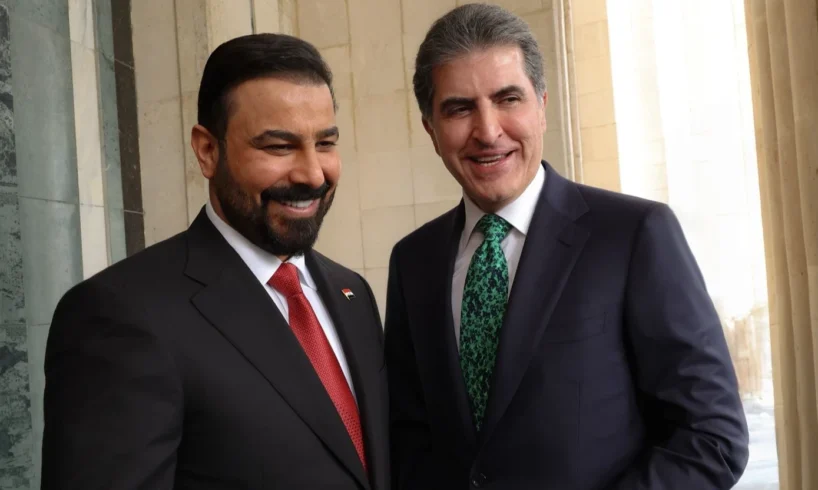
Within the first hours of his
arrival, Barzani met with leaders of the Shiite ruling Coordination Framework,
including State of Law head, Nouri al-Maliki, caretaker Prime Minister Mohammed
Shia al-Sudani, al-Hikma (Wisdom) Movement leader Ammar al-Hakim, then with
prime minister-designate Ali Falah al-Zaidi, and leaders of the Sunni National
Political Council.
The agenda moved from government
formation to oil revenue sharing, salary arrears, the federal budget, and the
necessity of insulating Iraq from regional escalation —a range that reflected
not a courtesy call but a substantive attempt to shape the parameters of what
comes next.
Official statements from the
meetings emphasized the need for a government “commensurate with the
challenges of the current phase,” capable of meeting the demands of Iraq’s
constituent communities while resolving outstanding Erbil-Baghdad disputes on a
constitutional basis. Barzani also reaffirmed Kurdistan’s readiness to support
the new government’s formation.
Testing the Ground
Kurdish politician Abd al-Salam
Barwari described the visit as “a new positive development for breaking
the tensions that accompanied the post-presidential election phase”
—tensions that had been building since the KDP staked a claim to the Iraqi
presidency as a matter of established political entitlement, only to find Sunni
and Shiite coalition leaders divided between rival Kurdish candidates, with
some backing the PUK’s nominee, Nizar Amedi, over Fuad Hussein, one of the
KDP’s most senior figures. Barwari was careful to characterize Barzani’s
meetings as exploratory rather than conclusive— closer to preliminary
consultations for testing positions and exchanging views before the moment of
decision than to a finalized political settlement.
Speaking to Shafaq News, Barwari
pointed to al-Zaidi’s recent visit to Erbil, where the prime minister-designate
met separately with Kurdistan Democratic Party (KDP) leader Masoud Barzani,
President Nechirvan Barzani, PM Masrour Barzani, and Patriotic Union of
Kurdistan head, Bafel Talabani, as evidence that the Kurdistan Region’s
position is being treated as a structural variable in the government formation
calculus, not an afterthought.
The KDP’s weight in that calculus is
concrete: the party secured over one million votes in November’s parliamentary
elections, the highest total of any single party nationwide, translating into
26 seats in parliament, making it a bloc no government formation can ignore
mathematically. Political circles in Baghdad read that visit as an attempt to
avoid repeating the crises that plagued previous governments’ relationships
with the Region from the outset.
Researcher in political affairs
Suhad al-Shammari offered a broader frame, noting that the current government
formation is unfolding in conditions meaningfully different from previous
cycles, with a prime minister-designate navigating simultaneously between
rebuilding trust among political forces, managing divisions within each
community, and arranging a working relationship with the Kurdistan Region that
does not begin in confrontation.
Barzani’s visit, in her assessment,
signals Kurdistan’s readiness to “engage constructively,” though she stopped
short of predicting specific outcomes, describing the visit’s likely
contribution as “bringing positions closer rather than resolving the underlying
disputes.”
That picture from the meetings said
more than any statement. In one session with leaders of the Sunni National
Political Council, Barzani sat at the center flanked by prominent Sunni
figures, including rivals Khamis al-Khanjar and Mohammed al-Halbousi, a
composition that appeared to summarize the visit’s function.
He was not present solely as Erbil’s
representative but as someone operating in the grey space between adversaries,
attempting to anchor a proposition: that the next government cannot be born
from an internal Shiite understanding alone, nor from an isolated distribution
of positions, but from a broader equilibrium that includes Kurds, Sunnis, and
Shiites within a single political architecture. Both sides agreed that the new
government must prioritize services and reconstruction, and that dialogue among
political forces must be the entry point for resolving crises rather than a
formality that follows them.
Files That Never Leave the Table
Political analyst Ali al-Baydar
situated the visit within a structural argument, telling Shafaq News that the
issue is less about individual political figures than about the prevailing
political culture, and that the next government will largely be a continuation
of the Coordination Framework’s internal balances, with the variable being how
Baghdad manages its relationship with Erbil rather than whether that
relationship changes fundamentally.
Al-Baydar assessed al-Zaidi as
someone disinclined toward escalation with the Region or toward unilateral
decisions against it, suggesting the new prime minister-designate may offer
more room for addressing outstanding files within constitutional frameworks
than his predecessors, while leaving open whether that room translates into
resolved disputes.
Hussein al-Kinani, head of al-Hadaf
Center for Studies, noted to Shafaq News that Barzani’s meetings with al-Zaidi
fall within the standard pattern of coalition-building that precedes every new
government cycle, but that their substantive content centers on concrete
unresolved files: the federal budget, oil exports, oil and non-oil revenues,
and the degree to which both Erbil and Baghdad have honored previous
agreements.
Those files carry weight beyond the
political. Salaries in the Kurdistan Region have become a recurring living
crisis for the population. Oil has become the permanent headline of the
constitutional and financial dispute between Erbil and Baghdad, a dispute
sharpened in 2023 when the International Chamber of Commerce in Paris ruled
that Turkiye must pay Iraq approximately $1.5 billion for breaching the
Iraq-Turkiye Pipeline agreement by allowing unauthorized Kurdish oil exports,
halting loading, and export operations through the pipeline, and significantly
impacting the Region’s revenues. The budget, renegotiated in cycles, has
exposed the fragility of arrangements that both sides treat as temporary. Taken
together, they make Barzani’s visit an early test of whether the incoming
government intends to manage these crises as it finds them or move toward
closing them, a distinction that matters more to the Region’s population than
to the political class on either side.
Al-Zaidi is operating under time
pressure, constitutionally required to present his cabinet within 30 days, and
aware that passing the government will require more than a numerical
parliamentary majority; it will require understandings that ensure Kurdish and
Sunni participation within an arrangement that no party feels excluded from.
Barzani’s visit, in this reading,
functions as an attempt to produce a dual political guarantee: an assurance to
Erbil that the incoming Baghdad will not revert to the language of financial
pressure and punitive measures, and an assurance to Baghdad that the Region
will be a source of governmental stability rather than a recurring source of
tension.
The details of ministerial
portfolios and the distribution of positions also remain subject to ongoing
negotiation. What Barzani’s visit makes visible is that the contest over the
next government is not only about who enters the cabinet, but about the shape
of the state that cabinet will manage, the boundaries of the relationship
between center and Region, and Iraq’s capacity to hold its internal
arrangements together in a region changing faster than its political class is
moving to keep pace.
The Bill Comes Due
Three baseline conditions Barzani
wanted to stress before the new government takes shape: genuine partnership in
decision-making, constitutional rather than provisional solutions to the
outstanding files, and Iraq’s insulation from the currents of regional
escalation. Whether those conditions become structurally embedded in the next
government or remain aspirational language in post-meeting statements is the
question the visit leaves open.
Written and edited by Shafaq News
staff.