Indigenous Services Minister Mandy Gull-Masty says $8.5 billion will begin flowing to Ontario First Nations on May 29 to reclaim their child welfare systems.
The funding stems from a landmark settlement agreement reached between the federal government and 131 Ontario First Nations for long-term reform of on-reserve child and family services in their communities. The deal was approved last March by the Canadian Human Rights Tribunal.
Indigenous Services Canada estimates it will make approximately $158 million of the $8.5 billion available by the end of the month. The amount that each First Nation will receive will depend on its population, remoteness and other factors, according to the department.
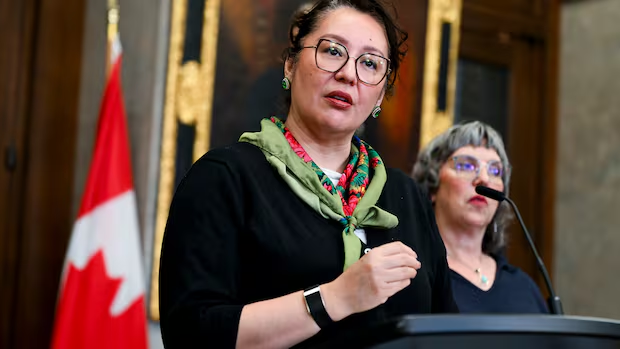
“Too many children grow up in systems that were never designed by their communities,” Gull-Masty said during a news conference on Friday in the foyer of the House of Commons. “When First Nations exercise their jurisdiction over child and family services, we see the outcomes that matter the most and we see significant improvement.”
The settlement funding is being delivered on top of money communities are already receiving for child and family services. It will be given to First Nations and to child and family service providers.
Nishnawbe Aski Nation Grand Chief Alvin Fiddler, whose organization represents 49 First Nations in northern Ontario, told CBC News the money will help communities make their own decisions about their children, prevent apprehensions and keep them connected to their culture.
“I’m really excited about what this will mean for our communities,” Fiddler said. “I’m just so grateful.”
Fiddler said each First Nation may spend its money differently, but all the funds will go toward a variety of supports such as facilities for child and family services, housing, food security and addictions treatment.
Alvin Fiddler, right, Grand Chief of Nishnawbe Aski Nation, said each First Nation in Ontario will spend its portion of the $8.5 billion differently, but he added they all have same goal: keeping children within their communities. (Nathan Denette/Canadian Press)
First Nations and service providers are expected to report regularly to Indigenous Services Canada on the use of the funding received under the agreement. If necessary and justified, the department said it may undertake audits.
“We welcome that oversight,” Fiddler said.
The Ontario agreement could be used as a model for other regional agreements with First Nations across the country to design and implement their own child and family services.
“As a former First Nations leader, I understand and know the importance — and also as a mother — what lasting change means when communities take their place to shape the systems that serve their children,” Gull-Masty said.
Negotiations are taking place with First Nations in Treaty 8 and 6 in Western Canada, the Assembly of Manitoba Chiefs, and First Nations in Atlantic Canada and Quebec, according to Gull-Masty.
The Canadian Human Rights Tribunal asked the federal government to complete talks by the fall, she said. Instead of rushing communities into a deal, Gull-Masty said she’s asking them to determine whether they want to strike a regional agreement or be part of a national one.
Assembly of Manitoba Chiefs Grand Chief Kyra Wilson told CBC News it’s considering a regional deal, but wants to make sure it would include enough support for families and caregivers, infrastructure, and to cover all First Nations children — not just those residing on-reserves.
“We need to ensure that we’re not leaving any children behind,” Wilson said. “This process, obviously, cannot be rushed, and so we are going to let Canada know that you’re going to have to respect our timelines as well.”
Ottawa trying to strike other regional deals
The Canadian Human Rights Tribunal greenlighted the Ontario deal with all of the province’s First Nations except Georgina Island First Nation and Taykwa Tagamou First Nation.
Gull-Masty said the federal government is seeking a narrow judicial review of that decision to better understand why.
The tribunal issued a letter decision when it announced its approval to ensure First Nations would not lose out on a full year of funding, and said a formal decision would be released later.
Gull-Masty said she visited Georgina Island earlier this week, and described the conservation with its chief and council as positive.
She also said she reached out to Taykwa Tagamou, and promised federal funding for child and family services in both communities will continue.
CBC News reached out to Georgina Island and Taykwa Tagamou for comment, but did not hear back before deadline.
Grand Chief Kyra Wilson of the Assembly of Manitoba Chiefs speaks at the Assembly of First Nations Annual General Assembly in Winnipeg on Sept. 3, 2025. (John Woods/Canadian Press)
The Ontario development marks a step toward resolving a dispute dating back to 2007 when the Assembly of First Nations and the First Nations Child and Family Caring Society filed a human rights complaint against the federal government for underfunding the on-reserve child welfare system.
In a 2016 ruling in response to that complaint, the Canadian Human Rights Tribunal concluded Ottawa discriminated against First Nations children and said Canada’s actions led to “trauma and harm to the highest.”
In 2019, the tribunal ordered Canada to pay maximum penalties under the Canadian Human Rights Act, and ordered long-term reform of First Nations Child and Family Services.
More than $23 billion in individual compensation announced under former prime minister Justin Trudeau is rolling out to more than 300,000 First Nations children and families, but long-term reform work is still mostly unresolved.
The Assembly of First Nations rejected a national $47.8-billion deal proposed by the Trudeau government for reform work because it excluded children who live off-reserve and didn’t include continuous funding.
Chiefs in Ontario then voted in favour of a separate provincial deal with Ottawa — the first of its kind in the country.
A new federal child welfare offer was presented by Prime Minister Mark Carney’s government last year. It proposes $35.5 billion in funding to 2033-34, followed by an ongoing commitment of $4.4 billion annually.
The new offer is being assessed by the Canadian Human Rights Tribunal, along with a counter proposal by First Nations leaders and children’s advocates.
“The path forward that we are committed to follows a key principle: First Nations must lead with full jurisdiction and the resources to reach the goals that they have set,” Gull-Masty said.
“The Ontario Final Agreement is a powerful example of what is possible when agreements reflect regional realities and support solutions created by and for communities.”