2026-05-12T15:00:09+00:00
font
Enable Reading Mode
A-
A
A+
Shafaq News- Baghdad
Before spring slips away each year,
Suad Ali follows a journey she has known since childhood. Alongside her mother
and grandmother, she heads to the shrine of al-Khidr on the banks of the Tigris
River in Baghdad, carrying candles, silent prayers, and wishes too personal to
say aloud.
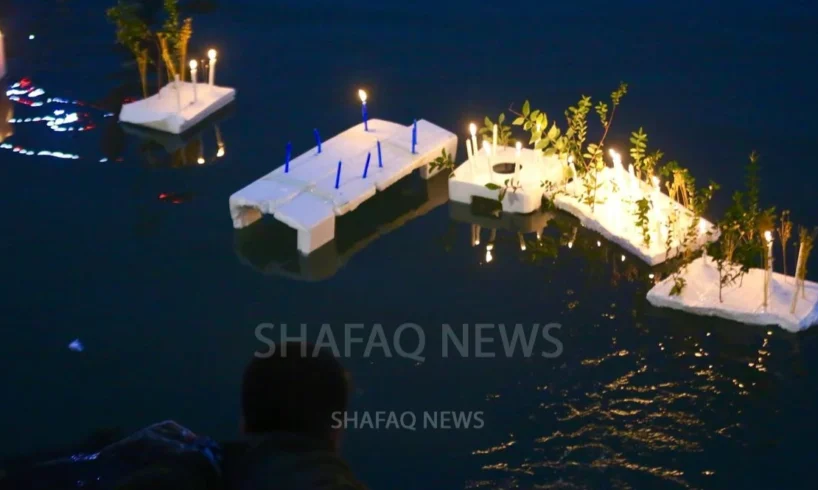
As darkness settles over the river,
dozens of small flames begin drifting across the water. Families gather quietly
along the shore, watching the candles float into the night as if the river
itself might carry their desires somewhere beyond reach.
“With every candle, we carry a
wish,” Ali reflected to Shafaq News. “We pray that it will come true.”
Known in Iraq as “al-Khidr Candles,”
the ceremony remains one of the country’s oldest surviving folk traditions. For
generations, families living near the Tigris and Euphrates rivers have marked
certain spring evenings by lighting candles and placing them on palm fronds or
small wooden boards before releasing them into the current. The occasion is
especially associated with the month of May, which Iraqi popular tradition
links to blessings, renewal, and answered prayers.
Many Iraqis believe al-Khidr —a
revered figure in Islamic tradition associated with wisdom, guidance, and
miraculous appearances during hardship— becomes spiritually present during this
period. Some arrive hoping for marriage, while others pray for healing, the
return of an absent relative, success for a child, or relief from personal
struggles. The farther a candle travels without being extinguished, according
to popular belief, the greater the chance that the accompanying prayer will be
fulfilled.
Although no clear historical account
explains how the custom first emerged in Iraq, folklore researchers believe it
likely evolved through the blending of local traditions and older spiritual
practices tied to rivers and flowing water. Iraqi folklore researcher Ali
al-Ward explained that Wednesday and Thursday nights have long been regarded as
blessed evenings in Iraqi social life, which is why many families choose one of
those nights to perform the ceremony.
Al-Ward stressed that the practice
is rooted more in emotional and social memory than in religious doctrine. Over
time, he noted, it became part of Iraq’s cultural identity, surviving political
upheaval, wars, and the rapid transformations that reshaped everyday life
across the country.
For women in particular, the
tradition often carries deeply personal meanings shaped by longing,
uncertainty, and optimism. Some longstanding customs involve unmarried women
removing their abayas inside the shrine courtyard while praying for marriage, while
others later return with offerings of myrtle, lit candles, and trays filled
with traditional treats after believing their wishes have been fulfilled.
“They arrive carrying flowers while
women around them break into ululations,” Bidaa Abdul Zahra described,
recalling evenings when marriages or long-awaited prayers were celebrated at
the shrine.
Near the al-Khidr shrine in
Baghdad’s al-Allawi district, Palestinian-Iraqi resident Nihal al-Zaki still
remembers childhood evenings spent watching glowing candles drift toward her
neighborhood from distant parts of the capital.
“Whenever a flame stayed lit for a
long time, we believed someone’s wish would finally come true,” al-Zaki
recalled. “We waited for those candles every Wednesday night.”
Women traditionally remained
standing by the riverbank until the candles disappeared into the darkness,
holding onto the fragile comfort offered by the tiny moving lights. Over time,
“al-Khidr Candles” found their way into Iraqi poetry, folk songs, and oral
storytelling, becoming more than a custom —a symbol of patience, longing, and
resilience.
The tradition also stretches beyond
religious boundaries. Sattar al-Hilu, the spiritual leader of Iraq’s Mandaeans
—an ancient monotheistic community whose religious practices center on flowing
water and baptism— noted that Mandaean religious texts contain no references to
vows or offerings linked to al-Khidr, though the figure remains deeply
respected among Mandaeans, much as he is among Muslims and other Iraqi
communities.
Among Christians, some believers
associate al-Khidr with Mar Elias, or Saint Elijah. Raya Emmanuel, from the
Christian-majority district of Hamdaniya in Nineveh province, explained that
Christians also light candles in his honor, though more as a gesture of
reverence toward a sacred figure than a ceremony tied to personal wishes.
Along the rivers that shaped some of
humanity’s earliest civilizations, the small floating flames continue to gather
Iraqis from different faiths and backgrounds around something profoundly
simple: the enduring desire to believe that even the faintest light can survive
the current.