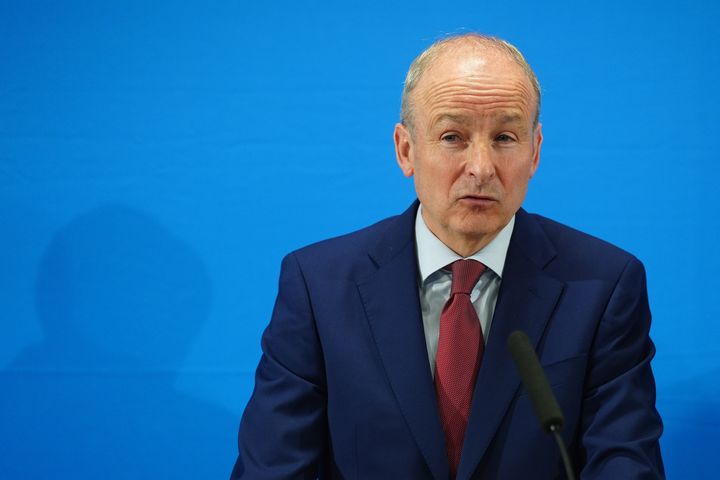
Mr Martin defended not deploying more of the State’s surplus to address the cost‑of‑living crisis, saying the Government must balance short‑term pressures with long‑term stability.
He said that, aside from the billions being placed into strategic investment funds, the Government could still run a surplus of around €2.5bn.
Speaking on Monday with Gavan Reilly on Virgin Media One, he also warned of the need to maintain reserves in case of further volatility in global energy markets.
“We’ve got to make sure that we have reserves to deal with any forwarder deterioration in terms of oil supply but consequential increase in price – that is a big concern for me.”
He added: “I think it does make sense that we would keep some funding in reserve for the Budget.”
The Taoiseach said the Government had already intervened to the tune of €750m in response to the fuel crisis this year.
He said there is “a range of things” Government can do in the Budget to “alleviate the pressures on families”.
“Tax is one, childcare is a key area, social protection for pensioners, and for lone parents, and people on low incomes more generally,” he said.
“And then, we have other specific measures we can do also to try and alleviate pressures. Retrofitting can help quite a number of families.
“So, we will make choices at the Budget, but the overall theme will be to reduce pressures on families because we acknowledge that families are under a lot of pressure.”
In the wake of US president Donald Trump saying the ceasefire in the Middle East is “on life support”, Mr Martin said it is important to ensure there is money in reserve to deal with any future impacts of the war in Iran.
“We can’t have a budget every month, and so we’ve got to make sure that we have reserves to deal with any further deterioration in terms of oil supply, with a consequential increase in prices.”
On the prospect of a “mini budget” in July, with fuel prices expected to remain high and the current package of Government supports set to expire, Mr Martin said “we’ll have to cross that bridge when we come to it”.
“We’ll see what will happen in July in terms of that. I mean, I think some people are asking, are saying we should put three or four billion in right now.
“We’ve got to be very careful we don’t fuel inflation and that anything we do it gets eaten up.
“We’ll need that in terms of increases, in terms of potentially more capital requirements – in terms of schools, for example, and other areas.”
He continued: “But, I do think we need to work through things as well and ask ourselves the question, what’s the best way to get people through next winter when this will hit the hardest?
“That’s the question we’re asking and saying we will deal with that in the context of the Budget in October.”
Asked if some of the commitments in the Programme for Government would have to be shelved, the Taoiseach said this Government still has four budgets to go, the economy is “proving resilient” and those commitments are to be delivered on “over the lifetime” of the Government.
Elsewhere in the interview, asked to explain the point of Fianna Fáil as it approaches its 100th anniversary in 2026, he said it was pro-European, pro-enterprise and believed in social progress.
Asked whether he believed Fine Gael was in favour of Europe, enterprise and social progress, Mr Martin said: “There’s no problem with having two parties of the centre, I would argue maybe Fine Gael might be more centre right and we were more centre left.”
Pressed to explain the differences between the two parties, he said: “I think if you look at over the last number of years, for example, in terms of budgetary approaches – if you take housing, for example, I actually think we’ve made a difference on housing since we came back in.”
He added: “I think we did make a difference as a party, and I think historically, we’ve had very significant achievements.”
“There is an attitude within Fianna Fáil that when you get into government, you get things done.”
The number of people accessing emergency accommodation has increased since Fianna Fáil took over the housing portfolio during a lull in the Covid-19 pandemic, which then saw a return to a pre-existing years-long upwards trend.
The figure was at 10,148 months before coronavirus restrictions came into effect and is at 17,517 now.
The Government has also officially abandoned annual housing completion targets for this term, instead setting a term-long goal of 300,000 homes out to 2030 – but has been off track based on previously published targets.
Opposition parties also criticised the Fianna Fáil-led department in the previous coalition, stating its targets had been too low and it had underdelivered affordable and social housing.
Mr Martin also said the party continues to make “very significant new departures” in terms of Northern Ireland, as he pointed to Fianna Fáil’s history with the Good Friday Agreement and the current Shared Island Unit within the Department of An Taoiseach.