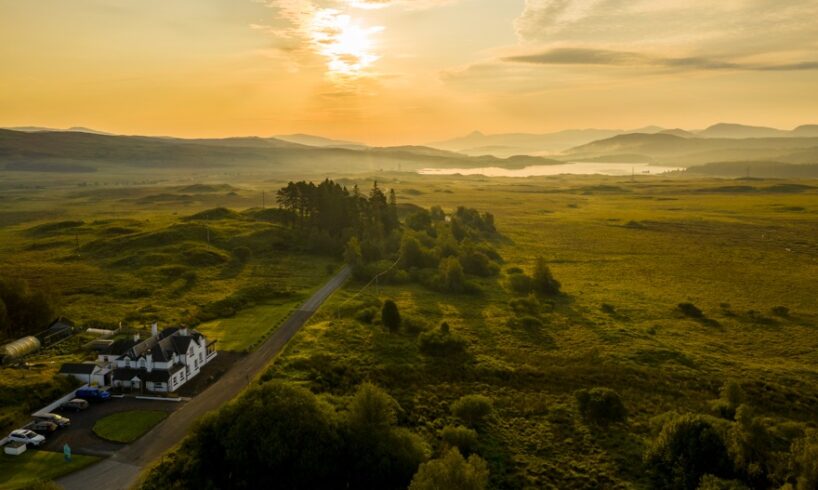
Now, the rural hotel – which sits in the middle of the wilderness of Rannoch Moor, boasts a two AA rosette restaurant and is just a stone’s throw from Rannoch Station – has been given the green light to expand.
On Wednesday, May 13, Perth and Kinross Council’s Planning and Placemaking Committee was recommended by council planners to approve plans which include a two-storey staff accommodation unit, café, outdoor seating area and car park.
The application received 10 letters of objection and 17 letters of support.
Credit: Moor Of Rannoch Hotel
Read More:
Objectors expressed concerns about the visual impact and scale of the proposal and how it would affect the unique and iconic wild landscape. Concerns were also raised about the impact it would have on the community-run tearoom at Rannoch Station but Perth and Kinross Council did not deem this a material planning consideration.
The report – put before councillors – said: “The planning system operates in the long-term public interest. It does not exist to protect the interests of one person or business against the activities of another.”
Presenting the application to the committee, architect Ged Young said: “The provision of on-site staff accommodation is critical to sustaining the operation of the hotel. Without it, recruitment and retention in such a remote area is extremely challenging.”
Regarding the design, he explained it would be built using repurposed shipping containers – clad in timber – as a “practical and sustainable response to the challenges of constructing in such a remote location”. He said the modular construction would “allow flexibility and adaptability where future needs may evolve”.
Please credit Aim Design if using this image
Hotel owner Scott Meikle told councillors he and his wife Steph – “a graduate architect who also happens to be a very high-quality chef” – bought the Moor of Rannoch back in 2013.
He told councillors that, together, they had “built a quality hospitality experience in a very remote part of Scotland” and a “high-end restaurant” attracting almost 2,500 guests a year.
The hotel is open from the beginning of February until the end of November and currently employs three full-time and three part-time members of staff.
He explained the development would be built on “almost exactly the same footprint” of three previous buildings – built in the 1950s and demolished between 2009 to 2011 – currently used as the hotel’s car park.
The Meikles proposed creating staff accommodation, a deer larder and butchery as well as facilities for the hordes of daytrippers who descend upon the remote location . The tourism facilities would include accessible toilets, baby-changing facilities, fresh drinking water, Wi-Fi, bike maintenance points, charging points for mobile phones and electric bikes and stop visitors ringing their doorbell requesting them.
He added: “It sounds selfish, we wish to stop people ringing our doorbell 10 times a day and provide those facilities free of charge in the car park.”
Moving the plans for approval, Independent councillor Dave Cuthbert said: “I spent a lot of my youth there and I think a facility of this sort would be excellent.”
Lib Dem councillor Claire McLaren seconded approval saying it was a “really strong application in a rural area adding to the rural economy”.
The plans were unanimously approved.
Please credit Aim Design if using this image
Following the decision, Scott Meikle told the Local Democracy Reporting Service: “We are delighted that our application received approval at today’s meeting of Perth and Kinross Council’s Planning and Placemaking Committee.
“Our proposal aims to develop infrastructure to meet the needs of increased visitor numbers to our remote community. By providing modern accessible facilities we hope to enhance the visitor experience at our destination, as well as manage the impact on our community.
“The construction of five high quality studio apartments will allow us to support existing employment while adding at least four FTE new positions in a remote rural setting. These will be permanent full-time positions with Moor of Rannoch accredited as a Real Living Wage employer.
“A new Deer Larder and Butchery will replace historic infrastructure, bringing small-scale processing capacity back to the area. Local venison will be processed for sale both to local businesses and also a new street food-styled outlet to showcase this underused, sustainable and nutritious product.”
The development is expected to be completed midway through 2027.