Novelist Ernest Hemingway’s father, a respected doctor, visited from Chicago in 1895; the Queen Mother, when she was Elizabeth, the Duchess of York, signed the book in 1937; and the last signature, on February 20, 1991, was Princess Diana’s, who was there to open a new centre for reproductive health.
“People from all over the world visited Rottenrow,” explains Aileen Dunlop, a midwife now at the Princess Royal Maternity, who worked the last night shift at the maternity hospital, in October 2001.
“Many of them signed the visitors’ book and left comments on what they thought of the place.”
She adds, with a laugh: “It’s like a 1900s Trip Advisor.”
The visitors’ book hints at a multitude of stories (Image: Colin Mearns)
It is 25 years since Glasgow Royal Maternity Hospital, commonly known as Rottenrow because of the street upon which it was situated, closed its doors.
Now, a fascinating new exhibition curated by Friends of Glasgow Royal Infirmary celebrates its history, and its place in the hearts of the many Glaswegians who were born there.
Amy Fogle (museum studies student), trustees of Friends of Glasgow Royal Infirmary Museum Dr Hilary Wilson and Dr Kate Stevens, midwives Aileen Dunlop and Professor Helen Cheyne. (Image: Colin Mearns)
Rottenrow: The Birth of a City has been compiled by Friends of Glasgow Royal Infirmary and it is on display at the group’s small museum on the Cathedral Precinct, off Castle Street.
The late Queen Mother visited the hospital when she was Duchess of York in 1932 (Image: Colin Mearns)
Led by consultant rheumatologist Dr Hilary Wilson and consultant nephrologist Dr Kate Stevens, the exhibition was also supported by Elle-Marie Murray, Hannah Milliken, Esther Barnes and Amy Fogle, who all contributed while on placement at the museum as part of their studies.
Trainee midwives at Rottenrow in the early 1900s (Image: Colin Mearns)
Rottenrow was internationally renowned for its outstanding maternity care. During its existence, key figures like Murdoch Cameron, Munro Kerr and Ian Donald played crucial roles in advancing obstetrics and enhancing maternal health practices through innovative research.
Cameron undertook the first Caeserian sections there in 1888 – the first baby was apparently named Caesar Cameron – while Kerr pioneered research into maternal mortality and Donald was a ground-breaking physician whose introduction of ultrasound technology transformed prenatal care methods worldwide.
Rottenrow was also renowned for its excellence in midwifery training.
Established as the Glasgow Lying-In Hospital on Greyfriars Wynd in 1834, the hospital moved to the city centre street which gave it its nickname in 1860.
Helen Cheyne, Professor of Midwifery at Stirling University, trained as a midwife at Rottenrow in 1980.
“I can still remember walking down the main corridor – we called it the umbilical cord,” she says, smiling. “It was a very happy hospital.
Aileen Dunlop, left and Professor Helen Cheyne (Image: Colin Mearns)
“I started a group on Facebook for Rottenrow midwives and it got such a great reaction, I started looking into the history of the place.
“I wanted to do something, such as an exhibition or an oral history project, because there are so many stories.”
She adds: “Most people know about how Rottenrow advanced maternity medicine with ultrasounds and C-sections, but I wanted to do something for the midwives.”
Midwives at Rottenrow visited the city’s poorest women in areas such as the East End, caring for unmarried women as well as those who were married.
“That was unheard of back then,” adds Professor Cheyne. “The midwifery service was pioneering.”
Aileen spotted the Facebook page and “immediately started rummaging through cupboards at the Princess Royal,” she says, with a laugh.
“There was surprisingly little that had been preserved. I was taking plaques off walls, looking in drawers, just gathering as much as I could.
“I found the visitors’ book in the photocopying room.”
The exhibition is a warm tribute to the much-loved hospital and its staff. Included are midwives’ uniforms, their badges (with the Rottenrow emblem, two little snowdrops, a symbol of hope, purity and rebirth), plus photographs, equipment and artwork, including an etching by physician OH Mavor, also known as James Bridie, who founded the Citizens Theatre.
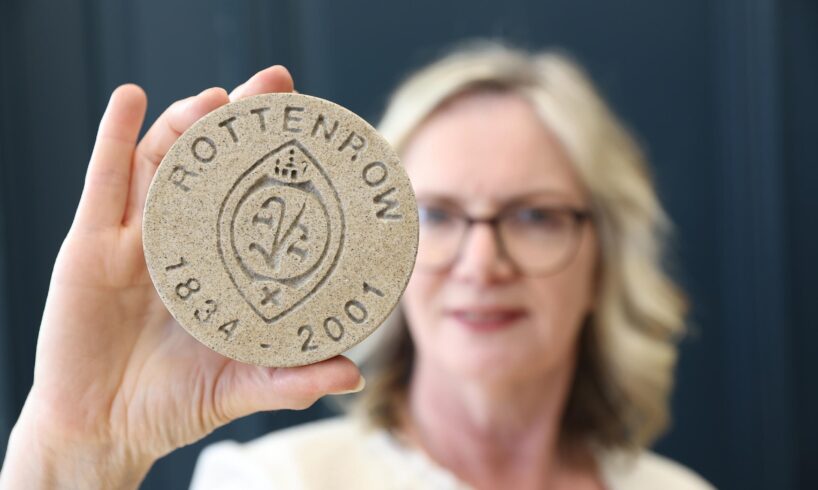
Also included is an old fireplace surround from the doctors’ mess, upon which countless former staff have engraved their names; and Aileen has donated a commemorative paperweight, made out of the stone of the old Rottenrow building. These were given to all the midwives after the hospital’s demolition.
Professor Cheyne says the closure of the hospital in 2001 was not entirely unexpected.
“We did know it was going to have to close – it was the city’s oldest hospital and while the quality of care was of very high standards, the facilities were deteriorating,” she says.
“It was still sad, though – the end of an era.”
She adds: “It has been wonderful to have the support of Friends of GRI, and we are so happy to have this space for the exhibition. People can share their own stories too and we are really excited about that.”
The exhibition runs until April 2027, and more details are available on the Friends of GRI website and social media pages.