Shafaq News
Before sunrise on Eid al-Adha morning, the roads leading into Najaf
begin to fill with headlights. Families drive through the night from Baghdad,
Basra, Diyala, and other provinces —not toward celebration, but toward graves.
By dawn, the narrow lanes of Wadi al-Salam Cemetery are already crowded
with mourners dressed in black. Some carry candles and incense. Others hold
bottles of rosewater or bags of Kleicha, the traditional date-filled pastry
distributed as sadaqa, a form of charity offered in the name of the dead.
Between rows of graves, families recite the Fatiha, the opening chapter of the
Quran, while the sound of weeping drifts quietly across the cemetery.
Children weave between tombs carrying plastic chairs. Elderly men lean
against gravestones, reading verses under the early morning light. Workers move
through the lanes sweeping dust from family plots before visitors arrive. Even
on Eid, when much of Iraq turns toward gatherings and celebrations, Wadi
al-Salam moves to a different rhythm, one shaped by memory, ritual, and loss.
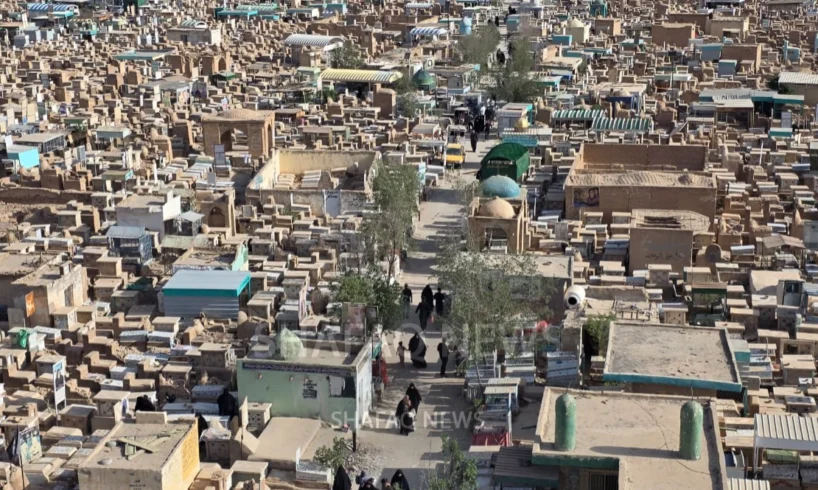
Known in Arabic as the Valley of Peace, Wadi al-Salam stretches across
the western edge of Najaf, roughly 160 kilometers south of Baghdad. Considered
the largest Islamic cemetery in the world, it surrounds one of Shia Islam’s
holiest cities, home to the shrine of Imam Ali ibn Abi Talib. For many Iraqis,
visiting the cemetery and praying at the shrine are inseparable acts, part of a
spiritual journey that moves between mourning and devotion.
Read more: Wadi Al Salam: Najaf’s ever-growing city of the dead
Fourteen centuries of continuous burial transformed the cemetery into
what many Iraqis describe as a city of the dead. Mausoleums rise above the
ground while catacombs extend beneath it. Some grave markers carry classical
Arabic poetry. Others display fading photographs of the deceased —soldiers,
clerics, tribal figures, poets, and political leaders whose stories remain
fixed to stone walls and plaster tombs.
Historical researcher Hassan al-Hakim told Shafaq News that the
cemetery existed long before the rise of Islam, when the area was known as
al-Thawiyya, an ancient burial ground. The discovery of Imam Ali’s tomb later
turned Najaf into the most important Shia burial destination in the world.
“Burial near the Imam became something people actively sought,”
al-Hakim explained. “Over centuries, the cemetery expanded until it became a
complete city for the dead.”
That expansion also created an economy of its own. Along the cemetery’s
main roads, hundreds of small offices provide what Iraqis call daffana services,
a term derived from the Arabic word for burial. The businesses handle grave
construction, catacomb excavation, plot sales, and long-term maintenance for
families who may live hundreds or thousands of kilometers away.
Abbas al-Najafi, who inherited one of the offices from his father and
grandfather, said many Iraqi families maintain relationships with cemetery
caretakers across generations.
“People trust those who look after their dead,” he told Shafaq News.
“Now Iraqis living abroad contact us through social media asking us to locate
graves belonging to relatives buried decades ago.”
He noted that burial customs have also changed over time. “In the past,
burial was communal. Today, nearly ninety percent of families own private
plots.”
Near one of the side lanes, workers repaint names on old gravestones
while others repair damaged tombs cracked by time and weather. Some families
install small trees or metal canopies to shield graves from the scorching
summer sun. Others leave framed photographs, prayer beads, or handwritten notes
tucked into the edges of stone.
Beneath the cemetery, however, lies another history.
During the years of mandatory military conscription under Saddam
Hussein’s regime, many draft evaders and fugitives hid inside Wadi al-Salam’s
sprawling underground catacombs. Al-Najafi remembers those years clearly.
“We spent nights underground by candlelight. We used candle stubs left
near the graves and followed the news on an old radio. Sometimes we survived on
food left behind by grieving families.”
He paused before recalling the dangers below ground. “The scorpions
frightened me more than anything. Sometimes we woke up and found snakes moving
through the tunnels searching for scraps.”
After the 1991 uprising against Saddam Hussein, Iraqi security forces
tightened control around the cemetery, making the catacombs difficult to use as
hiding places. Many who had escaped conscription eventually returned following
later government amnesties.
Yet on Eid morning, the cemetery’s older memories blend almost
seamlessly into present-day rituals.
A middle-aged laborer carrying a sack full of empty rosewater bottles
moved quietly between graves, collecting discarded containers. He barely
stopped when approached by Shafaq News correspondent.
“We collect them for the owner,” he said while continuing through the
crowd. “They get washed, refilled, and sold again.”
Nearby, a woman from Baghdad sat beside the grave of her son beneath a
small canopy she had installed to create shade. She had left her home shortly
after midnight to arrive in Najaf before dawn. A young tree planted beside the
grave swayed lightly in the afternoon wind.
Her son, Ali, was killed
in combat. “He broke my back when he left,” she said through tears. “I became
alone, even though my daughters are still with me.” She paused while adjusting flowers near the gravestone. “I dreamed of
seeing his wedding and his children, but fate stood between me and my
happiness.”
Around her, visitors continued arriving in waves, some carrying trays
of sweets, others reciting prayers quietly beside newly painted graves.
Loudspeakers from nearby mosques echoed across the cemetery as the afternoon
heat intensified.
At one point, the woman looked up and asked a question that seemed
larger than her own grief.
“Why can’t we live the way we see on television?” she said. “Countries
enjoying celebration and abundance without losing their sons to wars and
fighting.”
By midday, the crowds slowly begin to thin. Families leave the cemetery
on foot toward the nearby shrine of Imam Ali, completing a ritual that has
shaped Najaf for generations. The burial offices close their shutters one by
one. Workers gather abandoned bottles and extinguished candles from the
pathways.
Under the afternoon sun, the small tree beside Ali’s grave continues
casting its narrow patch of shade.
Wadi al-Salam will not remain quiet for long. It never does.
Written and edited by Shafaq News staff.