2026-06-04T16:51:54+00:00
font
Enable Reading Mode
A-
A
A+
Shafaq News-
Beirut
Hezbollah
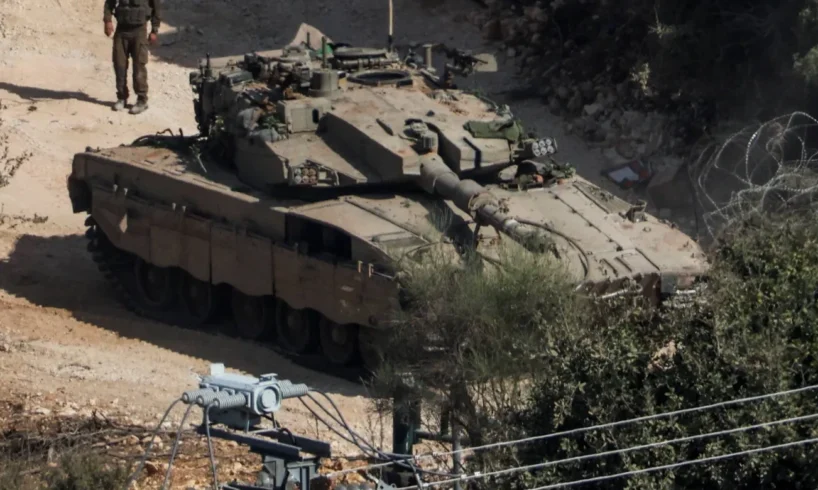
announced Thursday the destruction of three Israeli Merkava tanks near Beaufort
Castle (Qala’at al-Shqif) in southern Lebanon, as Israeli media reported
casualties from what it described as a “difficult” attack on a
military force in the border area.
In separate
statements, the group said it destroyed a first Merkava with a guided missile
before striking two additional tanks in the same area. The Israeli army
confirmed it had targeted militants in the Beaufort area and said operations
against Hezbollah positions and infrastructure in southern Lebanon were
continuing.
The ground
fighting coincided with a visit by Israeli Prime Minister Benjamin Netanyahu
and Defense Minister Israel Katz to northern border settlements, where they met
with local authority heads and toured frontline areas.
Shortly after
Netanyahu left the area, air raid sirens sounded three times in the town of
Shlomi in the western Galilee, according to Israeli media. Hezbollah claimed
responsibility for launching a drone toward the Arab al-Aramshe area; the
Israeli army said the incident ended without casualties.
Israeli
airstrikes also continued across southern Lebanon throughout the day, targeting
towns in the Nabatieh, Bint Jbeil, Tyre, and Saida areas. Lebanese reports said
three members of one family were wounded in a strike on the outskirts of
Nmeyrieh.
Lebanon’s
Ministry of Health said the death toll since Israel resumed military operations
on March 2 has risen to 3,526 killed and 10,733 wounded.
The Israeli army reported that
63 officers and soldiers had been wounded in combat in southern Lebanon over
the previous four days. Since fighting resumed in early March, the army said,
27 service members have been killed and 1,243 injured, including 72 in serious
condition and 139 with moderate wounds.
Ceasefire
divisions
Sharper
divisions emerged over the ceasefire agreement announced in Washington
following the fourth round of direct Lebanon-Israel talks held June 2 and 3
under US sponsorship.
Katz said the
agreement provides for a demilitarized zone south of the Litani River, with
Hezbollah fighters withdrawing and the Lebanese army deploying in areas under
its exclusive control. Israeli forces, he added, would remain inside what
Israel calls its “security zone” extending to the Yellow Line,
including the Beaufort Castle area, and Israel would retain the right to carry
out strikes inside Lebanon —including Beirut— with US backing if it judged its
security to be threatened.
Hezbollah
Secretary-General Naim Qassem rejected the agreement in its current form,
saying the group would not accept any arrangement that permits continued
Israeli military presence on Lebanese soil or separates southern Lebanon from
the rest of the country. Any agreement, he said, must begin with a full Israeli
withdrawal, followed by Lebanese army deployment south of the Litani, the
return of displaced persons, the release of prisoners, and the start of
reconstruction.
Lebanese
President Joseph Aoun said implementation could begin within 24 hours of
receiving final approvals and necessary guarantees. He described the preceding
negotiations as “very difficult,” noting that Lebanese delegation
head Simon Karam had suspended the talks before US Secretary of State Marco
Rubio intervened to resume them.
Iran’s Islamic
Revolutionary Guard Corps stated that peace in the region would not be
achievable without a full Israeli withdrawal from occupied Lebanese territory
and that any ceasefire must cover all fronts.