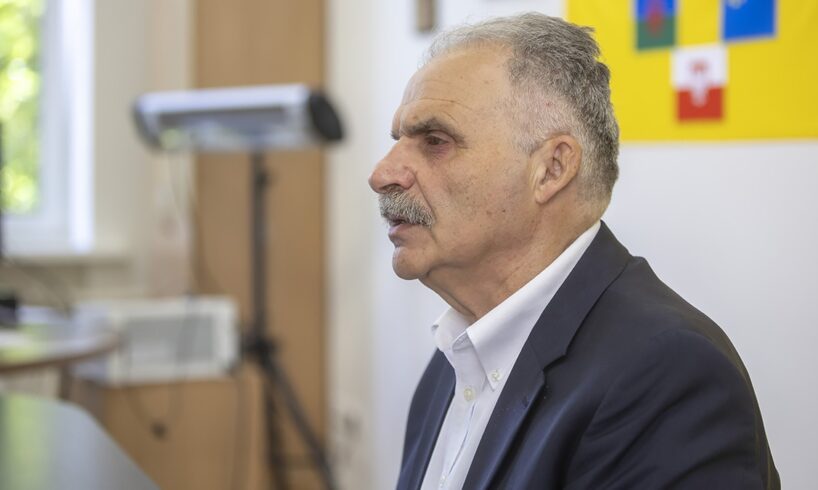
Viktor Yelensky head of Statement of the State Service of Ukraine for Ethnic. Kyiv, Ukraine, June 2, 2026
|
Photo: Interfax-Ukraine / Oleksandr Zubko
Head of the State Service of Ukraine for Ethnopolitics and Freedom of Conscience Viktor Elensky has said that the Ministry of Economy, Environment and Agriculture of Ukraine has prepared the first draft of the draft law “On alternative service”, designed for the period of martial law. At the same time, according to him, the adoption of this draft law will not be easy.
“We have people who cannot take up arms, but are ready to serve and fulfill their duty to the state. First of all, these are, for example, Jehovah’s Witnesses. They were persecuted for refusing to do military service under different regimes: in the Soviet period, under Hitler, in Russia they are generally prohibited, and in the occupied territories they receive terms that would have been unthinkable even in Soviet times. For such people, of course, alternative service should be provided,” said Elensky in an exclusive interview with the Interfax-Ukraine agency.
He reminded that Ukraine adopted the law “On alternative service” back in 1991, however, it is designed for peacetime and the passage of temporary military service, which is not currently being carried out. According to Elensky, this creates a serious problem for people who cannot use weapons, but would like to fulfill their duty to protect the Motherland in another way.
“Now the Ministry of Economy has prepared the first draft of this law on alternative service, designed for wartime conditions. At the conceptual level, there are many complex issues. We have studied international experience. The European Court of Human Rights assumes that the state has the right to verify the depth and sincerity of the religious convictions of a person applying for alternative service, as well as to apply certain mechanisms to prevent abuse,” said the head of the Service.
When asked who will be entrusted with the function of verifying the depth and sincerity of a person of religious conviction, he noted that the law after its adoption will provide that such verification will be carried out in accordance with the procedure provided by the Cabinet of Ministers, and most likely, it will be entrusted to the State Service for Ethnopolitics and Freedom of Conscience.
According to him, the relevant commission will include psychologists, managers, religious scholars, and representatives of churches.
“In addition, we are still talking about service, even if it is not military, which provides for a certain period, and this period can be longer than in ordinary military service. For example, after the end of martial law, persons who have undergone alternative service can remain in the service for a certain time and be involved in the restoration of the country for a certain strictly defined time. Among other things, a number of social, financial, and logistical problems arise that did not exist for alternative service in peacetime,” he added.
When asked whether the future law would provide for the so-called reverse action, i.e. the possibility to transfer from the usual service to an alternative one, the head of the State Service for Ethnopolitics and Freedom of Conscience stated that it is possible that such a possibility would exist.
“But, I think, the commissions will assess such a possibility in each individual case. In any case, the right to alternative service must be balanced with the impossibility of abusing this right,” he emphasized.
Regarding the prospects for the adoption of the law on alternative service, Elensky stated that he does not think that this law will be easily adopted.
“Even when it is prepared, interdepartmental coordination and public discussion will take place, heated discussions will await it at each of these stages. It can be said that the law will concern a relatively small number of people, but the state of human rights is judged in relation to the minority,” he added.
As reported, in December 2025, the deputy head of the Office of the President, Olena Kovalska, said that the government is now working on the law on alternative service.
According to Article No. 35 of the Constitution of Ukraine, no one can be exempted from his obligations to the state or refuse to comply with laws based on religious convictions. If the fulfillment of military duty contradicts the religious beliefs of a citizen, the fulfillment of this duty must be replaced by an alternative (non-military) service.