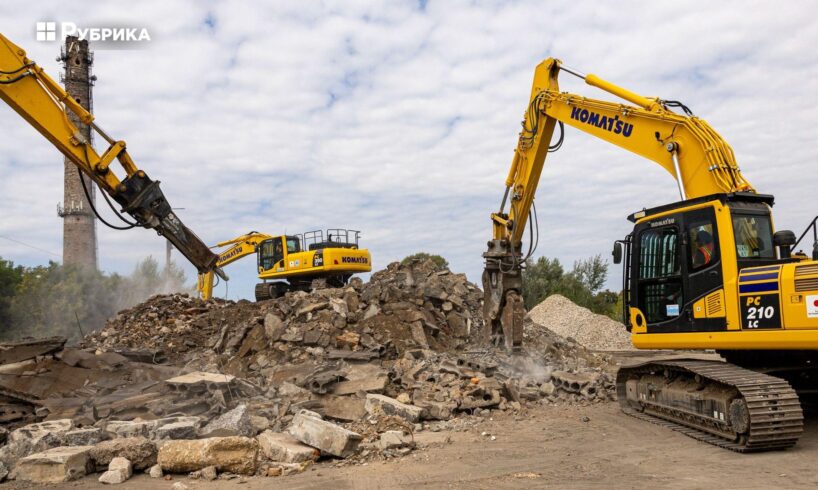
A demolition waste recycling line in Borodianka, where sorted waste is brought, August 20, 2025. Illustrative photo: Mykola Tymchenko / Rubryka
At the European Commission’s New European Bauhaus (NEB) 2026 biennale, which starts on June 9, the Ukrainian team ReThink and its partners will present innovative circular solutions for reconstruction. These include projects focused on reusing demolition waste, recycled plastic and steel, modular construction, energy-efficient renovation, and renewable natural materials.
Rubryka reports this.
What’s the problem?
Ukraine faces unprecedented challenges linked to destruction and the recovery of its territories. According to the Rapid Damage and Needs Assessment (RDNA5), published by the Government of Ukraine, the World Bank Group, the European Commission and the UN, the total cost of reconstruction and recovery in Ukraine stood at nearly 588 billion US dollars as of December 31, 2025.
At the same time, Ukraine aims not only to restore what has been lost but also to introduce new solutions based on the principles of sustainability, efficient resource use and the circular economy.
What’s the solution?
The New European Bauhaus Festival 2026 (NEB 2026), a European Commission biennale, starts in Brussels on June 9. It brings together architects, policymakers, community representatives, creative industries, businesses, researchers and changemakers. Over five days, festival participants will exchange ideas, present innovative solutions and shape a vision for a more inclusive, sustainable and comfortable future for communities and cities.
The festival has taken place every two years since 2021. Its idea is to develop new approaches in architecture, construction and urban development while following the principles of environmental sustainability, circular design, inclusiveness and aesthetics.
This year, the festival focuses on two key themes: public involvement in decision-making processes, or Democratic Engagement, and Affordable Housing.
This year, the Ukrainian team from ReThink will also join NEB 2026 for the first time and present the Circular Lab Ukraine project.
How does it work?
Circular Lab Ukraine is a curated stand that brings together innovative circular solutions already being tested and implemented in Ukraine’s reconstruction.
The exhibition combines applied research, demonstration projects and market-ready solutions that represent different approaches to Ukraine’s circular reconstruction. All the initiatives presented are already being tested, implemented in practice or prepared for scaling.
The exhibition features 13 projects focused on reusing demolition waste, recycled plastic and steel, modular construction, energy-efficient renovation and renewable natural materials.
“We deliberately do not rank the projects by maturity level, because each of them responds to different reconstruction challenges. Some solutions are already undergoing practical testing and can be implemented in the near future, while others require further development at the level of policy, regulation or investment. However, all the initiatives presented share one common feature: they offer practical mechanisms for a more sustainable and resource-efficient reconstruction of Ukraine,” ReThink told Rubryka.
ReThink adds that at the biennale, the team primarily hopes to develop partnerships between research institutions, government representatives, businesses and communities. For many solutions, the organization notes, joint research, exchange of expertise and access to European initiatives and support programs are crucial.
Investment is also important, but it is rather a result of trust and cooperation that emerge through such international platforms, the organization says.
Does participation in an international platform mean that European countries will adopt Ukraine’s experience? ReThink adds that Circular Lab Ukraine mainly involves consortiums with Ukrainian and European partners. Therefore, in this case, it is about jointly developing solutions rather than one-sided adoption of experience.
“Ukraine’s experience shows that even amid Russia’s full-scale aggression, approaches to community recovery inspire international partners. Above all, this is about the speed of finding and implementing solutions, as well as the ability to quickly adapt technologies to the challenges of reconstruction,” the organization concludes.