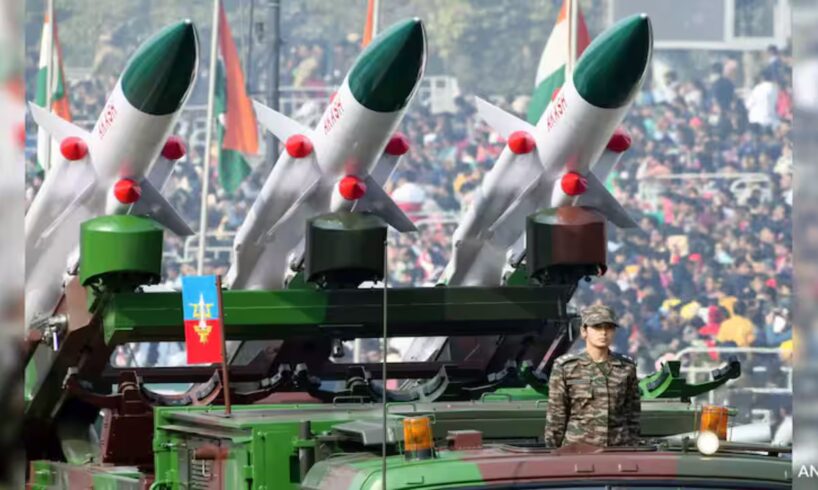
New Delhi: A recent report from the Stockholm International Peace Research Institute (SIPRI) has made an unusual claim about India’s nuclear posture. According to the Swedish think tank, New Delhi has, for the first time, deployed 12 nuclear warheads instead of keeping its entire stockpile in storage.
Released on June 8, the report estimates that India now possesses 190 nuclear weapons. Of these, 178 are believed to be stored and available for use if required, while 12 have been deployed.
Last year, the SIPRI estimated country’s stockpile at 180 warheads, all of which were kept in storage.
Add Zee News as a Preferred Source
The Ministry of Defence (MoD) has not issued any statement with regard to the claim made in the report.
The report comes at a time when governments are strengthening conventional military capabilities, cyber intelligence networks, surveillance capabilities and advanced military technologies to prepare for potential future confrontations.
Why the deployment suggests
Defence analysts say the report is unusual because India has traditionally followed a policy under which nuclear warheads and their delivery systems are kept separate during peacetime.
According to defence expert Rahul Bedi, India’s nuclear doctrine is built around keeping warheads and missiles separate until they are needed.
“This means that the warhead and the missile are stored separately. Their locations are also different. Then when there is an emergency, they are joined together. That is why deployment of nuclear weapons is a very serious matter,” he told BBC.
He believes the most likely explanation is that the warheads have been placed aboard nuclear-powered submarines.
“My estimate is that India has deployed these 12 warheads on two nuclear submarines. These submarines patrol with full readiness and are capable of staying at sea for long periods,” he said.
There has been no official confirmation of this assessment.
The report comes a year after Operation Sindoor, India’s military offensive against Pakistan in May last year in response to the deadly terror attack at Pahalgam in Jammu and Kashmir.
The SIPRI claims that Pakistan has not deployed any nuclear weapons in either 2025 or 2026. Islamabad’s estimated stockpile stands at 170 warheads, unchanged from last year.
A sea-based deterrent?
According to Bedi, India’s nuclear deterrence relies on three delivery methods. “First, air delivery. Second, land-based. Third, submarine-based,” he explained.
He said the submarine leg of the nuclear triad is considered the most secure because tracking nuclear submarines in vast ocean waters is extremely difficult.
“Nuclear powers such as the United States, Russia and China also patrol with warheads deployed aboard submarines. India appears to be adopting the same method. This is a major change,” he said.
He added that submarines operated by major nuclear powers usually conduct patrols while fully armed. “This is standard procedure. These submarines are loaded. Therefore, it can be assumed that the 12 warheads India has deployed are also fully loaded,” he said.
ALSO READ: Why India’s first 12 peacetime nuclear warheads deployment signals a major strategic shift?
Asked whether the reported deployment could be seen as part of India’s ongoing Operation Sindoor, Bedi said, “It is difficult to say whether this is part of the Operation Sindoor or the Operation Sindoor 2.0, but India is now conducting maritime patrols in a manner similar to major nuclear powers.”
India and Israel following a similar path?
The SIPRI report also says India is increasing production of fissile material used in nuclear weapons and is heavily relying on plutonium than enriched uranium.
According to the report, Israel follows a similar approach. Pakistan, Russia, China, France, Britain and the United States use both plutonium and enriched uranium in their nuclear weapons programmes.
Bedi described plutonium-based fuel production as a non-traditional approach that depends on the availability of raw materials. He said India has the capability to produce nuclear fuel through both uranium enrichment and plutonium processing.
Speaking about Israel, he said, “It is believed that Israel also possesses nuclear capability, but Tel Aviv has never publicly accepted or denied it.”
Eye on China
The SIPRI report says that India’s military modernisation programme is now geared towards developing long-range systems capable of reaching targets across China.
Bedi claimed this effort has been underway for years and gained momentum after earlier clashes between the two countries.
The report also says that China, Pakistan, Russia and the United States are upgrading their nuclear delivery systems and military capabilities.
India spent $92.1 billion on defence last year and emerged as the world’s fifth-largest military spender. That spending was 8.9 percent higher than in 2024.
The report also says that India accounted for 8.2 percent of arms imports between 2021 and 2025, making it the world’s second-largest arms importer. Pakistan also increased defence purchases during the same period.
Ukraine, Saudi Arabia and Qatar were among the countries that saw strong growth in arms purchases. Together, they accounted for 35 percent of international defence imports.
Bedi said India should continue strengthening domestic defence manufacturing rather than depending on overseas purchases.
Over 4,000 nuclear warheads deployed across the world
The SIPRI estimates that the world’s nine nuclear-armed states – the United States, Russia, Britain, France, China, India, Pakistan, North Korea and Israel – together possess around 12,187 nuclear weapons.
Of these, approximately 4,012 warheads are deployed with military forces. More than half (between 2,100 and 2,200 warheads) are kept on high alert on ballistic missiles. Another 9,745 warheads are held in military stockpiles and can be activated if required.
The report says the total number of nuclear weapons across the globe has declined because the United States and Russia continue dismantling older systems. At the same time, the SIPRI believes the pace of new weapons production could soon outstrip the rate at which older weapons are being retired.
The report also says that transparency around nuclear arsenals has decreased in recent years, making it increasingly difficult to determine the exact size of national stockpiles.
The United States and Russia still dominate the world in nuclear balance. They together account for about 86 percent of the world’s nuclear weapons. China’s stockpile has increased from 600 to 620 warheads, while India continues to expand both its military capabilities and defence procurement programmes.