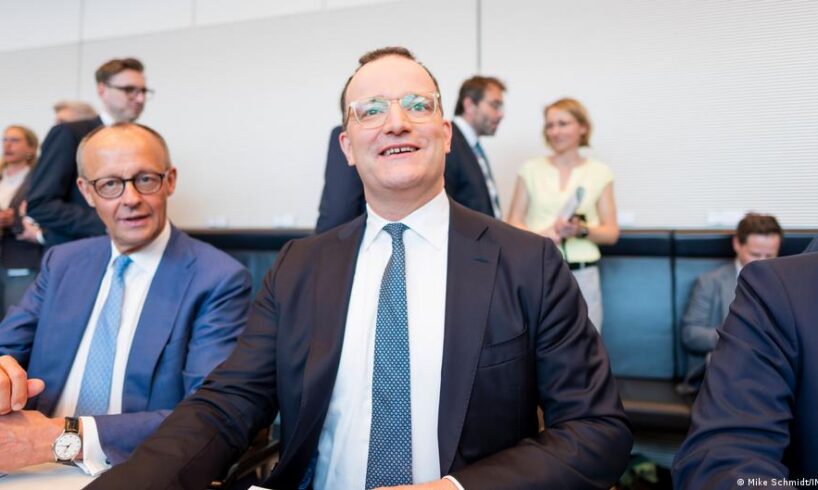
Jens Spahn, the parliamentary leader of the ruling conservative bloc in the Bundestag, stepped down on Saturday amid a controversy surrounding his decision to have a child via surrogacy.
The resignation was requested by Chancellor Friedrich Merz of the conservative Christian Democrats (CDU).
Spahn did not say he was standing down as a member of the Bundestag.
Surrogacy is not permitted in Germany and the CDU opposes its legalization. Spahn and his husband had their child through a surrogate mother in the United States.
What has Spahn said?
“In recent days, I have come to realize that my personal happiness in starting a family with my husband and becoming a father is incompatible with my political office,” Spahn said in a statement seen by news agencies.
After the announcement, Chancellor Merz said it was the called the decision both “correct” and “unavoidable,” saying that “credibility is the most valuable asset in politics.”
Merz went on to explain that he would now work with Markus Söder, the leader of the CDU’s Bavarian sister party the Christian Social Union (CSU) to put forward a proposal for a new parliamentary group chair.
“The procedure and timeline will now be coordinated with the party and parliamentary group committees,” he said.
Spahn and husband Daniel Funke [FILE: June 2025]Image: Annette Riedl/dpa/picture alliance
Surrogacy controversy
Earlier this week, Spahn, 45, and his husband, Daniel Funke, announced that they had become parents and posted a photo on social media pushing a stroller.
The announcement attracted immediate criticism from all sides of Germany’s political spectrum, accusing Spahn of double standards given his senior position in a party that supports upholding the legal ban on using surrogate mothers inside Germany.
Spahn had in the past said he found the idea of “rented wombs” very difficult to come to terms with as a Christian and a gay man, and he had voted on party lines in favor of the ban on using surrogates in Germany.
In a podcast interview with Germany’s Bild newspaper on Friday, Spahn had tried to defend his decision, saying he had “wrestled with myself for a long time, including on the issue of surrogacy.”
Spahn will not face legal consequences in Germany for having a baby via surrogacy, as it is not illegal in Germany to raise a child born abroad to a surrogate mother.
This is not the first time Spahn has faced controversy. As Germany’s COVID-era health minister, Spahn was investigated for alleged misuse of public money.
However, state prosecutors dropped their investigation into his COVID-era dealings in March.
Spahn was seen as a rising star in the conservative bloc, having been re-elected leader of the parliamentary group with 85% of the vote in May.
How did other parties react?
Political responses to the news of Spahn’s resignation varied in tone.
Spahn’s opposition number in the center-left Social Democrats (SPD), Mattias Miersch, opted to focus on personal empathy. The SPD are in coalition with their historical rivals the CDU/CSU.
“As a person I can imagine how the last few hours must have been for Jens Spahn and his family,” Miersch said. “I wish Jens Spahn and his family all the best and much strength for the time after office.”
Opposition politicians were more eager to twist the knife.
Far-right AfD co-leader Alice Weidel described Spahn’s resignation as “overdue,” saying his COVID-era misadventures alone made him “untenable.”
“That he has now undermined a law that he himself voted for has definitively destroyed his credibility,” Weidel said.
The Greens’ co-chairs Britta Hasselmann and Katharina Dröge issued a joint statement saying the resignation was not “only about a personal decisions that stood in defiance of a party position.” They said Spahn’s “scandals, mistakes and leadership weaknesses ultimately led to this point.”
The socialist Left Party’s Sören Pellmann said that anyone “who bears political responsibility must be measured by the yardsticks that they set for other people.”
And the Free Democrats’ leader Wolfgang Kubicki, a successor to the first senior openly gay party leader in Germany, said it was a “pity” that Spahn had not made it clear sooner “that he had changed his opinion on surrogate mothers on the basis of his own personal experiences.”
Jens Spahn: US decisive actor in international conflicts
To view this video please enable JavaScript, and consider upgrading to a web browser that supports HTML5 video
Edited by: Wesley Dockery
Don’t let the algorithm hide the news. If you rely on our team for trusted reporting, please take a moment to select us as your Preferred Source on Google, so you’ll always see our verified news first.